Core Skills Analysis
Mathematics
- AJ and Ella practiced basic number concepts by discussing prices, an early introduction to math vocabulary and counting.
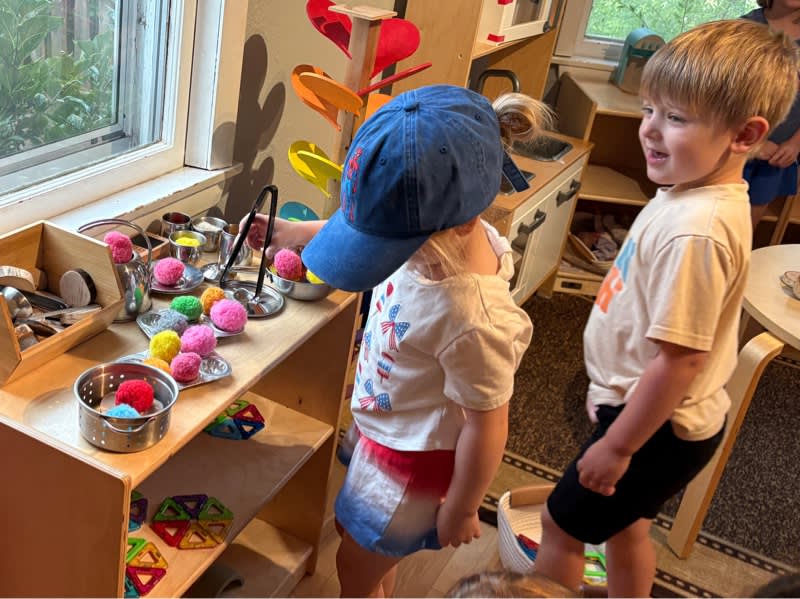
- They explored one-to-one correspondence by matching pom-poms to tin containers, helping with quantity recognition.
- The use of sorting the colorful pom-poms develops classification skills based on color and size.
- Turn-taking and decision-making during play demonstrate early problem-solving and understanding of commerce concepts.
Language Arts
- AJ and Ella used verbal communication to negotiate prices and describe items, strengthening vocabulary and expressive language skills.
- The imaginative play involved narrative building, where the children created stories around the store, fostering creativity in language use.
- They practiced listening and responding to each other, which supports social communication and language comprehension.
- Using terms like 'products' and 'goods' introduces them to basic economic and trade language.
Social and Emotional Development
- The activity promotes cooperation and teamwork as AJ and Ella work together to keep the store running smoothly.
- They practiced turn-taking and sharing, essential skills for positive social interaction and conflict resolution.
- Engaging in role-play fosters understanding of social roles and empathy by imagining different perspectives.
- The children likely developed self-esteem and autonomy by successfully managing roles in their play.
Fine Motor Skills and Physical Development
- Using tongs to pick up and arrange pom-poms supports eye-hand coordination and fine motor skill development.
- Manipulating small objects like pom-poms improves hand strength and precision.
- The activity encourages controlled movements, balance, and dexterity.
- Transferring items into tins or containers enhances object manipulation skills.
Tips
To deepen AJ and Ella's understanding, encourage them to create simple price tags using numbers and currency symbols to enhance math literacy. Introduce story-building by asking them to describe customers visiting the store, enhancing narrative skills. Incorporate emotional vocabulary by discussing how characters in their play feel during transactions, further developing empathy. Additionally, you can extend fine motor activities by offering varied tools like child-friendly tweezers or spoons for sorting and counting different materials to increase dexterity and focus.
Book Recommendations
- Lemonade in Winter: A Book About Two Kids Counting Money by Emily Jenkins: This story introduces children to counting money and basic math concepts through a lemonade stand adventure.
- The Very Busy Spider by Eric Carle: A classic book that promotes language development and sequencing through a story about a spider’s busy day.
- A Chair for My Mother by Vera B. Williams: A warm story about saving and teamwork, highlighting themes of family, cooperation, and community.
Learning Standards
- I. HEALTH & PHYSICAL C.EL.2 Exhibits eye-hand coordination, strength, control, and object manipulation.
- II. SOCIAL AND EMOTIONAL C.EL.2 Engages in social interaction and plays with others.
- III. LANGUAGE & COMMUNICATION B.EL.2b Uses vocalizations and spoken language to communicate. Language Content (Semantics)
- V. COGNITION & GENERAL KNOWLEDGE B.EL.1 Demonstrates an understanding of numbers and counting.
- IV. APPROACHES TO LEARNING A.EL.2 Engages in meaningful learning through attempting, repeating, experimenting, refining, and elaborating on experiences and activities.
Try This Next
- Create a worksheet where children match prices to pictures of items and practice counting coins.
- Draw and label 'store products' to build vocabulary with colors, numbers, and nouns.
- Set up a role-play script where children practice greeting customers and using polite phrases.
- Conduct a simple sorting experiment categorizing items by color, size, or type using everyday objects.