Core Skills Analysis
Art
- Asha practiced visual presentation by shaping and arranging cookies on a plate, which connects to food styling and the idea that appearance can be part of creativity.
- The choice of a green plate and the contrast with the baked cookies shows attention to color, composition, and how objects look together in a finished display.
- Working with dough and baked pieces helped develop tactile, hands-on artistry through shaping, portioning, and creating uniform forms.
- Using a recipe to transform simple ingredients into something appealing reflects creative problem-solving, a key artistic skill.
English
- Asha used ChatGPT to figure out what could be made from available ingredients, which demonstrates reading or interpreting instructions and ideas from written language.
- The activity builds vocabulary related to cooking, such as ingredients, measuring, mixing, baking, and texture.
- Following a recipe sequence supports comprehension of order and procedural language, where one step must happen before the next.
- Describing the finished cookies and the process would encourage clear oral or written narration of an experience.
Foreign Language
- Cooking activities naturally reinforce practical food and kitchen vocabulary, which can transfer into another language if translated or practiced bilingually.
- If Asha used ChatGPT for help, she was engaging with digital language input that may include different ways of phrasing the same idea.
- Recipe terms such as ingredients, mix, bake, and bowl are useful for building cross-language word associations.
- The task offers a simple context for learning how to name familiar foods and actions in another language.
History
- Baking connects to the long history of home cooking and family recipes, showing how people have used available ingredients for generations.
- Peanut butter cookies can be discussed as part of modern pantry-based cooking, which reflects changes in food availability and convenience.
- Using ingredients already in the house illustrates a practical approach to cooking that has historical roots in resourcefulness and frugality.
- The activity can open discussion about how recipes are passed down, adapted, and shaped by household traditions over time.
Math
- Asha likely worked with measurement, which is a direct application of math in real life through ingredients and proportions.
- Dividing dough into individual cookies uses estimation and equal partitioning, helping build early fraction and sharing concepts.
- Baking requires attention to time, which supports understanding of elapsed time and sequencing.
- The visible cookie portions on the plate suggest counting and comparing quantities, useful for basic arithmetic practice.
Music
- Although this was not a music activity, the rhythm of kitchen steps can be linked to musical sequencing and pacing.
- Following recipe instructions in order resembles keeping a steady beat, where each action happens at the right time.
- The repeated motions of mixing and portioning can be compared to patterns in music, such as repeated verses or rhythms.
- Asha may have experienced the kitchen as a lively, active environment, which can be connected to the energy and flow found in musical performance.
Physical Education
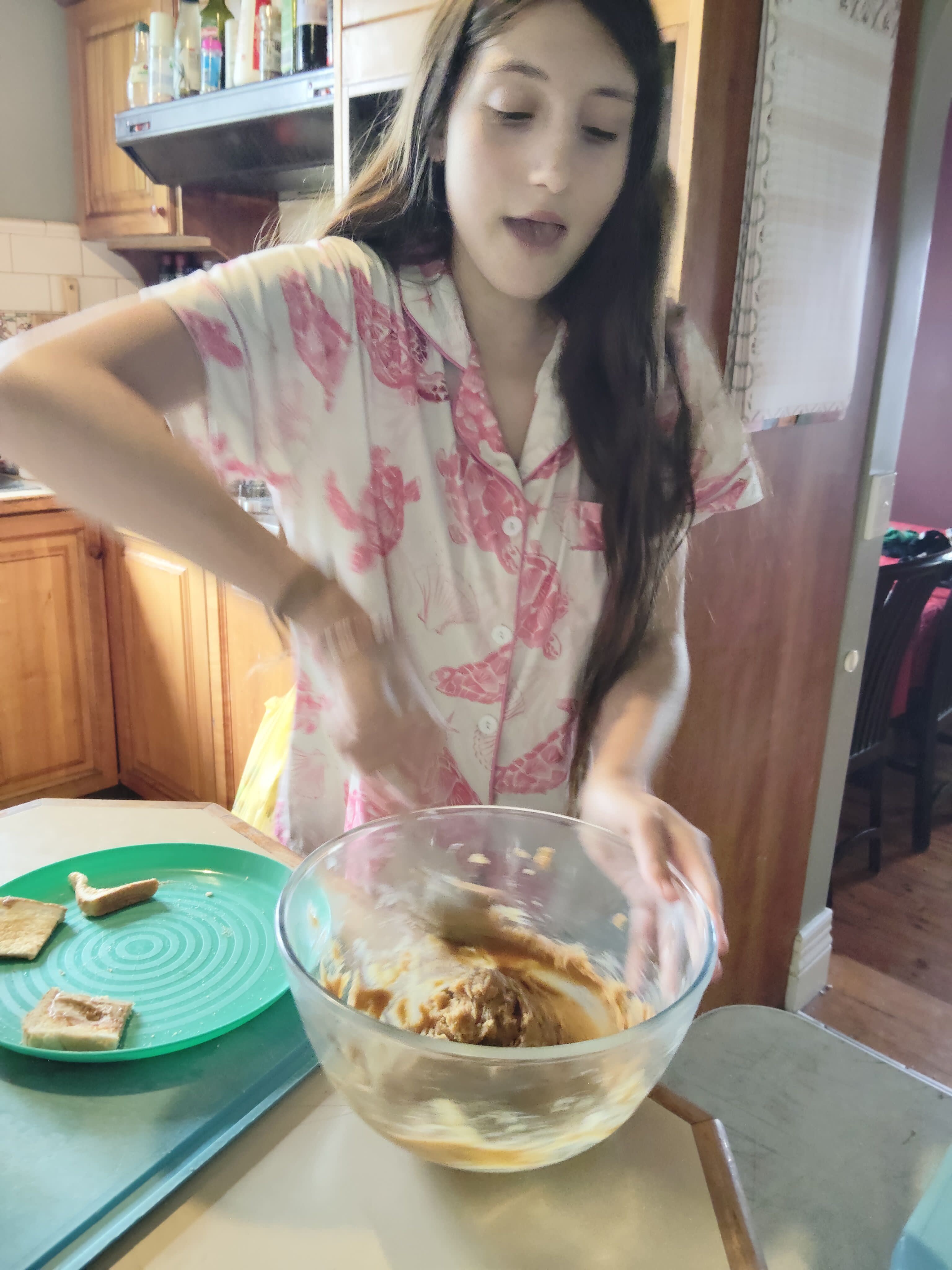
- Mixing dough by hand develops fine motor strength and coordination, especially in the wrists, hands, and fingers.
- Reaching, stirring, and transferring cookies to a plate involved body control and practical movement skills.
- Standing and moving around the kitchen supports balance, spatial awareness, and safe body positioning.
- The activity shows how everyday tasks can build endurance and functional physical skills in a low-pressure setting.
Science
- Baking is a clear science lesson because ingredients change when heat is applied, showing a physical and chemical transformation.
- Asha observed texture changes while mixing peanut butter dough, which reflects how substances combine and behave differently together.
- The oven process demonstrates how temperature affects food structure, taste, and doneness.
- Using available ingredients to make a new food also involves experimentation and observation, both important parts of scientific thinking.
Social Studies
- The activity reflects household decision-making, showing how families use what they have to meet a practical need.
- Cooking from available ingredients connects to resource management and responsible use of supplies, which are important community and life skills.
- Sharing cookies on a plate suggests hospitality and the social practice of making food for others.
- Using an AI tool to plan a recipe introduces a modern technology use pattern that is becoming part of everyday life and home routines.
Tips
Tips: This would be a great time to turn the baking experience into a mini learning sequence. First, have Asha compare the original ingredients with the finished cookies and talk through what changed, which strengthens scientific observation and vocabulary. Next, invite her to write or dictate the recipe steps in order, then underline the action verbs and measurement words to build English skills and sequencing. You could also ask her to double or halve the recipe on paper to practice math in a meaningful way, or estimate how many cookies each person would get if the batch were shared. For a creative extension, let her design a simple recipe card with a drawing of the cookies and a short note about what she learned from using ChatGPT to solve a cooking problem.
Book Recommendations
- If You Give a Mouse a Cookie by Laura Numeroff: A playful story that connects to baking, cause-and-effect thinking, and the fun of food-related routines.
- Biscuit by Alyssa Satin Capucilli: A warm, simple early-reader book that supports sequencing, everyday vocabulary, and familiar routines.
- Betty Crocker’s Cooky Book by Betty Crocker: A classic cookie cookbook that connects directly to baking, measuring, and family kitchen traditions.
Try This Next
- Make a cookie recipe worksheet: list ingredients, sequence the steps, and circle all math words like cup, teaspoon, and half.
- Write 3 observation questions: What changed after mixing? What changed after baking? What did the cookies smell, look, and feel like?
- Draw the before-and-after of the dough and baked cookies, then label the changes using science vocabulary.