Core Skills Analysis
Art
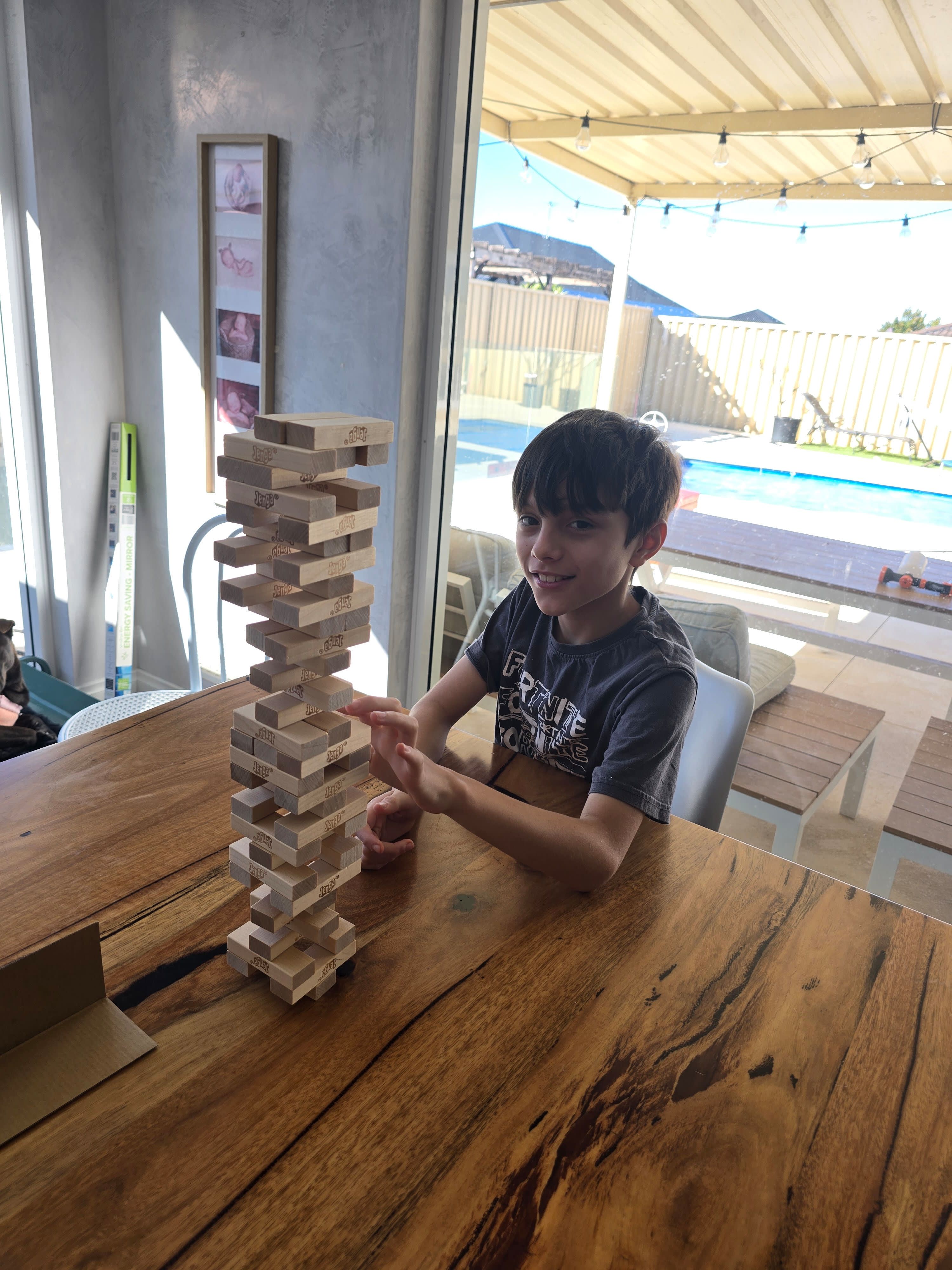
- The block tower shows an understanding of form, pattern, and visual balance, since the structure was built to look intentional as well as stand upright.
- Stacking blocks in a repeated, twisting arrangement suggests an awareness of design and how repeated shapes can create an interesting visual effect.
- The child likely practiced spatial creativity by choosing how the blocks should be arranged to make the tower both stable and visually striking.
- Using everyday wooden pieces as a construction medium shows flexible thinking, a key part of art-making and design.
English
- Reading Eggs work indicates exposure to reading comprehension, where the student understood the questions and could identify correct answers.
- Independent work for five minutes shows growing stamina for language tasks, even if support was needed to finish.
- The need for adult prompting suggests the activity also involved following instructions, sustaining attention, and processing written directions.
- Because he understood the content, the main challenge appears to have been endurance and regulation rather than basic understanding.
Foreign Language
- No foreign language activity is shown or described in this activity.
- The student did not appear to work on vocabulary, listening, speaking, reading, or writing in another language here.
- If desired, the game names or block labels could later be used as a light vocabulary-entry point, but that is not part of what happened in this activity.
- This subject was not directly addressed in the session.
History
- No historical topic, timeline, or past-event learning is included in the activity description.
- The games and construction work do not provide direct evidence of history instruction.
- The student may have experienced familiar household or game traditions, but that is not enough to count as history learning from this activity alone.
- This subject was not directly represented in the session.
Math
- The tower-building task required early geometry and engineering thinking, especially judging stability, weight distribution, and where support columns should go.
- Whole number lessons on Maths Online suggest practice with number recognition, counting, or basic operations involving whole numbers.
- Playing Blockus and strategic card games also likely supported planning, pattern recognition, and evaluating possible moves, which are mathematical habits of mind.
- Needing prompting and typing help shows the student could engage with the content but may have needed reduced cognitive load to keep working.
Music
- No music activity is described or visible in the session.
- There is no evidence of singing, rhythm, instrument use, or music listening in this task.
- The construction and game-based tasks do not provide enough information to connect directly to music learning.
- This subject was not part of the documented activity.
Physical Education
- Fine-motor control was clearly involved as the student carefully placed blocks without collapsing the structure.
- The activity required hand-eye coordination, controlled movements, and patience while reaching toward a delicate tower.
- Sustained seated engagement and self-management were also important physical-regulation skills during the games and online work.
- Although not a traditional PE lesson, the activity supported coordination and body control through precise movement.
Science
- The Jenga-style tower provided a hands-on investigation of balance, gravity, and structural integrity.
- Adding internal columns shows intuitive experimentation with load-bearing support and how reinforcement changes stability.
- The student likely observed cause and effect as different placements either strengthened or weakened the tower.
- This was a practical, low-pressure introduction to engineering science and physical forces.
Social Studies
- Playing card games and Blockus involved turn-taking, shared rules, and strategic interaction, all of which are important social learning skills.
- The session demonstrates participation in cooperative family or home learning routines, which supports social responsibility and shared activity norms.
- The student’s success with independent work for a short period also reflects self-management in a group-learning context.
- Using games to learn strategy can help develop fairness, patience, and respect for structured play.
Tips
Tips: This was a strong, low-pressure learning session, and the biggest win was the student’s ability to work independently for short stretches on both reading and math. To build on that success, keep lessons brief and predictable, then slowly extend the time only if he stays regulated. You could turn the block tower into a mini engineering challenge by asking him to predict which design will hold the most weight, then test and compare results. For academics, try breaking Reading Eggs or online math into tiny “win” chunks with a clear finish line so he can experience success without shutdown. It may also help to alternate a demanding task with a preferred game like Blockus or cards, using the game as a reset before returning to schoolwork. Finally, consider letting him explain his strategies out loud or with simple drawings, which can show understanding without adding too much pressure.
Book Recommendations
- The Most Magnificent Thing by Ashley Spires: A story about persistence, problem-solving, and redesigning a creation until it works.
- Rosie Revere, Engineer by Andrea Beaty: A fun, encouraging book about building, testing ideas, and learning from mistakes.
Try This Next
- Draw and label the tower: identify which parts acted like support columns and which parts looked least stable.
- Make a 3-question exit quiz: What made the tower stronger? What did the card game require? What helped you finish Reading Eggs?
- Write or tell a short ‘how I built it’ sequence using first, next, then, last.
- Try a build-and-test challenge: create two block towers, one with supports and one without, and compare which is more stable.