Core Skills Analysis
Art
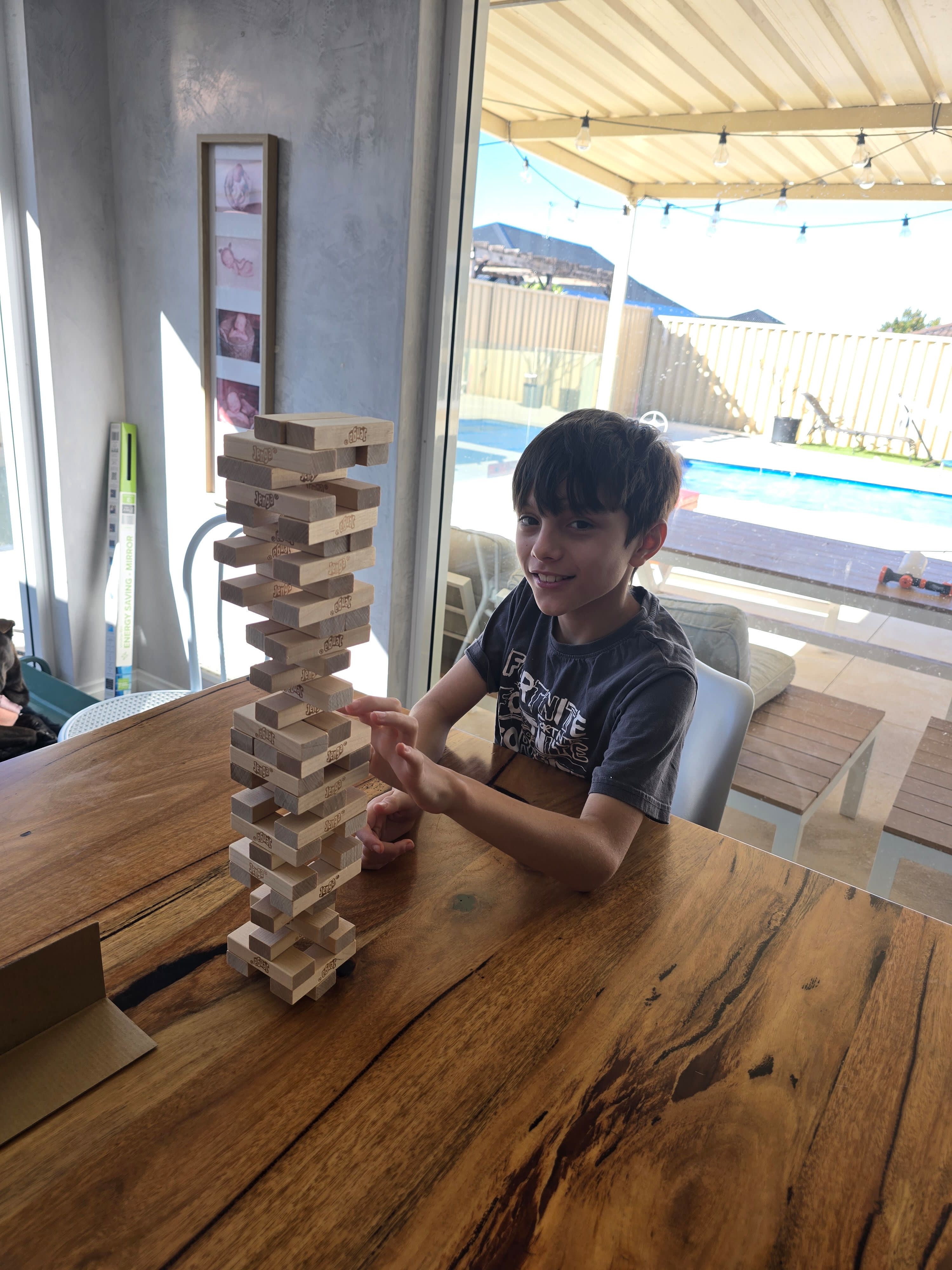
Isaac built a tall Jenga structure that had clear design and visual balance, showing an understanding of how repeated shapes can be arranged into an interesting form. He also made intentional structural choices by adding columns inside the build, which gave the tower a more engineered, architectural look. The activity likely helped him explore symmetry, spacing, and the relationship between form and stability in a hands-on way. His careful construction suggested focus and creativity as he experimented with making the tower both impressive and secure.
English
Isaac completed one unit of Reading Eggs and spent about five minutes working independently before needing support to finish. He understood the reading and knew the answers, which showed that he had comprehension skills and could make sense of the material even when he needed help managing the task. The activity supported early reading fluency, listening to instructions, and responding to question-based comprehension work. His response suggested that the challenge was not understanding the content, but maintaining engagement long enough to complete the activity.
Foreign Language
No foreign language activity was mentioned in this session, so there is no evidence that Isaac practiced another language. Because the report focused on building, games, Reading Eggs, and maths work, this subject was not directly represented. Even so, the structured turn-taking and rule-following in the games could indirectly support language development through listening and vocabulary exposure. If a foreign language had been included, it would have been a good time for simple game-related words, directions, or counting practice.
History
No history-specific activity was described, so Isaac did not appear to work on timelines, past events, or historical topics during this session. The block tower and games were more focused on problem-solving than on historical learning. However, the careful building process could connect in a future lesson to how people design towers, bridges, and other structures over time. In this activity, history was not directly addressed.
Math
Isaac completed four lessons on whole numbers in Maths Online and worked independently for about five minutes before needing encouragement and prompting. He showed that he could answer the work and likely understood the number concepts, even though he needed adult support to keep going and to help with typing. Playing Thirteen and Blockus also gave him opportunities to think mathematically through counting, pattern recognition, spatial reasoning, and strategy. The Jenga tower added another mathematical layer by involving balance, structure, and the practical application of stability and volume-like thinking.
Music
No music activity was mentioned in the session, so Isaac did not directly engage in singing, rhythm, instruments, or listening tasks tied to music learning. The games and building activity did involve timing, patience, and sequencing, which can sometimes support rhythmic thinking, but not in a formal music context. There is no clear evidence of music-specific learning in the described work. A future extension could include rhythm-based counting or movement games to connect with the same patterning skills used here.
Physical Education
The activity did not include a formal physical education task, but Isaac still used fine-motor control and body awareness while placing blocks carefully in the tower. He had to coordinate his hands, move slowly, and judge pressure and balance to avoid collapsing the structure. The games also required seated attention, turn-taking, and sustained posture, which are indirect parts of physical regulation. While not active sport or exercise, the session still involved controlled movement and hand-eye coordination.
Science
Isaac’s block construction naturally involved scientific thinking about gravity, balance, and structural integrity. By adding columns inside the tower, he tested how internal supports could improve strength and prevent collapse, which is a basic engineering principle. The process likely helped him observe cause and effect as he adjusted the structure and saw how changes affected stability. This hands-on experimentation encouraged prediction, problem-solving, and early understanding of how forces act on objects.
Social Studies
Isaac practiced social studies skills through shared play, especially in card game Thirteen and Blockus, where rules, turn-taking, and strategic choices matter. These games supported cooperation, fairness, and decision-making within a social setting. He also showed persistence in a family learning environment, which reflects participation in group routines and shared expectations. The activity gave him experience with social interaction in a structured, low-pressure context.
Tips
To build on this success, try short, low-demand learning blocks that keep the same structure but reduce pressure, since Isaac showed he could do more when the task stayed manageable. You could extend the Jenga work by asking him to predict which changes will make the tower stronger, then test his ideas and talk about what happened. For reading and maths, keep sessions brief and celebrate completion rather than length, then gradually add one small challenge at a time so he can stay regulated and confident. The games could also become learning tools by asking him to explain a move, count points, or describe a strategy, which helps him practice communication, reasoning, and flexible thinking without making the work feel overwhelming.
Book Recommendations
- Iggy Peck, Architect by Andrea Beaty: A story about creativity, building, and structural design that fits well with tower construction and engineering thinking.
- The Most Magnificent Thing by Ashley Spires: A relatable story about persistence, problem-solving, and adjusting plans when a build does not go as expected.
Try This Next
- Tower Test Sheet: draw the Jenga build, label the strongest support points, and write one sentence about what made it stable.
- Math Quiz Prompts: count, compare, and explain whole numbers using 3–5 quick oral questions tied to the block game or card game score.
- Prediction Experiment: before removing a block, predict whether the tower will stay standing and explain why.
- Reading Reflection: write or dictate one thing Isaac knew from Reading Eggs and one part that felt harder to finish.