Core Skills Analysis
Art
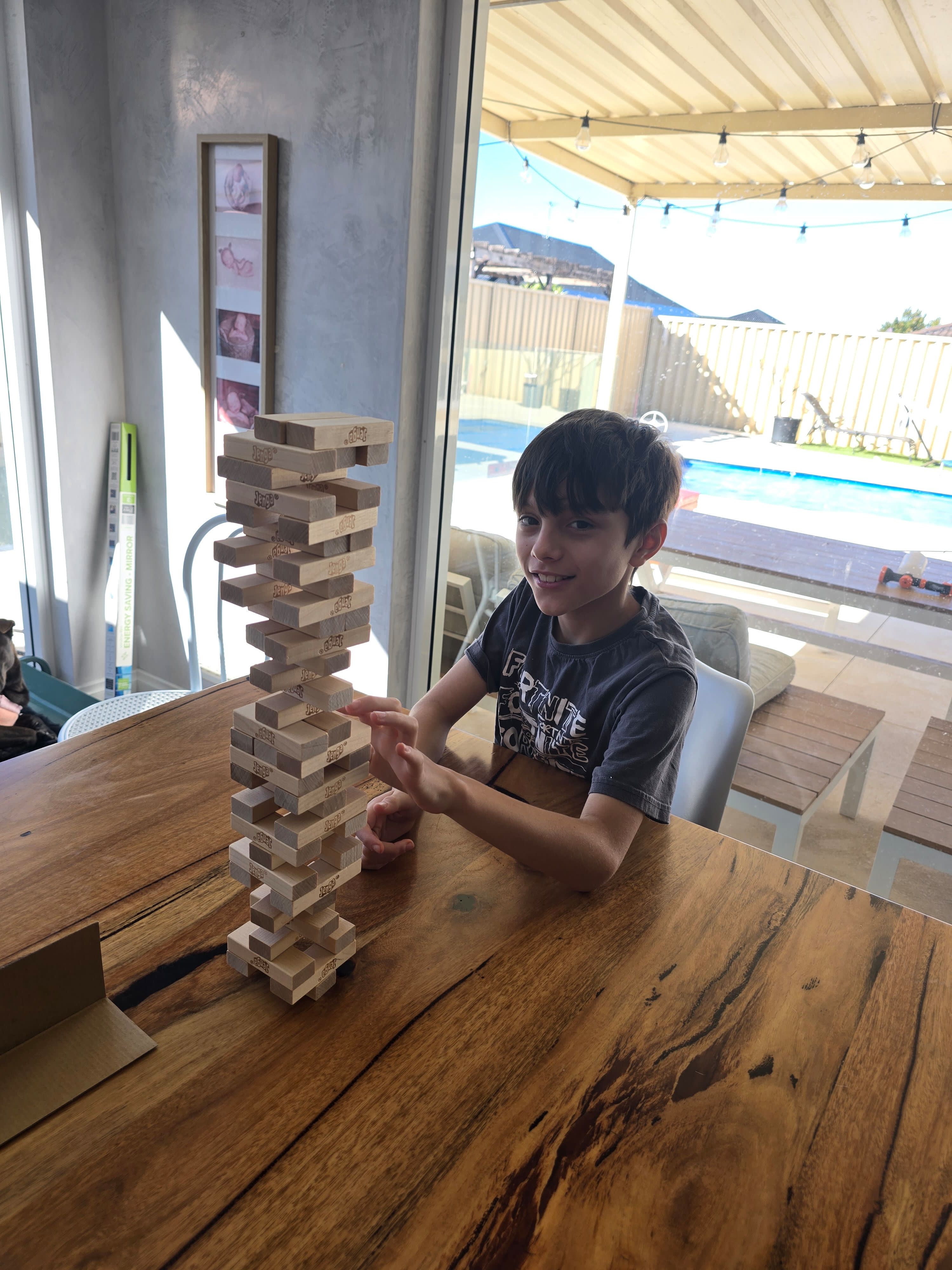
- The block tower shows spatial design choices, including layering, balance, and visual rhythm, which are core elements of three-dimensional art.
- Using repeated wooden pieces creates a pattern-based composition, helping develop an eye for symmetry, contrast, and structure.
- The child’s careful placement of blocks suggests an appreciation for form and construction as a creative process, not just play.
- The finished tower can be seen as a temporary sculpture, giving experience with building art that is both functional and aesthetic.
English
- During Reading Eggs, he demonstrated comprehension by knowing the answers, showing active reading understanding rather than simple guessing.
- Working independently for a short time before needing support suggests emerging stamina for literacy tasks and the ability to engage with instructions.
- The need for prompting after a few minutes may indicate that written tasks require emotional regulation and supportive scaffolding, not that the language skills are absent.
- His success with the reading content suggests he may be ready for more challenging texts when the workload is adjusted to avoid shutdown.
Foreign Language
- The activity itself does not show a direct foreign-language task, so there is no clear evidence of language learning in another language.
- If the card games or reading program included vocabulary labels, he may have practiced recognition of symbols and word forms, but this is not explicitly shown.
- The visual, rule-based play could still support future foreign-language learning by strengthening memory for sequences and patterns.
- Because no foreign-language materials are mentioned, this subject remains unrepresented in the activity.
History
- The wooden blocks and tabletop games connect indirectly to the history of traditional family games and classic hands-on learning materials.
- Jenga and card games represent long-standing forms of social play, which can be used to discuss how people have learned strategy and taken turns over time.
- The use of structured games rather than only digital activities reflects a more traditional educational approach to leisure and learning.
- No specific historical content is present, so this subject is only lightly connected through the cultural history of games.
Math
- The tower-building required understanding balance, quantity, and structural stability, all of which involve practical geometry and spatial reasoning.
- Adding internal columns shows applied problem-solving, as he identified a way to improve load-bearing support and prevent collapse.
- Whole-number lessons on Maths Online likely reinforced counting, number recognition, and basic numerical reasoning, even though he needed prompting to continue.
- The card game and Blockus also supported strategic thinking, pattern recognition, and planning ahead, which are important mathematical habits.
Music
- No music-making or listening activity is shown, so there is no direct evidence of music learning in the task.
- The repeating structure of the tower has a visual rhythm that can loosely connect to musical patterning, but this is only an indirect connection.
- Card games and block play may strengthen sequencing and timing, which are helpful foundations for later musical learning.
- Because no instruments, singing, or rhythm work are mentioned, this subject is not directly represented.
Physical Education
- The block-building required fine motor control, hand steadiness, and careful coordination while placing pieces without toppling the structure.
- Managing the tower’s balance likely involved body awareness, controlled movement, and patience while leaning in and adjusting position.
- Sustaining play across different activities shows endurance and the ability to shift attention between tasks, which supports overall physical self-regulation.
- Although not vigorous exercise, the activity still developed coordination and motor planning through precise manipulation of objects.
Science
- Building a tall tower with internal supports introduced engineering concepts such as force, gravity, stability, and load distribution.
- He experimented with structure by adding columns inside, showing an understanding that design changes can affect how materials behave.
- The observation of what made the tower stronger is a form of informal scientific investigation and trial-and-error learning.
- The success of the structure suggests he was thinking like a young engineer: testing, adjusting, and improving a model.
Social Studies
- Playing games like Thirteen and Blockus involved following shared rules, turn-taking, and respectful competition, all important social skills.
- The need to ask for support during schoolwork also highlights adult-child collaboration, a key part of learning within a family or home setting.
- Working through frustration without giving up entirely suggests developing self-advocacy and participation in a learning community.
- The positive note about progress reflects social-emotional growth, including perseverance and the experience of being recognized for effort.
Tips
Tips: To extend this learning, try turning the tower into a mini engineering challenge: ask him to predict which design will hold the most weight, then test it with small objects and compare results. You could also use the card game and Blockus as a bridge to math by talking through strategy choices, patterns, and “best move” reasoning out loud, which helps make thinking visible without adding pressure. For reading and maths, keep the sessions short and successful—finish with a clear stopping point before shutdown begins, then gradually build stamina by adding only a minute or two when he is regulated. If he enjoys hands-on learning, invite him to draw or photograph a “building plan” for a new tower and label the parts, connecting creativity, vocabulary, and problem-solving in a low-demand way.
Book Recommendations
- The Most Magnificent Thing by Ashley Spires: A child learns that building something great takes patience, problem-solving, and trying again when the first design does not work.
- Iggy Peck, Architect by Andrea Beaty: A fun story about a boy who loves building and uses creativity and engineering thinking to solve problems.
- Henry's Freedom Box by Ellen Levine: A powerful picture book that can connect to thinking about structures, boxes, and creative solutions, while also supporting discussion and comprehension.
Try This Next
- Draw a blueprint of the Jenga tower and label where the support columns were added.
- Make 3 quiz questions about balance, strategy, and what helped the tower stay standing.
- Write a short reflection: “What move did I make that improved the structure?”
- Create a simple data chart showing how long he worked independently in reading and maths.