Core Skills Analysis
Mathematics
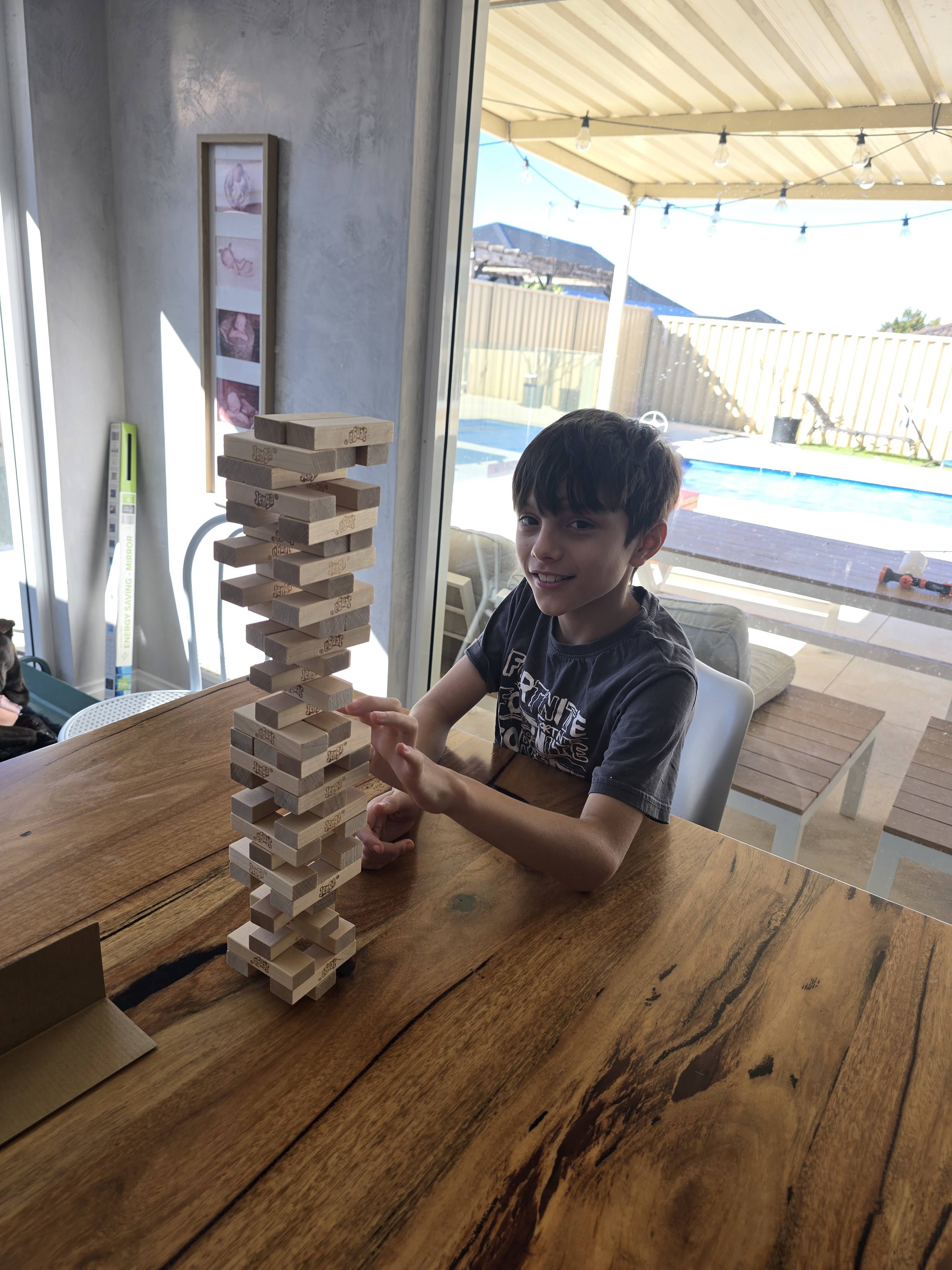
Isaac worked on whole numbers in his online maths lessons and showed that he could begin independently before needing encouragement and typing support to keep going. He practiced understanding number concepts while also managing the effort of staying engaged for longer than usual, which was a meaningful step in building stamina for formal learning. In the Jenga activity, he also used mathematical thinking by judging balance, spacing, and how the blocks affected the structure’s stability as he added columns inside to keep it upright. His success with working for about 10 minutes independently suggested growing confidence with number work and problem-solving, even though the task also showed that he needed a calm, supportive pace.
English / Reading
Isaac completed one unit of Reading Eggs and first worked independently for about five minutes before needing support to finish it. He understood the reading and knew all the answers, which showed that his comprehension skills were strong even when the task itself started to feel hard for him emotionally or mentally. This activity showed that he could process simple reading content accurately and that his challenge was more about maintaining participation than understanding the material. His ability to keep going with help was an important sign that he could access reading work successfully when the pressure stayed low and the support stayed steady.
Critical Thinking / Logic / Games
Isaac played the card game Thirteen and Blockus, both of which required strategic moves, planning ahead, and noticing patterns in how actions affected the outcome. In these games, he had to think about choices before acting, adjust his approach, and use visual-spatial reasoning to place pieces in ways that worked well. The Jenga tower also added a logic challenge because he needed to decide where the structure could handle another block and where reinforcement was necessary. These activities showed that Isaac was practicing flexible thinking and decision-making in a playful setting, which likely felt more manageable than traditional school tasks.
Science / Engineering
Isaac built a structure using blocks and strengthened it by adding columns inside, which gave him a hands-on introduction to engineering ideas like support, load, and stability. He learned that a tall structure needed a strong internal design if it was going to stay standing, and he applied that idea by reinforcing the inside rather than only focusing on the outside shape. The process of testing, adjusting, and improving the build mirrored how scientists and engineers solve problems by observing what works and making changes. This kind of construction play also supported curiosity, persistence, and practical understanding of how structures hold weight.
Tips
Isaac showed that short bursts of work with clear support helped him succeed, so the next step could be to keep lessons brief, predictable, and tied to hands-on success. You could extend the maths learning by using blocks to sort, count, compare heights, or build towers with specific number goals, then connect those ideas back to whole-number practice in a low-pressure way. For reading, try very short independent reads followed by a choice-based response, such as pointing to an answer, drawing a picture, or retelling one sentence, so comprehension stays visible without creating overload. To build on his engineering and game play strengths, invite him to predict which structure will be strongest, explain a move in a game, or sketch a design before building, because that keeps learning active while respecting his need for manageable demands.
Book Recommendations
- Rosie Revere, Engineer by Andrea Beaty: A story about creativity, persistence, and redesigning ideas—great for connecting with building and structural problem-solving.
- The Way Things Work Now by David Macaulay: A visual guide to how machines and structures work, ideal for curious children who enjoy figuring out how things stay together.
- Jenga by Hasbro: A familiar game-related pick that connects to balance, strategy, and careful decision-making during block play.
Learning Standards
- Australian Curriculum Mathematics: The whole number work connected to counting, representing, and comparing numbers, as well as using practical reasoning to solve problems with blocks and structure-building. This aligns well with number sense and mathematical thinking in the early primary years.
- Australian Curriculum Mathematics – Problem Solving and Reasoning: Isaac used strategy when he played Thirteen and Blockus and when he adjusted the Jenga structure for balance, showing planning, testing, and refining ideas.
- Australian Curriculum English: Reading Eggs supported decoding and comprehension as Isaac read, understood the content, and responded accurately. His ability to know the answers showed that he was processing text meaningfully, even when he needed support to finish.
- Australian Curriculum Science / Design and Technologies: Building a stable block structure with internal columns matched concepts of stability, strength, and design improvement. Isaac was exploring how materials and shape affect whether a structure stands or falls.
- General Capability: Personal and Social Capability: Isaac showed persistence, self-regulation, and the ability to continue with support, which is especially important given the noted shutdown risk. His progress in independent work reflected growing confidence and resilience.
Try This Next
- Draw and label Isaac’s tower: identify the base, supports, and strongest section, then circle the parts that helped it stay stable.
- Mini quiz: Which move in Jenga or Blockus was the smartest? Why did it help the structure or game plan?
- Write one sentence about how Isaac made the structure stronger by adding columns inside.
- Whole-number challenge: build towers of 5, 10, and 15 blocks, then compare which is tallest and which is most stable.