Core Skills Analysis
History
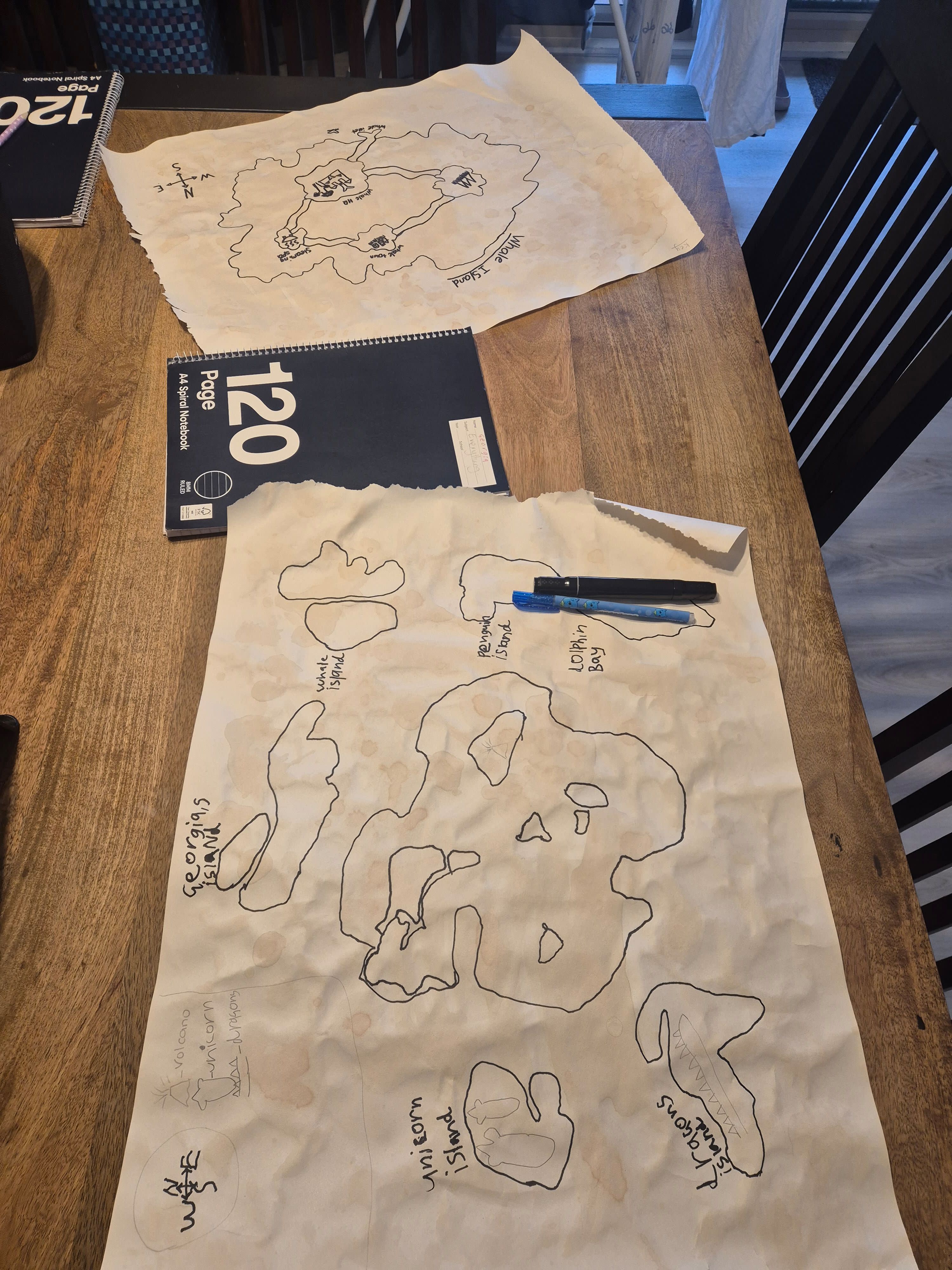
- The map-making activity shows an understanding that places can be organized and related to one another, which is a foundational history skill for studying geography, migration, exploration, and how stories are tied to locations.
- By labeling islands and creating a named setting, Audrey practiced the historical habit of turning a blank space into a meaningful place with identity, which helps build awareness that people give names, roles, and significance to locations over time.
- The compass rose and island layout introduce early map literacy, including directional thinking and spatial relationships, both of which are important for reading historical maps and understanding how people navigate territories.
- Creating a story to match the map supports the idea that historical knowledge can be reconstructed from evidence and setting; she is learning to connect physical spaces with events, characters, and possible sequences of action.
Art
- Audrey used hand-drawn outlines, label placement, and large-scale composition to design a visually coherent map, showing control over line quality, shape, and spatial arrangement.
- The repeated island forms and variation in size demonstrate creative design choices, including balance, contrast, and visual interest across the page.
- The paper texture and ink outlines suggest experimentation with presentation, giving the project an aged or handmade look that adds artistic atmosphere to the map.
- Her work combines illustration and invented symbolism, showing that art can be both decorative and functional when used to communicate a fictional world.
English
- Audrey practiced narrative writing by inventing characters, defining their personalities, and explaining their roles, which develops plot-building and character development skills.
- Writing a summary of the story shows she is learning to condense ideas, identify important events, and communicate the main idea clearly.
- The labels on the map connect written language to visual elements, supporting vocabulary growth and the ability to use text to clarify meaning in a story setting.
- This activity builds sequencing and descriptive writing skills because the story must logically fit the geography of the map and the relationships between the islands.
Tips
To extend this project, encourage Audrey to turn the map into a fuller story by adding a beginning, problem, and resolution for the characters she created. She could also write a legend or map key with symbols for important places, which would strengthen both mapping skills and descriptive writing. Another great step would be to have her narrate the story orally before writing it, helping her organize ideas and notice where details can be expanded. For a creative connection, she could create a travel log or postcard from one island to another, using the map as evidence for what each location might look and feel like.
Book Recommendations
- My Map Book by Sara Fanelli: A playful picture book that shows how maps can represent places, memories, and imaginative worlds.
- There’s a Map on My Lap! All About Maps by Tish Rabe: A beginner-friendly introduction to maps, directions, and how people use map features to understand places.
- Island: A Story of the Galápagos by Jason Chin: A beautifully illustrated nonfiction story that explores islands and the living world connected to them.
Try This Next
- Write a character profile sheet for each island leader: name, personality, job, and favorite place on the map.
- Create a 5-question map quiz using the compass rose, island names, and the story summary.
- Draw a legend for the map with symbols for homes, danger spots, and important landmarks.
- Write a short chapter beginning with: 'On the island of ______, everything changed when...'