Core Skills Analysis
Math
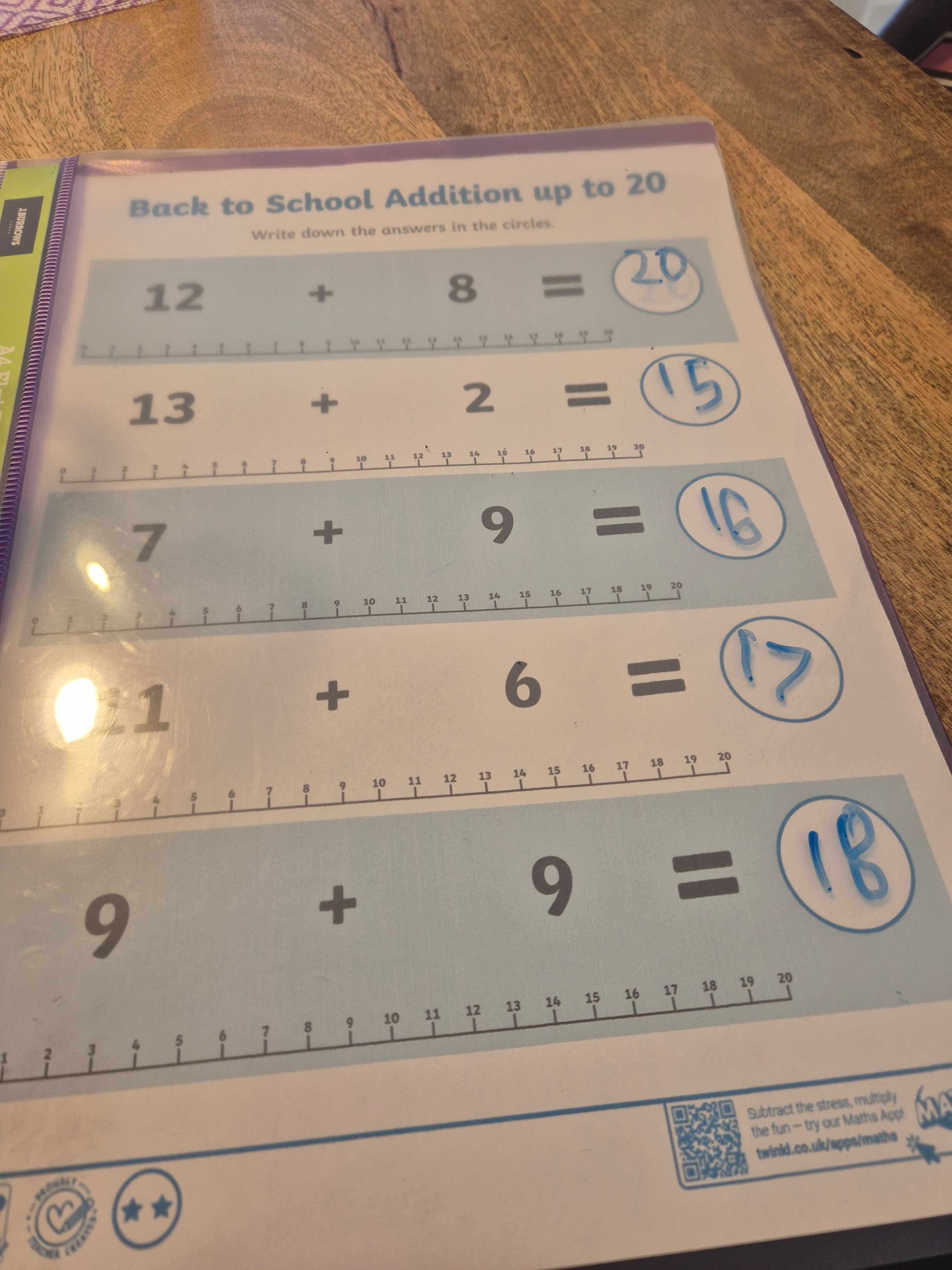
- Practiced addition facts within 20 by solving single-digit and teen-number problems, building fluency with sums such as 12 + 8, 13 + 2, 7 + 9, and 11 + 6.
- Used a number-line strategy shown on the worksheet, which supports understanding addition as counting forward rather than only memorizing answers.
- Worked on skip counting patterns with 2s, 3s, and learning 4s, helping strengthen number sense, sequencing, and pattern recognition.
- The worksheet format suggests Georgia was connecting written equations to visual counting supports, an important step toward confidence and independence in early arithmetic.
Tips
To deepen this learning, keep building on the number-line idea by having Georgia hop forward on a floor number line or count objects in small groups to match her skip-counting practice with 2s, 3s, and 4s. You could also mix in oral games like “What comes next?” or “Start at 7 and count on 9 more,” which strengthens mental math and flexibility. A fun hands-on extension would be sorting counters into pairs, threes, and fours so she can see why skip counting works. Finally, ask her to create a few of her own addition problems and explain how she found each answer, which helps turn her practice into real understanding.
Book Recommendations
- One Is a Snail, Ten Is a Crab by April Pulley Sayre: A playful counting book that supports number sense and skip-counting ideas through imaginative examples.
- Anno's Counting Book by Mitsumasa Anno: A classic visual counting book that reinforces number patterns and quantity recognition.
- Ten Black Dots by Donald Crews: A simple, engaging book that encourages counting and seeing numbers in creative ways.
Try This Next
- Make a mini worksheet of 10 addition problems using a number line for support.
- Ask: "How did you know the answer without counting all the way from 1?" for each problem.
- Draw or build groups of 2s, 3s, and 4s with dots, blocks, or coins.
- Write three new addition facts that equal 15, 16, or 18.