Core Skills Analysis
Physical Education
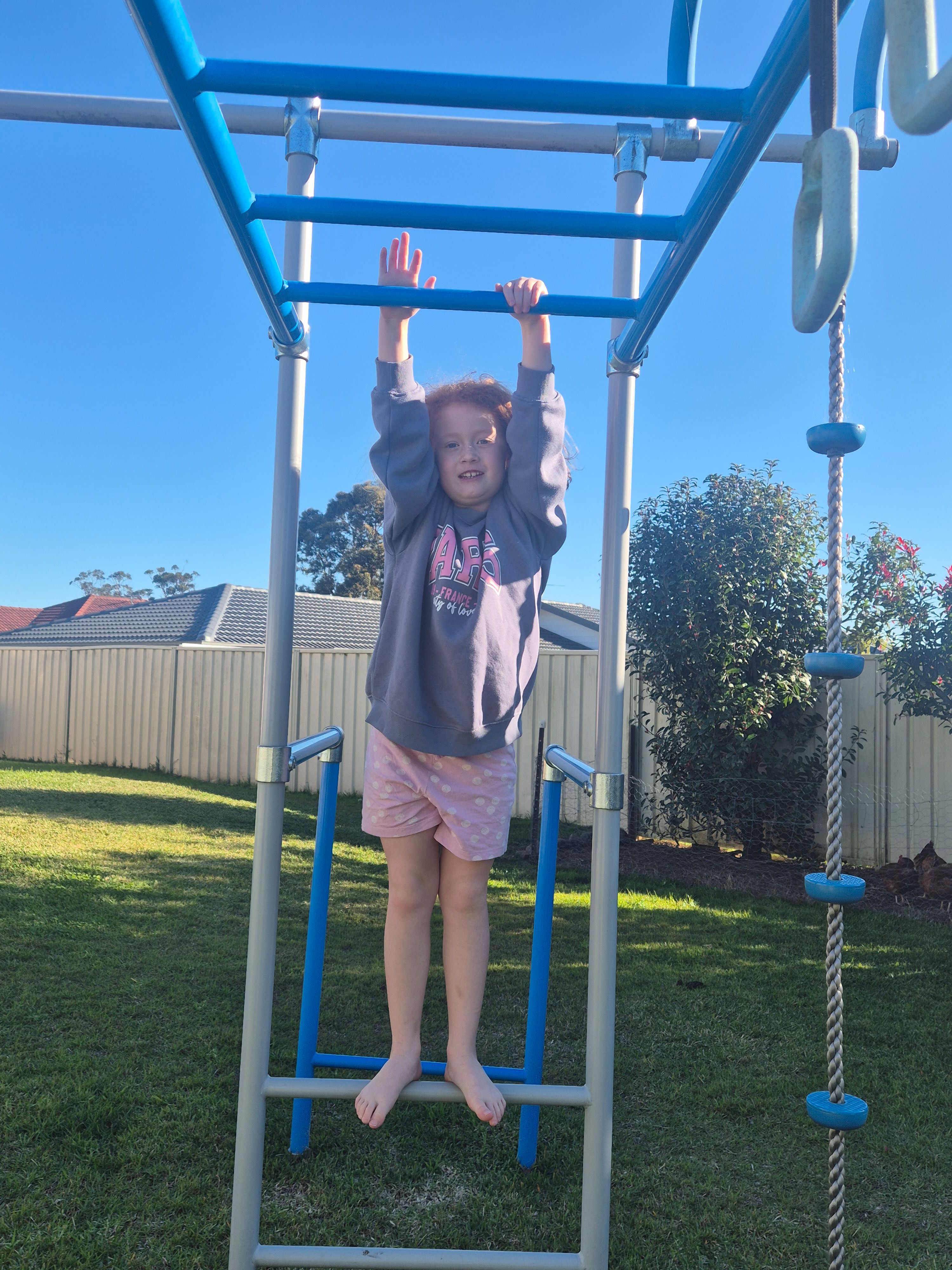
- Georgia is practicing upper-body strength and grip endurance by hanging from the monkey bars and supporting her body weight.
- Daily use of the monkey bars, trampoline, and obstacle course builds coordination, balance, and body control through repeated movement patterns.
- The activity supports gross motor development by challenging climbing, swinging, jumping, and controlled landing skills.
- Regular outdoor play also encourages stamina and spatial awareness as she navigates different equipment and movements.
Science
- Georgia is learning how her body works during movement, especially how muscles, hands, and arms help her hold and move on equipment.
- The trampoline and obstacle course offer natural opportunities to observe force, bounce, motion, and gravity in action.
- Her grip on the bars shows an early understanding of balance and support, as she adjusts her body to stay steady.
- Outdoor play connects her to the physical environment, including the ground, weather, and space around the equipment.
Math
- Daily obstacle play can reinforce sequencing as Georgia moves through steps in an order, such as climb, hang, jump, and land.
- She is experiencing basic measurement concepts through distance, height, and speed while moving between pieces of equipment.
- Counting repetitions, jumps, or swings can turn active play into informal number practice.
- Comparing which activity feels easier, harder, higher, or longer helps build early classification and comparison skills.
Social-Emotional Learning
- Georgia’s willingness to try the equipment suggests confidence and a readiness to take on physical challenges.
- Hanging and balancing require persistence, because she must keep trying even when the task is demanding.
- Daily outdoor activity may help her regulate energy and mood through active, engaging movement.
- The relaxed expression in the photo suggests she may be comfortable and proud while participating in the obstacle course.
Tips
To extend Georgia’s learning, turn her daily play into a mini movement study. You could count how many rungs she climbs, how many jumps she completes on the trampoline, or how long she can hang safely, then compare those numbers over time to notice growth. Add language development by asking her to describe each movement using words like higher, lower, faster, slower, and careful. You can also make it a science lesson by talking about what helps her body stay balanced, what muscles feel active, and how bouncing or swinging changes direction. For a creative extension, let her draw a map of the backyard course and label each challenge, or help design a new obstacle route using simple household items.
Book Recommendations
- From Head to Toe by Eric Carle: A playful movement book that encourages children to copy body actions and notice how different parts of the body move.
- Move! by Steve Jenkins and Robin Page: An engaging look at how animals and people move, perfect for connecting physical activity to science and observation.
- The Busy Body Book by Lizzy Rockwell: A kid-friendly introduction to the human body that explains how muscles, bones, and movement work together.
Try This Next
- Create a simple checklist: hang, climb, jump, balance, and land — then have Georgia mark which skills she practiced each day.
- Ask her to draw her favorite part of the obstacle course and label the movements she used.
- Make a quick comparison chart: Which was easiest? hardest? highest? bounciest?
- Write 3 movement words together and have her act them out: swing, balance, climb.