Core Skills Analysis
Math
- She practiced doubling a recipe, which builds an early understanding of multiplication as repeated addition.
- She likely compared ingredient amounts and adjusted quantities carefully, strengthening number sense and proportional thinking.
- Measuring ingredients for two cakes supports practical estimation, counting, and maintaining accuracy across multiple steps.
- Following a doubled recipe also reinforces sequencing and attention to numerical detail, since one incorrect amount can affect both cakes.
Science
- Baking a banana cake gives hands-on experience with how ingredients change when mixed and heated.
- She observed a real food transformation, from separate ingredients to a finished batter and then baked cake.
- The activity introduces cause-and-effect thinking, since ingredient amounts and oven heat influence the final texture and rise.
- Working with bananas, flour, and other ingredients supports early awareness of materials, states of matter, and kitchen chemistry.
Language Arts
- Following a recipe supports reading comprehension because she had to understand directions and apply them in order.
- Doubling ingredients likely required her to notice key words such as 'add,' 'mix,' and quantity terms, strengthening functional vocabulary.
- Cooking together can build oral language through discussion, prediction, and describing steps or changes in the mixture.
- The activity supports retelling and procedural writing skills, since she could later explain how the cake was made from start to finish.
Social-Emotional Learning
- Helping bake for weekend visitors suggests she was participating in a shared family task with a clear purpose.
- The activity likely encouraged responsibility, since she had an important role in preparing food for others.
- Working toward two cakes may have supported patience and persistence, especially while measuring and waiting through the process.
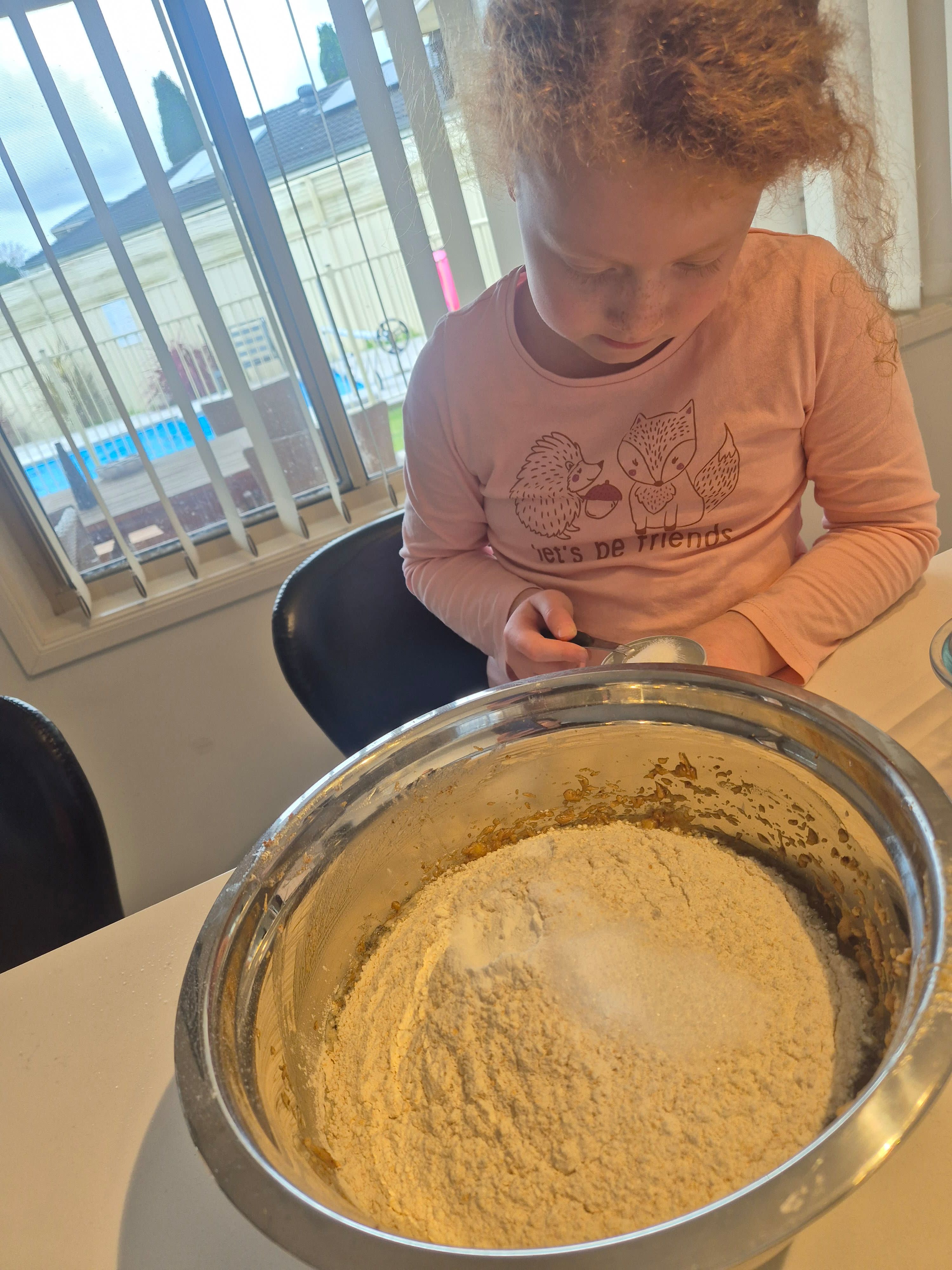
- Her focused posture in the image suggests concentration and engagement, showing attention to the task at hand.
Tips
To extend this learning, invite Georgia to help compare a normal recipe and a doubled recipe side by side so she can see how every ingredient changes. You could also let her measure ingredients with cups and spoons to practice fractions and quantity awareness in a concrete way. After baking, ask her to describe the steps in order or dictate them into a simple “How We Made Banana Cake” story, which strengthens sequencing and language skills. For a creative follow-up, she could draw the ingredients, label them, or predict what would happen if an ingredient were left out, helping her connect cooking with problem-solving and scientific thinking.
Book Recommendations
- Blueberries for Sal by Robert McCloskey: A classic story that connects well to food preparation, family activity, and simple counting moments.
- If You Give a Mouse a Cookie by Laura Numeroff: A playful book that builds sequencing and cause-and-effect understanding, just like following steps in a recipe.
- From Seed to Pumpkin by Wendy Pfeffer: An accessible science book that supports early learning about food, growth, and real-world processes.
Try This Next
- Recipe math worksheet: write the original ingredient amounts and the doubled amounts in two columns.
- Sequence activity: put the baking steps in order from first to last.
- Drawing prompt: illustrate the bowl before mixing, during mixing, and after baking.
- Quick quiz: Which ingredients stayed the same? Which ingredients needed to be doubled?