Core Skills Analysis
Fine Motor Skills
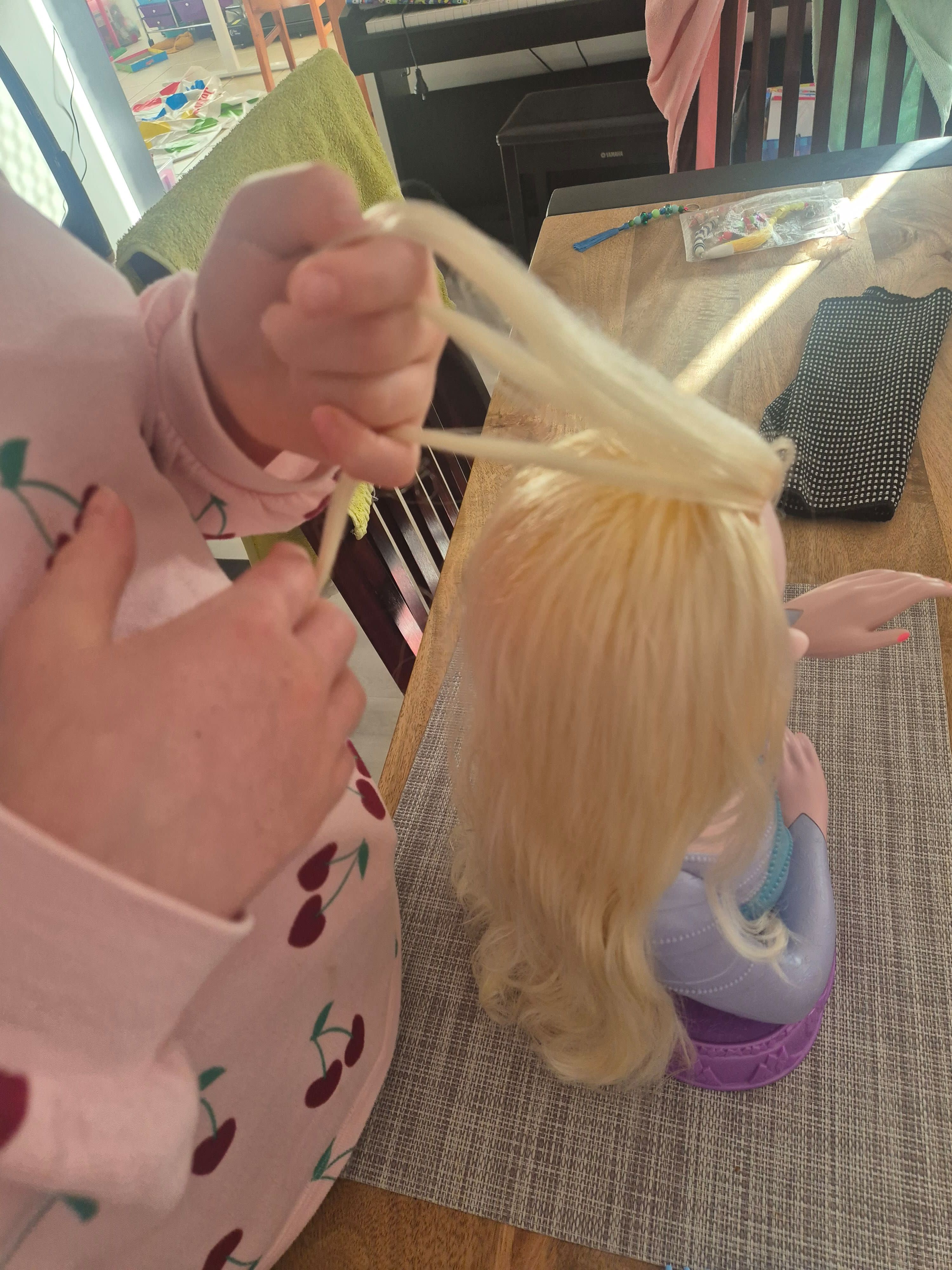
- Audrey practiced controlled hand movements while braiding, brushing, and sectioning the doll’s hair, which builds finger dexterity and hand strength.
- Using both hands together to hold hair in place and guide the braid supported bilateral coordination and midline crossing.
- Giving the doll a haircut helped her work on precision, careful tool use, and coordination between what she sees and what her hands do.
- These repeated grooming motions suggest she is developing the stamina needed for longer self-care routines.
Practical Life / Self-Care
- The activity directly connected to real-life hair care skills, including washing, brushing, styling, and trimming.
- Audrey’s interest in learning to care for her own hair shows growing independence and awareness of personal responsibility.
- Practicing on a doll provides a safe way to learn the sequence of hair-care steps before applying them to herself.
- The routine likely reinforced patience, sequencing, and following through on a task from start to finish.
Science
- Washing and brushing hair introduced simple ideas about cleanliness and how water, soap, and brushing affect hair.
- Comparing the doll’s hair before and after grooming helped Audrey observe cause and effect, such as how brushing changes tangles and appearance.
- Trying a haircut opened a basic understanding that hair can be cut, shaped, and maintained in different ways.
- The activity naturally supported observation of textures, lengths, and how hair behaves when handled.
Language Arts
- Hair-styling work gives rich vocabulary practice with words like braid, brush, wash, haircut, and style.
- Talking through the steps of the activity supports sequencing language such as first, next, then, and last.
- If Audrey described what she was doing, she practiced expressive language and clear instruction-giving.
- This kind of pretend-care play can also strengthen storytelling and role-play language around everyday routines.
Tips
To extend this learning, you could turn hair care into a simple routine chart with pictures showing the steps Audrey used: wash, brush, braid, and tidy up. Let her practice on the doll first, then compare that routine to her own hair-care needs so she can begin building independence. You might also set up a “hair salon” role-play with a mirror, combs, clips, and soft brush, encouraging her to name each tool and explain what it does. For an added challenge, invite Audrey to practice sectioning hair into two or three parts, which builds planning, sequencing, and control. If she is ready, she can help choose a style for the doll and describe why she picked it, giving her a chance to think, decide, and communicate her ideas.
Book Recommendations
- Hair Love by Matthew A. Cherry: A warm story about a father learning to style his daughter’s hair, celebrating care, patience, and confidence.
- Llama Llama Hair Drama by Anna Dewdney: A gentle story about the feelings and routines involved in getting hair done.
- Not All Princesses Dress in Pink by Jane Yolen: A playful book that celebrates different kinds of self-expression, including everyday care and individuality.
Try This Next
- Make a hair-care sequence chart: wash, dry, brush, braid, and finish.
- Ask Audrey to show how to make one braid step by step on the doll.
- Draw or label the tools used in a hair salon: brush, comb, clip, spray bottle.
- Practice a simple comparison: Which part of the doll’s hair changed after washing or brushing?