Core Skills Analysis
Language Arts
- Georgia practiced level 4 sight words, showing developing word recognition and stronger fluency with high-frequency vocabulary.
- Starting level 5 suggests she is ready to transfer previously learned words into new reading and writing tasks, building confidence with more advanced text.
- Writing the words by hand supports spelling memory, letter formation, and the connection between seeing a word and producing it independently.
- Working on writing skills at the same time indicates she is practicing sentence-level literacy habits such as spacing, alignment, and careful copying.
Fine Motor / Handwriting
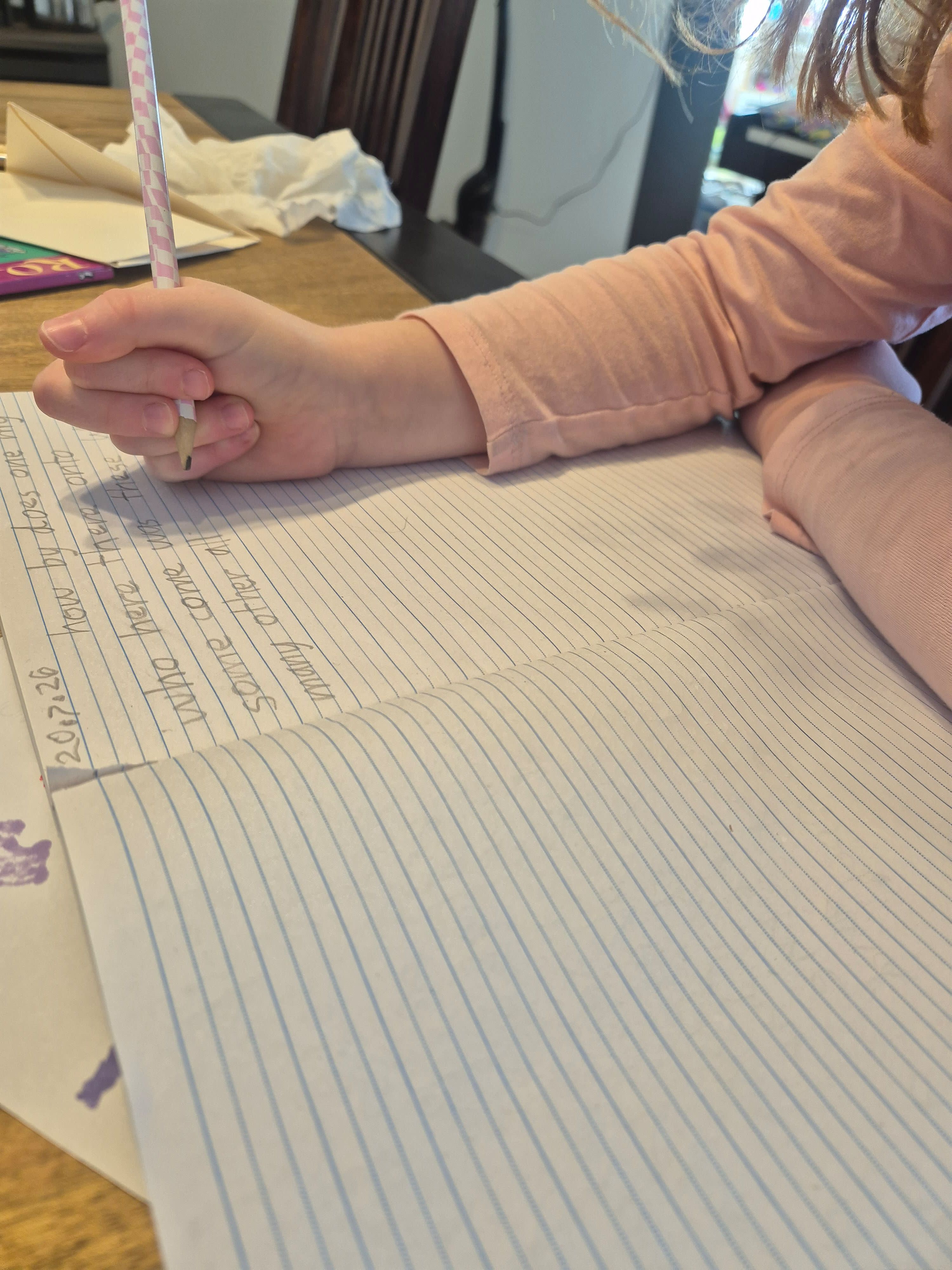
- Her pencil grip and steady placement on the page show she is practicing controlled hand movements needed for legible handwriting.
- The lined notebook provides visual guidance that helps with letter sizing, baseline control, and staying on track while writing.
- Repeated copying of sight words strengthens coordination between eye movement and hand movement, an important foundation for fluent writing.
- The focused posture and attention to the page suggest she is building stamina for seated academic work.
Tips
To extend this lesson, keep the sight-word practice short and consistent so Georgia can build automaticity without fatigue. You could turn level 5 into a small daily routine: read the new words aloud, trace them once, write them from memory, and then use one or two in a simple sentence. For a more hands-on approach, try rainbow writing, magnetic letters, or spelling the words with tiles before writing them in her notebook. You might also mix in a quick review game with the level 4 words so she keeps older words strong while learning new ones. If she enjoys challenge, invite her to choose one sight word and use it in a picture, caption, or mini-story, which helps connect spelling, reading, and meaning.
Book Recommendations
- The Very Hungry Caterpillar by Eric Carle: A classic early-reader favorite with repeated language and familiar words that support sight-word recognition.
- Green Eggs and Ham by Dr. Seuss: Rhythmic, repetitive text makes it fun to notice and practice high-frequency words.
- Brown Bear, Brown Bear, What Do You See? by Bill Martin Jr. and Eric Carle: Repetition and patterned language help young readers anticipate and recognize words while building confidence.
Try This Next
- Write 5 level 5 sight words in a worksheet, then circle the letters that change from word to word.
- Make a quick quiz: say the word, spell the word, and use the word in a sentence.
- Draw a picture for one sight word and label it with the word underneath.
- Use flashcards for a timed read-through of level 4 words to build speed and confidence.