Core Skills Analysis
Language Arts
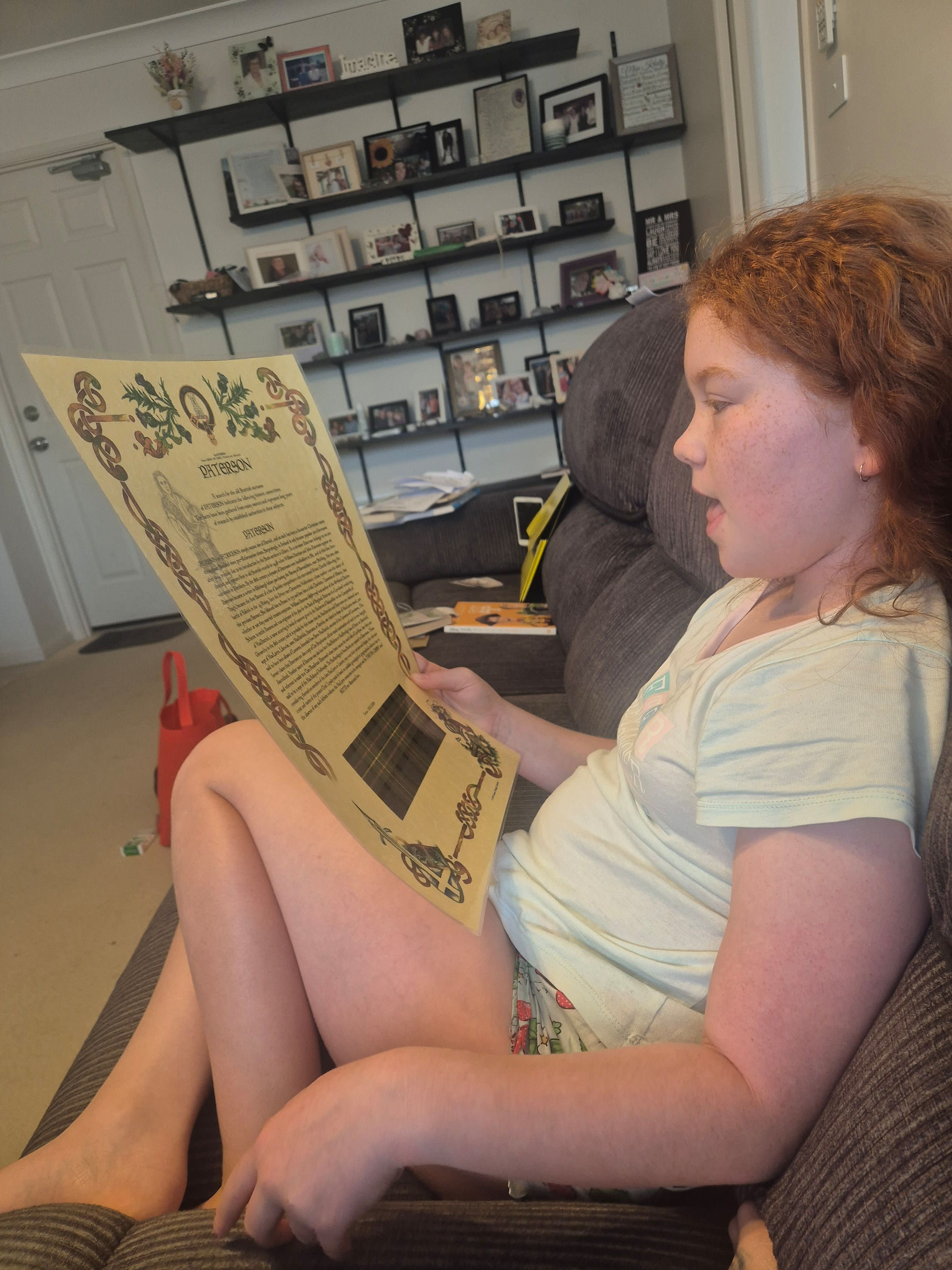
- The student practiced sustained reading while examining a written document about Scottish heritage and a family crest.
- The activity supported vocabulary development through heritage-related words such as "Scotland," "family crest," and the visible surname "Patterson."
- The student practiced using visual text features, including a decorative border, heading, illustrations, and paragraphs, to interpret the document.
- Reading alongside an adult created an opportunity to discuss meaning, ask questions, and summarize information from the text.
History and Heritage
- The activity introduced the idea that family history can be explored through written records, surnames, and heraldic symbols.
- The student engaged with Scottish cultural heritage through a document focused on a family crest and ancestry.
- The crest provided a concrete connection between historical identity and the way families preserve information about their past.
- The activity encouraged the student to consider how historical information is passed between generations.
Social Studies and Geography
- The student encountered Scotland as a place connected to family heritage, creating a starting point for locating Scotland on a map.
- The discussion could help distinguish between a country, a family name, a cultural tradition, and a personal connection to heritage.
- Examining a family crest introduced the social-studies idea that communities use symbols to represent identity, belonging, or history.
- The activity connected personal family stories with broader cultural traditions rather than treating history as only distant or unfamiliar.
Art and Visual Design
- The student observed how the document uses ornamental lettering, a patterned border, illustrations, and a crest-like design to communicate historical importance.
- The crest offered an example of visual symbolism, in which images and colors may represent ideas associated with a family or group.
- The activity supported visual literacy by inviting the student to look closely at both the written information and the artwork surrounding it.
- The presentation of the document demonstrated how design choices can make a historical text feel formal, memorable, and meaningful.
Social-Emotional Learning
- The student appeared engaged in a calm, shared reading experience with an adult, supporting connection and attentive listening.
- Exploring family heritage can provide an opportunity for identity-building and thoughtful conversation about where family stories come from.
- The student showed willingness to participate in an unfamiliar or detailed reading topic by holding and examining the document closely.
- The activity created space for curiosity, questions, and appreciation of family traditions without requiring the student to already know the historical background.
Tips
Tips: Turn this into a short family-history lesson by first locating Scotland on a map and comparing it with the family’s current location, using only information the family can confirm. Next, invite the student to draw the crest and label the symbols, colors, animals, or objects they can identify, then distinguish between what the document states and what they infer. Read a child-friendly book about Scotland and compare its setting, traditions, language, or landscape with the document. Finally, help the student create a one-page heritage record with a title, a few verified facts, a drawing, and one question they would like to investigate with a trusted family member.
Book Recommendations
- Katie Morag Delivers the Mail by Mairi Hedderwick: A warm picture book set on a Scottish island, offering an accessible introduction to Scottish landscapes, community life, and cultural setting.
- This Is Edinburgh by Miroslav Šašek: A colorful, child-friendly tour of Edinburgh that can help the student connect family heritage with Scottish places, buildings, and history.
- Eyewitness Scotland by DK: An illustrated reference book covering Scotland’s geography, history, landmarks, traditions, and culture for guided browsing and fact-finding.
Try This Next
- Crest-symbol worksheet: draw the visible crest and label each symbol, color, or decorative feature.
- Map activity: locate Scotland, Edinburgh, and one other Scottish place mentioned in a book or family record.
- Reading response prompt: "One detail I learned, one detail I noticed, and one question I still have is..."
- Family-history interview cards: ask a trusted relative about the surname, the document, and any known Scottish traditions.