Core Skills Analysis
Physical Education
- Georgia practiced bike-control skills including pushing off independently, starting, changing direction, and riding over bumps.
- The activity developed balance, coordination, steering accuracy, pedaling control, and whole-body motor planning.
- Repeated practice with starting and maneuvering can build confidence and help Georgia become more independent on the bicycle.
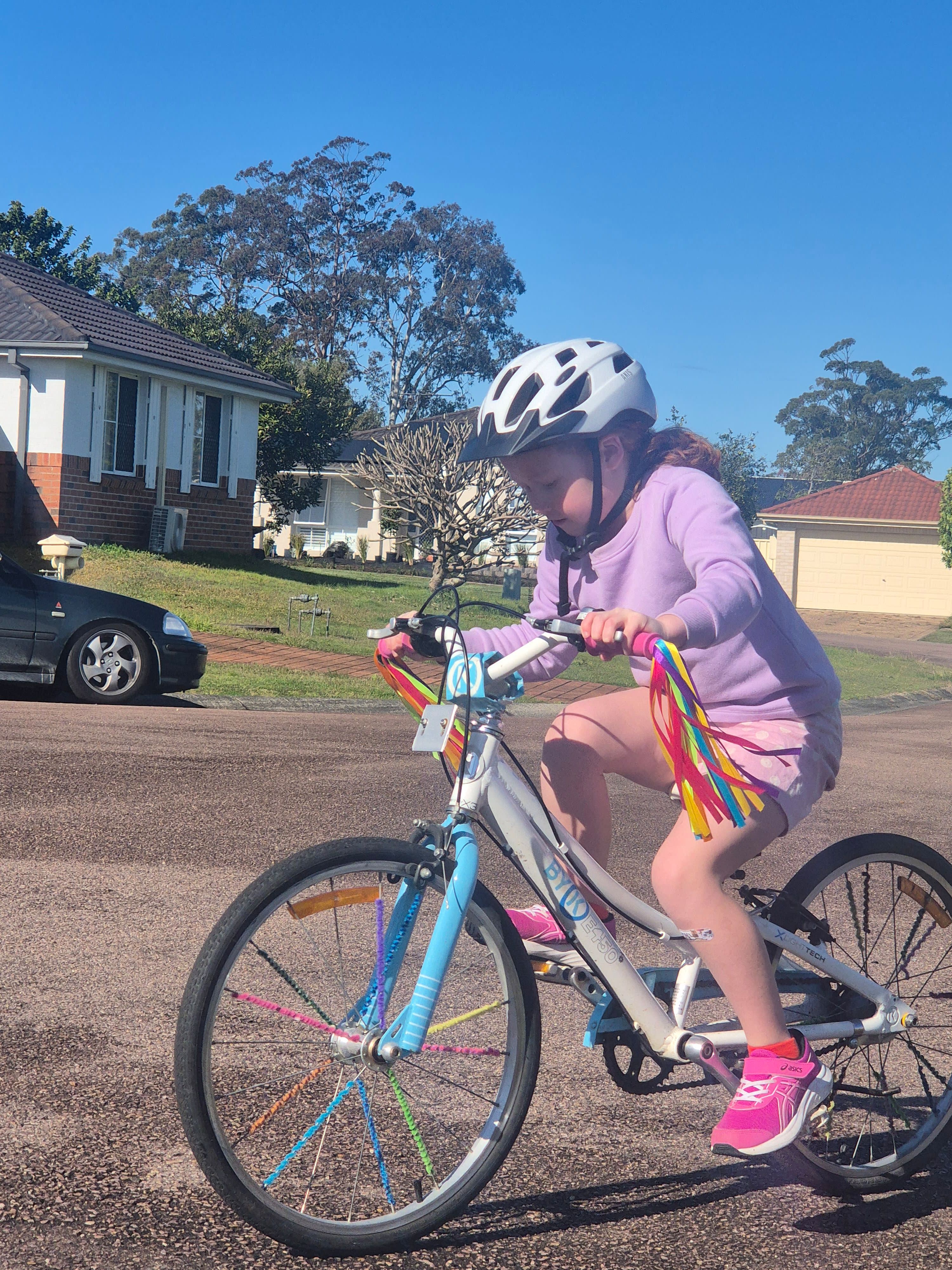
- The image shows Georgia riding a bicycle while wearing a helmet, demonstrating active participation in a practical outdoor movement activity.
Health and Safety
- Georgia worked on making safer decisions around traffic and other riders, connecting cycling practice with real-world road awareness.
- The activity highlighted the importance of wearing protective equipment; Georgia is visibly wearing a bicycle helmet in the uploaded image.
- Learning what to do near bumps, vehicles, and other cyclists supports hazard recognition and responsible risk management.
- Practicing in a residential outdoor setting creates opportunities to reinforce stopping, checking surroundings, signaling, and maintaining a safe distance.
Science and Engineering
- Riding over bumps gives Georgia firsthand experience with how uneven surfaces affect balance, motion, steering, and the bicycle’s wheels.
- Changing direction demonstrates how turning the handlebars and shifting body position influence the bicycle’s path.
- Pushing off and pedaling provide an observable example of force causing motion, while braking demonstrates how friction can slow or stop the bicycle.
- The bicycle’s wheels, frame, handlebars, pedals, and brakes offer a meaningful introduction to simple machines and designed systems.
Environmental Studies
- Georgia’s interest in mountain-bike riding through the bush creates a connection between physical activity and outdoor environments.
- A bush-riding discussion can introduce how trails differ from streets in surface, slope, obstacles, visibility, and habitat.
- The activity encourages careful observation of the local surroundings, including trees, houses, roads, and possible riding spaces visible in the image.
- Cycling can provide a practical context for discussing how people move through outdoor spaces while respecting plants, wildlife, and shared trails.
Social-Emotional Learning
- Working toward independent starts and controlled riding supports perseverance, patience, and confidence-building through gradual skill development.
- Managing traffic and other riders requires attention, self-control, and consideration for other people using the road or path.
- Georgia’s expressed interest in mountain biking suggests curiosity and motivation that can be used to set achievable riding goals.
- Progress can be reinforced by celebrating specific successes, such as a smooth push-off, a controlled turn, or a safe response to an obstacle.
Tips
Tips: Turn the riding practice into a short skills course using clearly marked stations for pushing off, stopping, turning, and riding over a small safe bump, with an adult supervising and checking the area first. After each attempt, invite Georgia to describe what she noticed and choose one skill to improve, building reflection and vocabulary. Create a simple route map together and mark places where a rider should slow down, look, stop, or give space to others. Before exploring a bush trail, visit it on foot to identify its surface, slopes, obstacles, trail etiquette, and safe stopping places; then begin with a short, easy section while following local cycling rules and wearing appropriate protective equipment.
Book Recommendations
- Duck on a Bike by David Shannon: A playful picture book about learning to ride, trying something new, and developing confidence on a bicycle.
- The Bike Lesson by Stan and Jan Berenstain: A classic beginner cycling story that opens discussion about practicing skills, listening to guidance, and staying safe.
- Pedal It! How Bicycles Work by Michael Dahl: An accessible nonfiction book that connects cycling with bicycle parts, motion, balance, and mechanical design.
Try This Next
- Bike-safety picture sort: place cards into “stop,” “slow down,” “look,” and “give space” categories.
- Create a neighborhood cycling map and mark safe stopping points, turns, bumps, driveways, and places to watch for traffic.
- Science experiment: test how a toy bicycle or rolling object moves across smooth, grassy, and bumpy surfaces.
- Writing prompt: “My safest and most confident bike skill is…; next I would like to practice…”