Core Skills Analysis
Mathematics
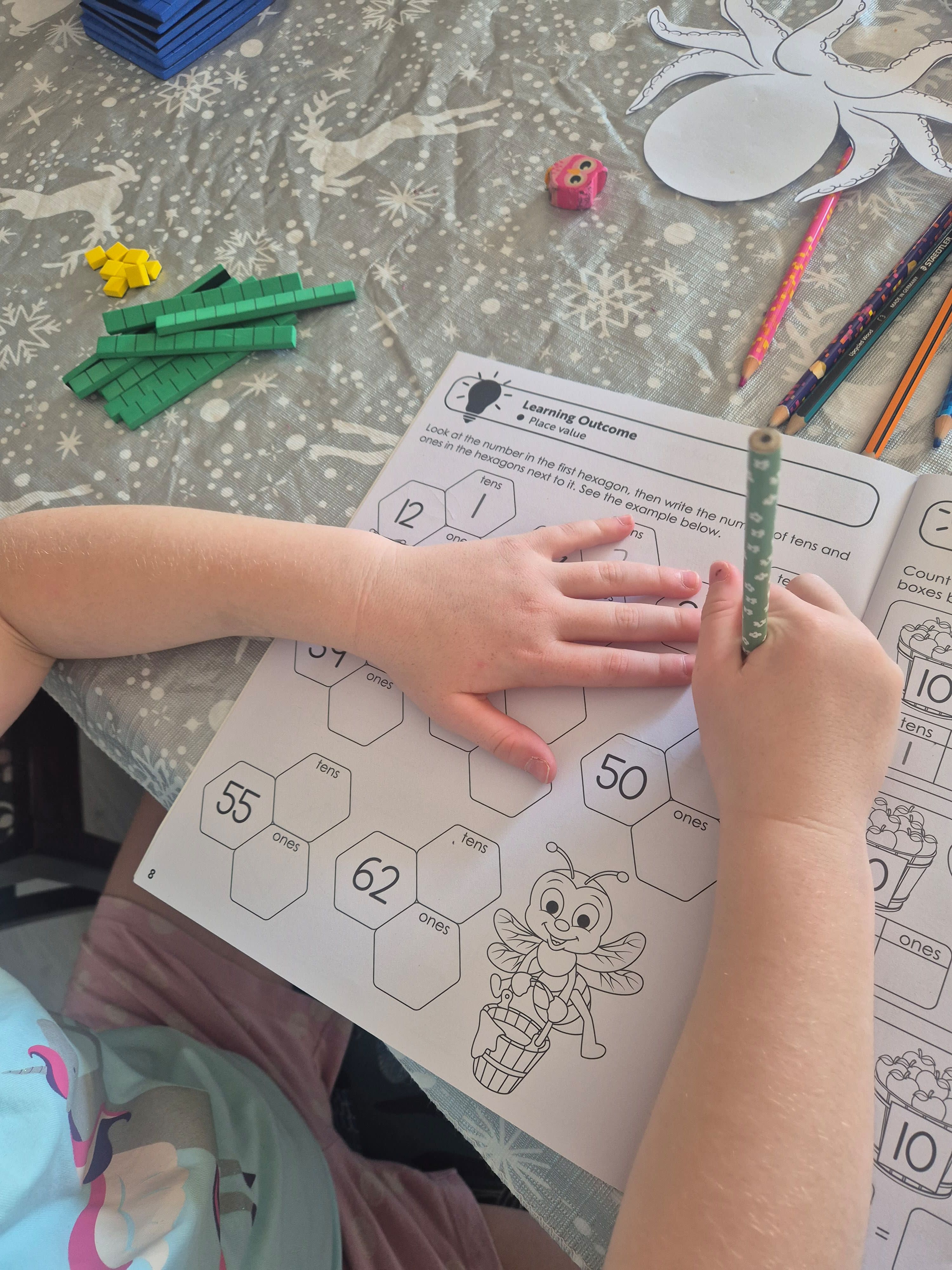
- Georgia practiced place value by identifying the tens and ones positions in two-digit numbers such as 12, 50, 55, and 62.
- She connected written numerals to concrete quantities by building numbers with the available manipulatives, supporting the idea that a digit’s value depends on its position.
- The workbook activity required her to determine missing tens or ones values and record answers, strengthening number decomposition into groups of tens and individual ones.
- Using both physical resources and written questions gave Georgia practice moving between hands-on modeling, visual representations, and abstract mathematical notation.
Language Arts
- Georgia engaged with mathematical vocabulary, including the words “place value,” “tens,” and “ones.”
- She practiced reading and interpreting written directions in the workbook before completing the number tasks.
- Writing numerals in the answer spaces supported number formation, pencil control, and clear communication of mathematical thinking.
- The adult’s pointing and guidance appear to support Georgia’s attention to the relevant part of the page while she worked through the instructions.
Tips
Tips: Extend the lesson by asking Georgia to build a number with the tens and ones manipulatives, say the number aloud, and explain how many tens and ones it contains. Create a simple “mystery number” game in which one person gives clues such as “I have 4 tens and 3 ones,” and Georgia finds or builds 43. Look for two-digit numbers on calendars, food packages, or house numbers and have her identify each digit’s place value. To deepen understanding, invite her to draw a picture showing why 5 tens is different from 5 ones, then write a sentence such as “In 55, the 5 in the tens place means 50.”
Book Recommendations
- A Place for Zero: A Math Adventure by Angeline LoPresti: A story that introduces the importance of place value and the role of zero through a friendly mathematical adventure.
- Sir Cumference and All the King's Tens: A Math Adventure by Cindy Neuschwander: A playful math adventure that helps children explore groups of ten and the structure of larger numbers.
- How Much Is a Million? by David M. Schwartz: An illustrated introduction to large numbers that encourages children to think about counting, grouping, and the meaning of numerical quantities.
Try This Next
- Make a place-value mat labeled “tens” and “ones”; call out numbers for Georgia to build and record.
- Create a five-question quiz: “What is the value of the 6 in 62?” and “How many ones are in 55?”
- Ask Georgia to draw 3 groups of ten and 7 single objects, then write the matching number and number sentence.
- Cut out numeral cards from 0–9 and have Georgia make the greatest and least two-digit numbers using two chosen cards.