Core Skills Analysis
Science
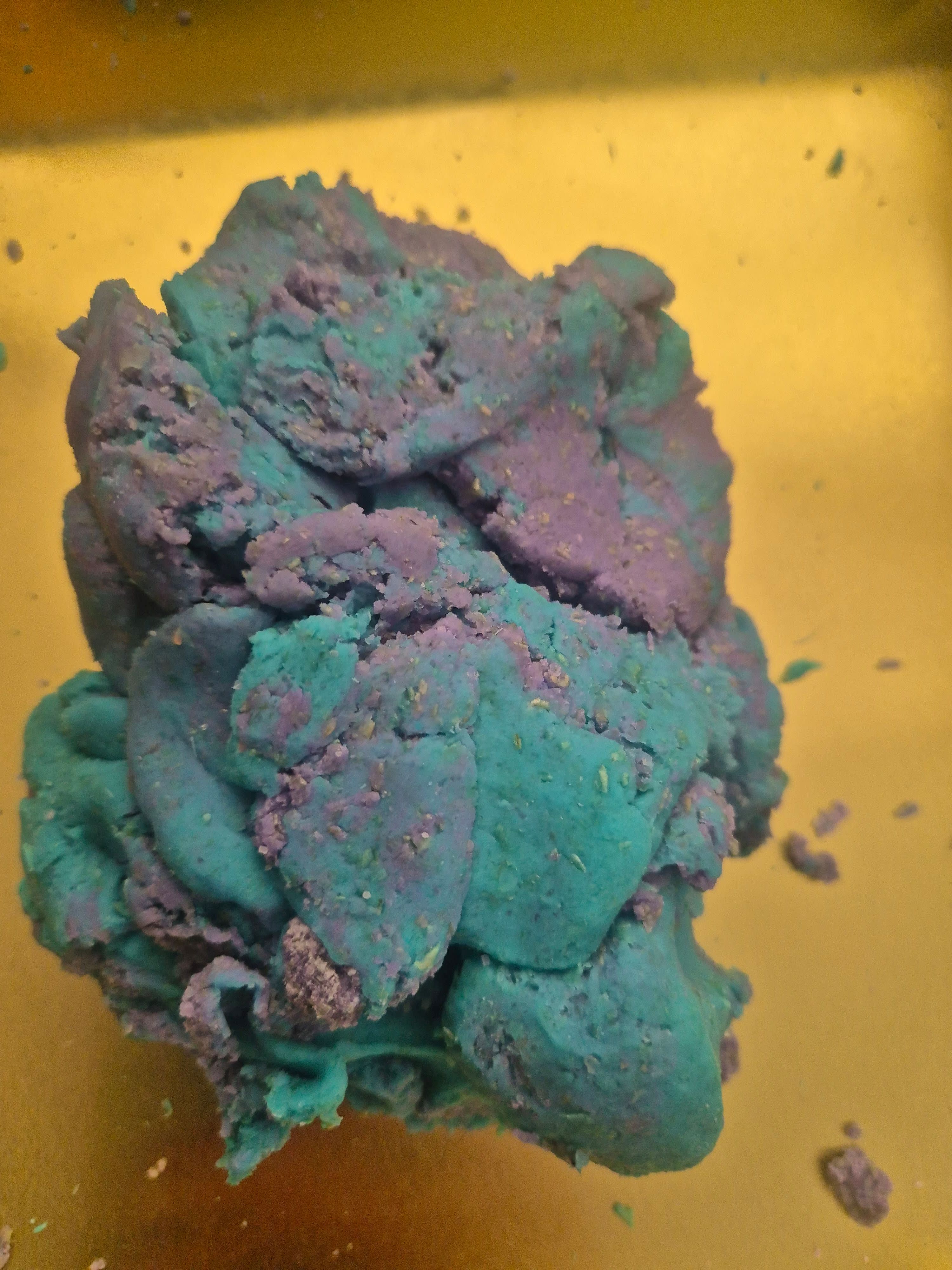
- Georgia explored color mixing by combining playdough in several colors, including turquoise/greenish and purple shades, to observe whether new colors appeared.
- She practiced making predictions before mixing, using her understanding of primary colors to anticipate a possible color change.
- The activity introduced cause and effect: changing the materials by combining them produced a different-looking mixture.
- The finished playdough shows that mixing can create a complex, less-uniform color rather than one perfectly even shade.
Art
- Georgia used color as a creative material, selecting and combining contrasting cool colors to make an expressive sculptural piece.
- She explored texture through pressing, layering, folding, and shaping the playdough; the image shows many uneven, raised pieces across the surface.
- The yellow background creates strong color contrast with the blue-green and purple playdough, making the artwork visually striking.
- She demonstrated creative choice and willingness to experiment rather than trying to preserve each original color separately.
Math
- Georgia informally practiced classification by noticing and working with different colors as separate groups before combining them.
- She explored quantity and proportion: using more of one color than another can affect the final appearance of the mixture.
- The activity supported early comparison language such as same, different, lighter, darker, more, and less.
- Arranging and combining multiple pieces involved spatial reasoning as she shaped a three-dimensional object and considered how parts fit together.
Language Arts
- Georgia practiced prediction language by thinking ahead about what might happen when particular colors were mixed.
- The activity creates a natural opportunity to explain a process in sequence: choose colors, predict, mix, observe, and describe the result.
- Describing the finished piece can build precise vocabulary, including color names, texture words, shape words, and sensory adjectives.
- Comparing her prediction with the observed result supports reflective communication and using evidence to explain whether an idea was accurate.
Tips
Tips: Turn this into a simple color-investigation lesson by offering small, equal-sized pieces of primary-colored playdough and asking Georgia to record a prediction before each combination. Mix two colors at a time first, then compare the results with a homemade color wheel or painted swatches; afterward, try changing the proportions to see whether more blue, yellow, or red changes the final shade. Invite her to make a color-mixing chart with drawings or photographs, using sentences such as “I predicted…” and “I observed…”. Finish with an open-ended art challenge: create a creature, landscape, or abstract sculpture using only newly mixed colors, then discuss which combinations and textures she likes best.
Book Recommendations
- Mouse Paint by Ellen Stoll Walsh: Three white mice discover what happens when they step into different colors and mix them together, making it a strong picture-book connection to Georgia's color experiments.
- Mix It Up! by Hervé Tullet: An interactive art book that invites children to imagine touching, mixing, and changing colors through playful visual prompts.
- The Color Monster by Anna Llenas: A colorful, visually engaging story that can extend discussion about identifying, naming, comparing, and expressing colors.
Try This Next
- Create a prediction chart with columns for “Colors Mixed,” “My Prediction,” and “What I Observed.”
- Make a playdough color wheel by mixing red, yellow, and blue in pairs and labeling each new color.
- Try a proportion challenge: mix mostly blue with a little yellow, then mostly yellow with a little blue, and compare the results.
- Write or dictate a five-step process description: choose, predict, mix, observe, and explain.