Core Skills Analysis
Physical Education and Health
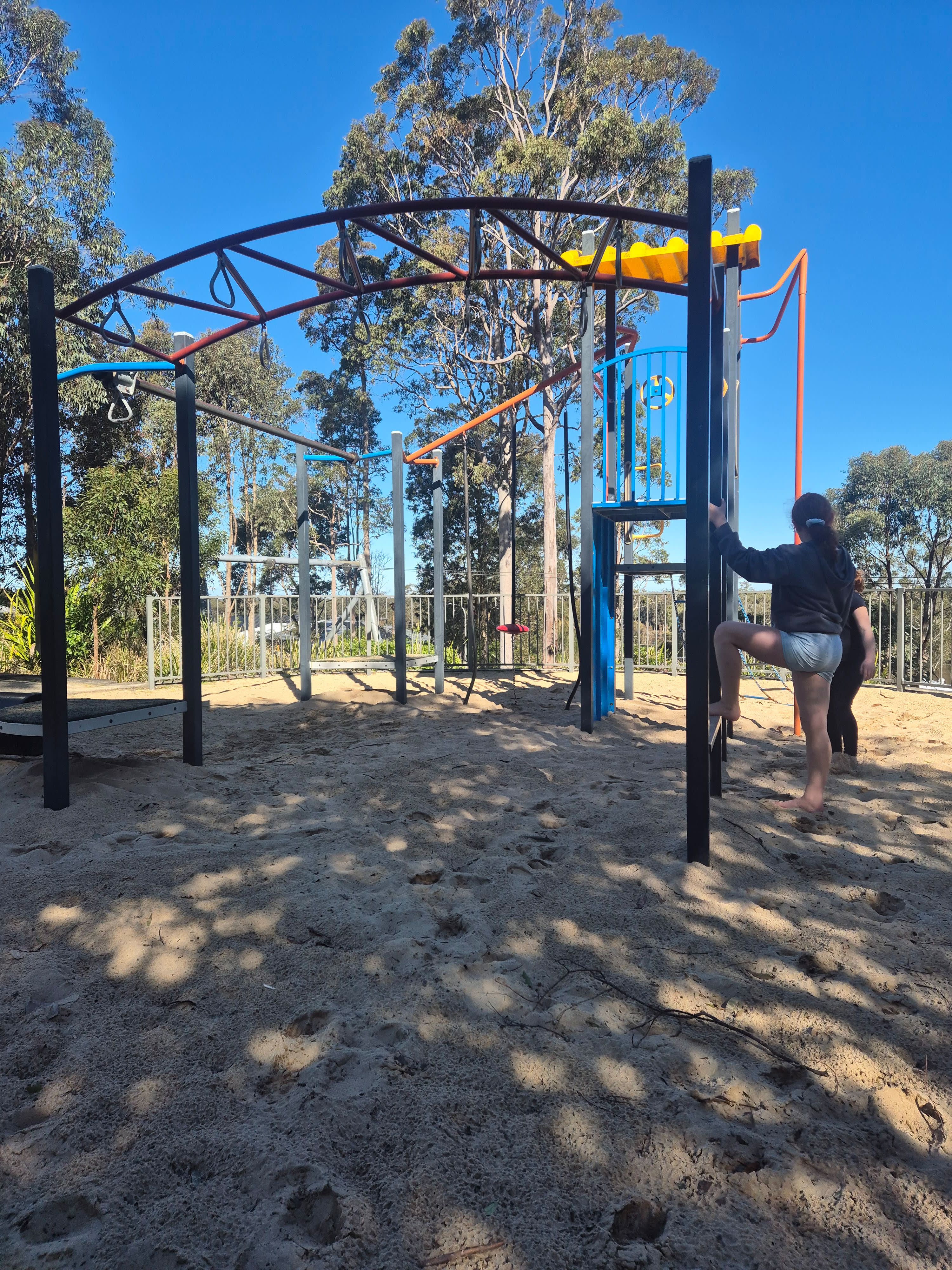
- The flying fox and monkey bars provided opportunities to develop upper-body strength, grip, balance, coordination, and body control.
- The obstacles and fireman pole encouraged students to plan movements, adjust their speed, and move safely through a sequence of challenges.
- Climbing, swinging, and sliding supported gross-motor development through active outdoor exercise.
- The activity encouraged awareness of personal safety, including holding equipment securely, waiting for space, and checking where to land.
Science
- The flying fox introduced observable ideas about motion, including movement along a line, speed, stopping, and the effects of pushing or gravity.
- The fireman pole and climbing equipment provided practical examples of forces such as gravity, friction, pulling, and pushing.
- The playground setting allowed observation of how sunlight creates shadows on the sand, equipment, and surrounding trees.
- The eucalyptus trees and sandy ground connected the human-built playground with the natural environment.
Mathematics
- The student could compare playground features by height, length, distance, and the number of steps or movements needed to complete them.
- Moving through the obstacles supported sequencing and positional language such as over, under, across, beside, behind, and between.
- The different bars, poles, platforms, and rails offered opportunities to notice shapes, lines, angles, symmetry, and repeated patterns.
- A timed or counted playground challenge could develop early data skills by recording attempts, distances, or completion times.
Language Arts
- The activity offered a rich setting for descriptive vocabulary such as swing, climb, slide, balance, grip, platform, pole, obstacle, and sand.
- The student could practice oral storytelling by explaining the order of events from arriving at the park to using each piece of equipment.
- Discussing the activity supports speaking and listening skills through describing choices, giving directions, and explaining how a challenge was completed.
- The experience could inspire a personal narrative using sensory details about the bright sky, trees, playground colors, movement, and sandy surface.
Social-Emotional Learning
- Trying several playground challenges provided opportunities to practice persistence when a movement was difficult or unfamiliar.
- Choosing between the flying fox, obstacles, fireman pole, and monkey bars encouraged decision-making and awareness of personal comfort levels.
- A shared playground environment supported understanding of turn-taking, spatial awareness, and consideration for other users.
- The outdoor activity may have supported confidence and enjoyment through active, self-directed play; the image alone does not establish the student's specific emotions.
Tips
Tips: Turn the park visit into a short investigation by inviting the student to choose three pieces of equipment and predict which will require the most strength, balance, or time, while keeping all play supervised and following posted safety rules. Count steps between structures, compare heights or lengths visually, and record results in a simple table. Afterward, ask the student to draw a map of the playground and label routes using words such as across, under, beside, and around. Finish with a brief journal entry or oral retelling that explains which challenge was attempted first, what movement was needed, and how the student felt about the experience without pressuring them to repeat any activity.
Book Recommendations
- Maisy Goes to the Playground by Lucy Cousins: A simple, colorful picture book about Maisy exploring familiar playground equipment and enjoying active play.
- The Berenstain Bears Go to the Playground by Stan and Jan Berenstain: A well-known early reader that connects playground fun with cooperation, behavior, and safe use of equipment.
- Last Stop on Market Street by Matt de la Peña: A thoughtful picture book about a child and grandmother traveling through a city and noticing community places, people, and everyday experiences.
Try This Next
- Create a playground map worksheet: draw and label the flying fox, obstacles, fireman pole, monkey bars, sand, trees, and entry route.
- Make a movement-sequence card set with prompts such as climb, balance, swing, slide, stop, and wait; arrange the cards in the order of the park experience.
- Record a simple comparison chart showing which equipment is tallest, longest, fastest, or most challenging, using observations rather than risky measuring.
- Write or dictate a five-sentence park adventure using the sequence words first, next, then, after that, and finally.