Core Skills Analysis
Physical Education
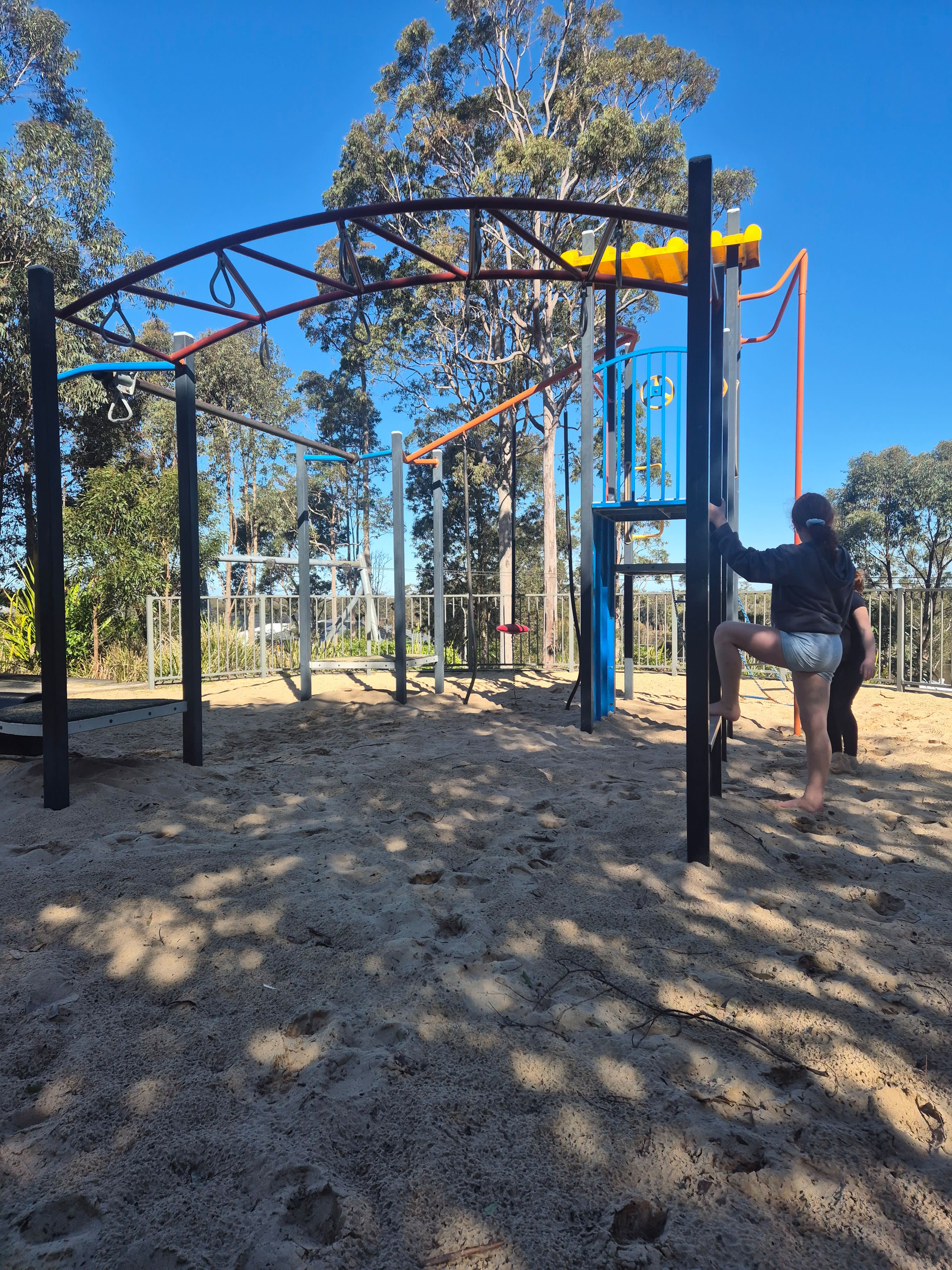
- Practiced whole-body strength and coordination while using the flying fox, monkey bars, obstacles, and fireman pole.
- Developed grip strength and upper-body endurance through hanging, climbing, pulling, and supporting body weight.
- Explored balance, body control, and spatial awareness while moving across playground equipment and sandy ground.
- Practiced planning movement sequences by deciding how to approach different challenges safely and efficiently.
Science
- Explored forces and motion through the flying fox, including how pushing, pulling, gravity, and body position affect movement.
- Experienced friction and surface texture by moving over metal equipment and landing or walking on sand.
- Observed how playground structures use strong posts, bars, joints, and support beams to hold weight and remain stable.
- Encountered simple concepts of energy transfer as body movement created swinging, sliding, climbing, and downward motion.
Mathematics
- Used informal measurement concepts by comparing the height, length, and distance of different playground features.
- Practiced sequencing and positional language through directions such as over, under, across, up, down, beside, and between.
- Could identify and compare geometric forms in the equipment, including straight bars, curved rails, circles, rectangles, and triangular supports.
- Experienced early problem-solving by judging reach, spacing, timing, and the number of movements needed to complete an obstacle.
Language Arts
- Built activity-related vocabulary through words such as flying fox, obstacle, fireman pole, monkey bars, climb, swing, grip, balance, and slide.
- Practiced oral storytelling by describing the afternoon at the park and retelling the order in which the equipment was used.
- Developed descriptive language by observing the bright equipment, blue sky, trees, sand, and movement in the playground setting.
- Could strengthen communication skills by explaining how to use a piece of equipment or giving a friend clear directions.
Social-Emotional Learning
- Had opportunities to build confidence by attempting several different physical challenges in an outdoor setting.
- Practiced persistence when a climbing or balancing task required repeated attempts and adjustments.
- Could develop self-awareness by noticing which activities felt easy, challenging, exciting, or in need of a rest.
- Practiced awareness of others by waiting, sharing equipment, observing personal space, and considering playground safety.
Tips
Tips: Turn the park visit into a mini investigation by choosing one piece of equipment at a time and asking what movements, forces, and safety decisions are involved. Invite the learner to create a simple playground map, label the flying fox, obstacles, fireman pole, monkey bars, trees, and sand, and then add arrows showing a possible route. After play, encourage a short journal entry or oral retelling using sequence words such as first, next, then, and finally. For a creative design extension, provide blocks, cardboard tubes, or craft sticks and challenge the learner to build a model playground with one climbing feature, one sliding feature, and one balancing feature, explaining how each part works.
Book Recommendations
- The Most Magnificent Thing by Ashley Spires: A child designs, tests, and revises an invention, making it a useful connection to playground problem-solving and persistence.
- Giraffes Can't Dance by Giles Andreae: A lively story about movement, confidence, and finding a personal way to participate physically.
- We're Going on a Bear Hunt by Michael Rosen: The repeated movement sequence encourages children to act out traveling over, under, and through obstacles while practicing descriptive language.
Try This Next
- Create a playground-mapping worksheet: draw the equipment, label each feature, and use arrows to show a route.
- Ask: Which equipment involves hanging, sliding, climbing, or balancing? Sort the four activities into movement categories.
- Write or dictate a five-sentence park recount using the words first, next, after that, finally, and because.
- Design a safer or more exciting playground feature with craft materials and explain how its supports, motion, and safety features work.