Core Skills Analysis
Math
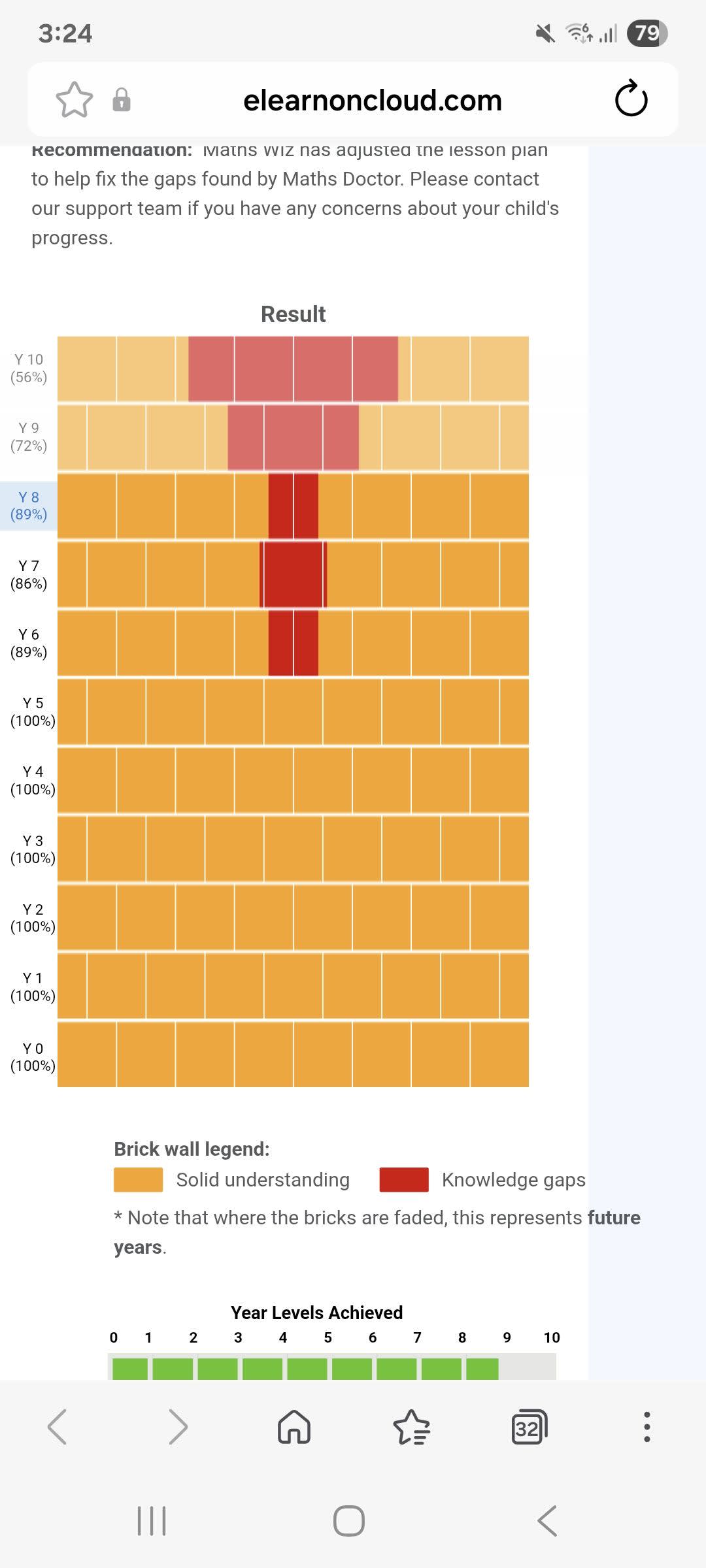
The student completed a 45-minute mathematics assessment through Kinetic Education to identify areas of strength and possible gaps. The uploaded report showed solid understanding across Years 0–5, with scores of 100% at each level, and strong performance at Years 6–8, with results of 89%, 86%, and 89%. Performance decreased at Years 9 and 10, where the report recorded 72% and 56%, and the red sections of the brick-wall chart identified specific knowledge gaps for targeted review. The assessment therefore provided a measured starting point for a personalised mathematics curriculum rather than indicating that the student lacked understanding across all areas.
Tips
Tips: Use the assessment results to create a short, focused learning plan that begins with the red knowledge-gap areas while revisiting earlier skills only when they support those topics. Ask the student to explain how they solved selected questions, keep a simple progress chart, and celebrate improvements in accuracy and confidence rather than focusing only on scores. Turn practice into real-life investigations—such as comparing prices, planning a budget, measuring ingredients, or analysing sports statistics—so new concepts have a meaningful purpose. Reassess selected skills after a few weeks and adjust the personalised curriculum according to demonstrated progress.
Book Recommendations
- The Grapes of Math by Greg Tang: A visual, puzzle-based book that encourages flexible strategies for solving arithmetic and spotting patterns.
- Math Curse by Jon Scieszka: A humorous story that shows how mathematical thinking can be applied to everyday situations and problems.
- Sir Cumference and the First Round Table by Cindy Neuschwander: An engaging mathematical adventure that introduces geometric ideas through story, wordplay, and problem solving.
Try This Next
- Create a personalised ‘math gap tracker’ with one box for each target skill; record the date, attempt, strategy used, and improvement.
- Write five practice questions based on the weakest assessment areas, then solve each one using two different methods where possible.
- Complete a real-life budgeting challenge: plan a small shopping list, calculate totals, compare prices, and explain the chosen strategy.
- Hold a short ‘teach-back’ session in which the student explains one recently mastered skill using drawings, examples, or manipulatives.