Core Skills Analysis
Science
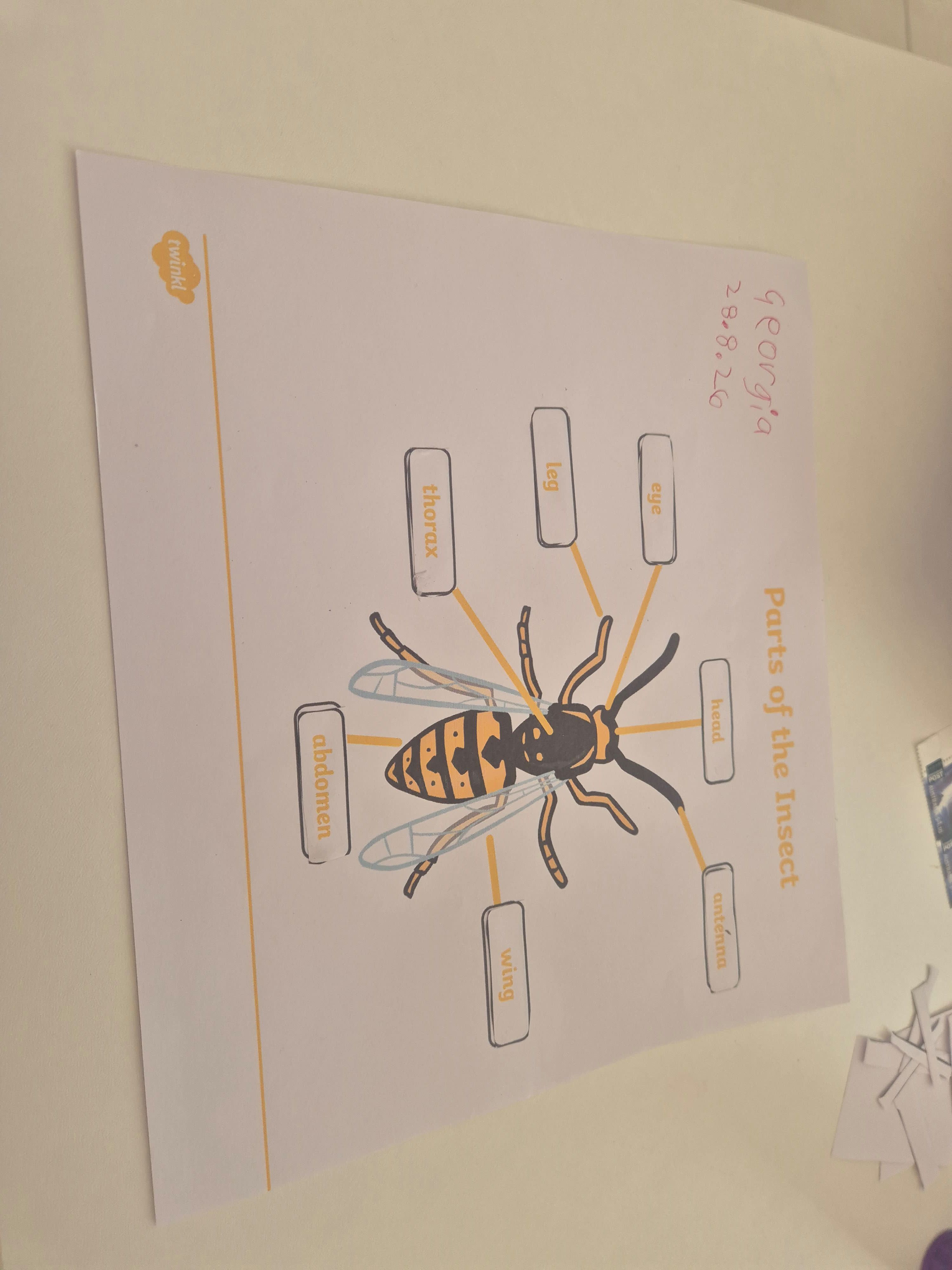
The student revisited an insect body-parts activity and completed diagrams for three insects. The student correctly named all of the required body parts, including labels shown on the worksheet such as the head, thorax, abdomen, legs, and wings. This work strengthened the student’s understanding that insects have identifiable external structures and that labeled diagrams can be used to communicate scientific information. Returning to the activity also gave the student additional practice applying the same scientific vocabulary across multiple insects.
Language Arts
The student practiced reading, recalling, and writing insect-related vocabulary while labeling the diagrams. The student accurately matched scientific words to the corresponding body structures, demonstrating careful attention to word meaning and visual context. Completing labels for three insects provided repeated practice with spelling and using subject-specific vocabulary. The activity also supported clear written communication because each word conveyed precise information about the insect.
Visual Learning and Fine-Motor Skills
The student used visual information from each insect diagram to determine where the labels belonged and completed the written responses on the worksheet. The student coordinated observation, line placement, and handwriting while connecting scientific terms with specific body parts. Working through three insects provided repeated practice in organizing information on a page and following a structured labeling task. The completed work showed sustained attention to accuracy across the activity.
Tips
Tips: Turn this into a short insect-labeling mini-lesson by having the student compare the three completed insects and identify which body parts they shared. Next, invite the student to observe a safe outdoor insect or look at a clear photograph, draw it, and label its head, thorax, abdomen, legs, wings, and any other visible parts. Create a sorting game with body-part cards and insect pictures, asking the student to explain which labels belong together. To reinforce communication, have the student dictate or write three sentences describing how the insect’s body parts helped it move, sense its surroundings, or protect itself, using only observations supported by the picture.
Book Recommendations
- Bugs! Bugs! Bugs! by Bob Barner: A colorful nonfiction picture book that introduces young readers to a variety of insects and encourages close observation of their features.
- The Grouchy Ladybug by Eric Carle: A playful picture book featuring a ladybug and other animals, offering an engaging connection to insect vocabulary, observation, and comparison.
- The Very Hungry Caterpillar by Eric Carle: A well-known story that connects naturally to insect life cycles and provides opportunities to discuss the caterpillar’s body and its transformation.
Try This Next
- Create a three-column comparison worksheet with spaces for head, thorax, abdomen, legs, and wings; have the student record which parts appeared on each insect.
- Ask the student to draw an original insect and label every body part using arrows.
- Make vocabulary cards for insect body parts and play a matching game with insect diagrams.
- Writing prompt: "I can identify an insect because I notice..."