Core Skills Analysis
Phonics and Spelling
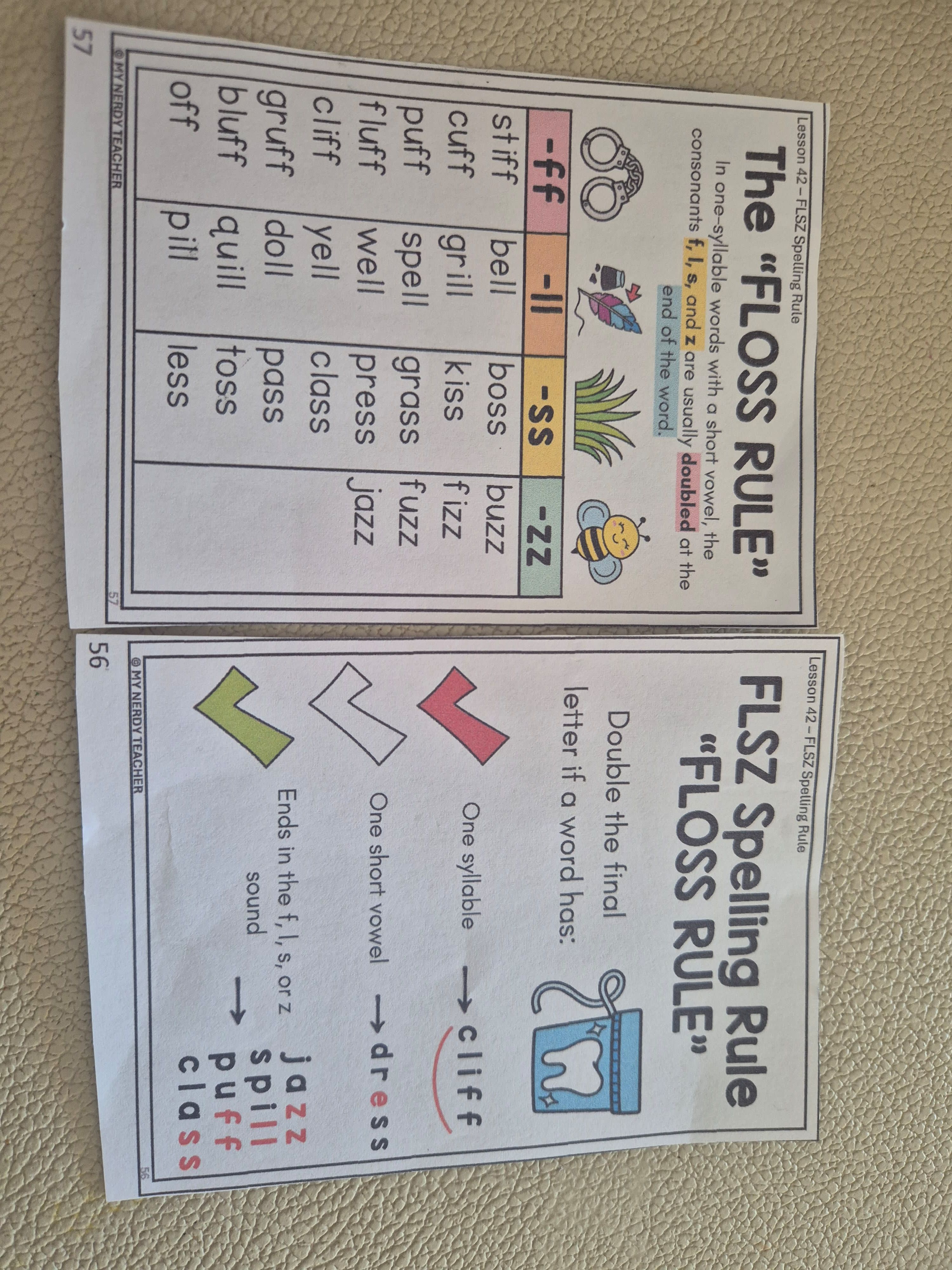
- Georgia reviewed the FLOSS rule: in many one-syllable words with a short vowel, the final consonant sound /f/, /l/, or /s/ is doubled after the vowel, as in “fluff,” “bell,” and “pass.”
- The worksheet also extends the pattern to words ending in doubled “z,” such as “buzz,” “fizz,” “fuzz,” and “jazz.”
- She practiced recognizing short-vowel spelling patterns in words including “cliff,” “spell,” “grass,” and “kiss.”
- The activity strengthened visual word recognition by grouping words according to their final spelling patterns: -ff, -ll, -ss, and -zz.
Language Arts and Reading
- Georgia worked with one-syllable words, reinforcing the connection between syllables, vowel sounds, and word structure.
- She encountered rhyming or near-rhyming word families, including “bell,” “well,” and “yell,” which supports decoding and fluent reading.
- The word list provided practice noticing how changing the beginning sound creates a new word while the ending pattern remains consistent.
- Reading the words aloud would help connect letter patterns with their corresponding sounds, especially the final consonant sounds.
Handwriting
- Georgia practiced forming lowercase letters while writing or reviewing words such as “stuff,” “grass,” “quill,” and “jazz.”
- Copying words with repeated letters gives her practice maintaining consistent letter size, spacing, and alignment across longer letter sequences.
- The activity offers repeated practice with commonly formed lowercase letters, including f, l, s, z, and double-letter combinations.
- Writing the same spelling pattern in several words helps build automaticity and encourages careful attention to each letter.
Learning Behaviors
- Georgia is engaging in focused review rather than encountering the spelling rule only once, which supports retention through repeated practice.
- Working on spelling and handwriting together requires attention to both what a word looks like and how it is produced on the page.
- The structured word groups provide a clear routine for practicing a rule step by step.
- Her continued work on the worksheet suggests an opportunity to build confidence through noticing and correcting spelling patterns.
Tips
Tips: Turn the worksheet into a short word-study lesson by first having Georgia say each word, identify the short vowel, and underline the doubled ending. Next, sort word cards into the -ff, -ll, -ss, and -zz groups, then mix in a few words that do not follow the FLOSS pattern so she can explain why they belong elsewhere. For handwriting practice, invite her to choose three words from each column and copy them carefully, checking letter size, spacing, and alignment. To make the learning experiential, go on a “double-letter hunt” through favorite books or household labels and record words that contain ff, ll, ss, or zz; finish by having Georgia write and illustrate one sentence using a selected word.
Book Recommendations
- Hop on Pop by Dr. Seuss: A playful early-reader book featuring short, rhyming words that supports decoding, word-family recognition, and reading aloud.
- The Cat in the Hat by Dr. Seuss: A familiar beginner-friendly story with rhythmic language and many short, phonics-friendly words for reading-pattern practice.
- Green Eggs and Ham by Dr. Seuss: A highly repetitive story that encourages children to notice spelling patterns, rhyme, and repeated words while building reading fluency.
Try This Next
- Create a sorting worksheet with headings -ff, -ll, -ss, and -zz; have Georgia place words such as “cliff,” “bell,” “grass,” and “fizz” in the correct column.
- Ask: “Which letter is doubled in the word ‘fluff,’ and what short vowel comes before it?”
- Make a handwriting tracing strip for “stuff,” “spell,” “kiss,” and “buzz,” followed by a blank line for independent copying.
- Use word cards to play a matching game: pair words with the same ending pattern, then read each pair aloud.