Core Skills Analysis
Math
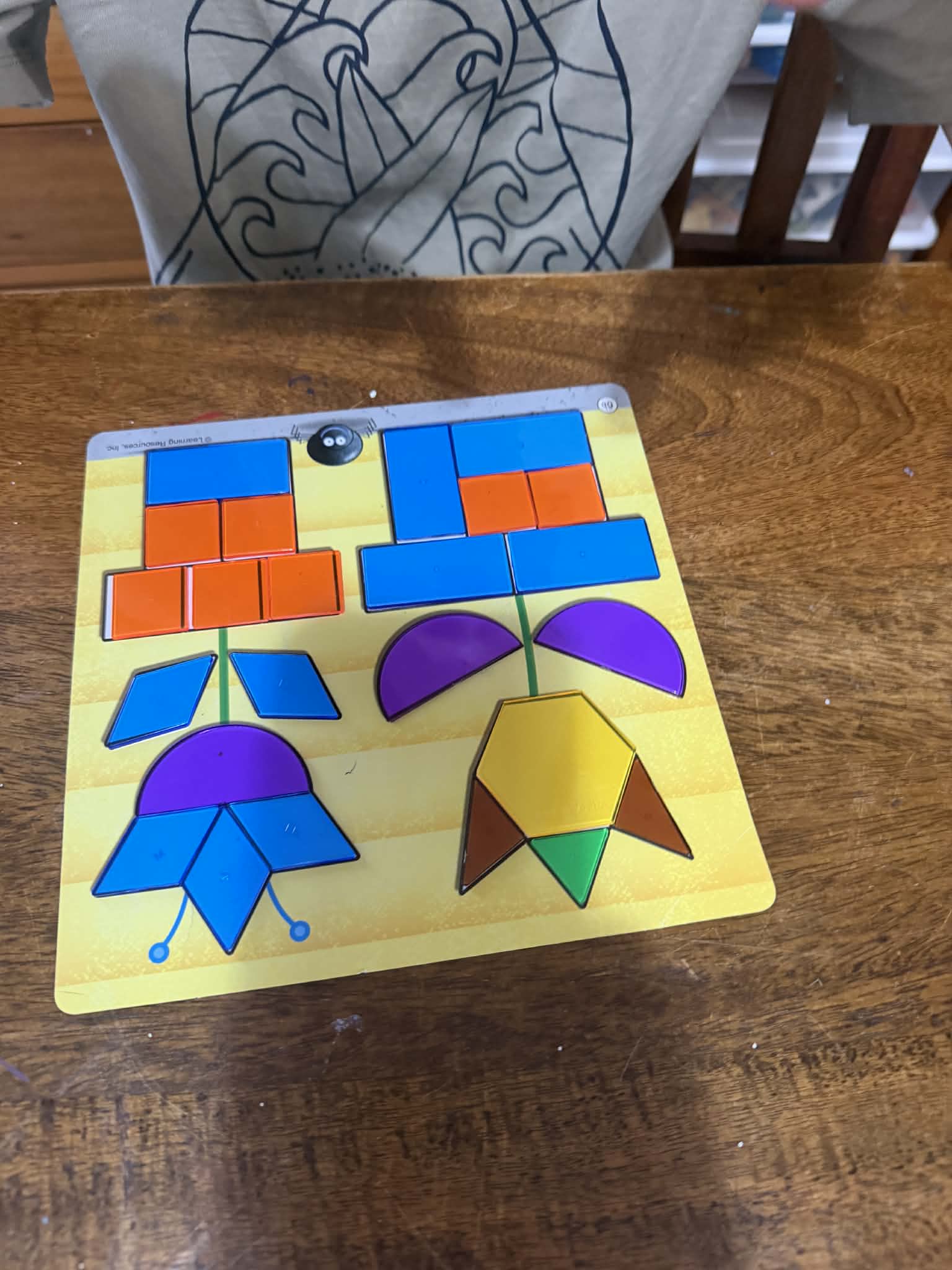
- Rhydan practised spatial reasoning by matching each geometric piece to its correct position in the picture, using visual information about size, shape, orientation and fit.
- Rhydan explored composition and decomposition of shapes by placing smaller pieces together to form larger picture sections, developing an understanding that a whole shape can be partitioned into several parts.
- Rhydan encountered a variety of two-dimensional shapes, including rectangles, quadrilaterals, triangles, semicircles and other polygonal pieces, and could compare their sides, corners and curved edges.
- Rhydan used mathematical classification and quantity language by noticing groups of pieces with different colours and forms, and by considering how many pieces were needed to complete particular sections of the design.
Tips
Tips: Invite Rhydan to draw each completed picture and label the shapes used, including the number of sides and any curved edges. Next, remove one piece from a section and ask Rhydan to predict which shape is missing before testing the idea. Use paper copies of the pieces to create a new animal, object or abstract pattern, then have Rhydan explain which smaller shapes were combined to make each larger part. For an experiential extension, look around the home for examples of the same shapes in architecture, furniture, signs and packaging, discussing how rotating or reflecting a shape changes its position but not its essential properties.
Book Recommendations
- The Greedy Triangle by Marilyn Burns: A playful story that explores how triangles can be transformed into other shapes, supporting discussion of sides, angles and changing geometric forms.
- Sir Cumference and the First Round Table by Cindy Neuschwander: A mathematical adventure that introduces geometric ideas through a story, making shape vocabulary and problem-solving memorable.
- Shapes, Shapes, Shapes by Tana Hoban: A visual exploration of shapes found in everyday environments, encouraging children to identify and compare geometry in the real world.
Learning Standards
- Australian Curriculum v9.0 Mathematics — AC9M3SP01: Supports identifying and describing features of two-dimensional shapes, including sides, vertices and curved boundaries, as Rhydan works with the different puzzle pieces.
- Australian Curriculum v9.0 Mathematics — AC9M3SP02: Connects with classifying and comparing two-dimensional shapes according to geometric properties such as side types, corners and overall form.
- Australian Curriculum v9.0 Mathematics — Spatial reasoning and geometric reasoning: The activity develops visualising, composing, decomposing, rotating and fitting shapes together to create a complete representation.
- Australian Curriculum v9.0 Mathematics — Number and quantity connections: Counting and discussing how many pieces are used in each section provides an opportunity to represent, compare and communicate quantities in a practical context.
Try This Next
- Shape detective worksheet: draw each puzzle piece, name its shape, record its number of sides and identify whether it has curved edges.
- Missing-piece challenge: cover one piece in a completed section and ask Rhydan to sketch or describe the shape that belongs there.
- Create-and-explain task: design a new picture from paper shapes, then write a short explanation of how the smaller pieces combine to make the whole.
- Rotation quiz: show one puzzle piece in three different orientations and ask Rhydan to identify which versions are the same shape.