Core Skills Analysis
English
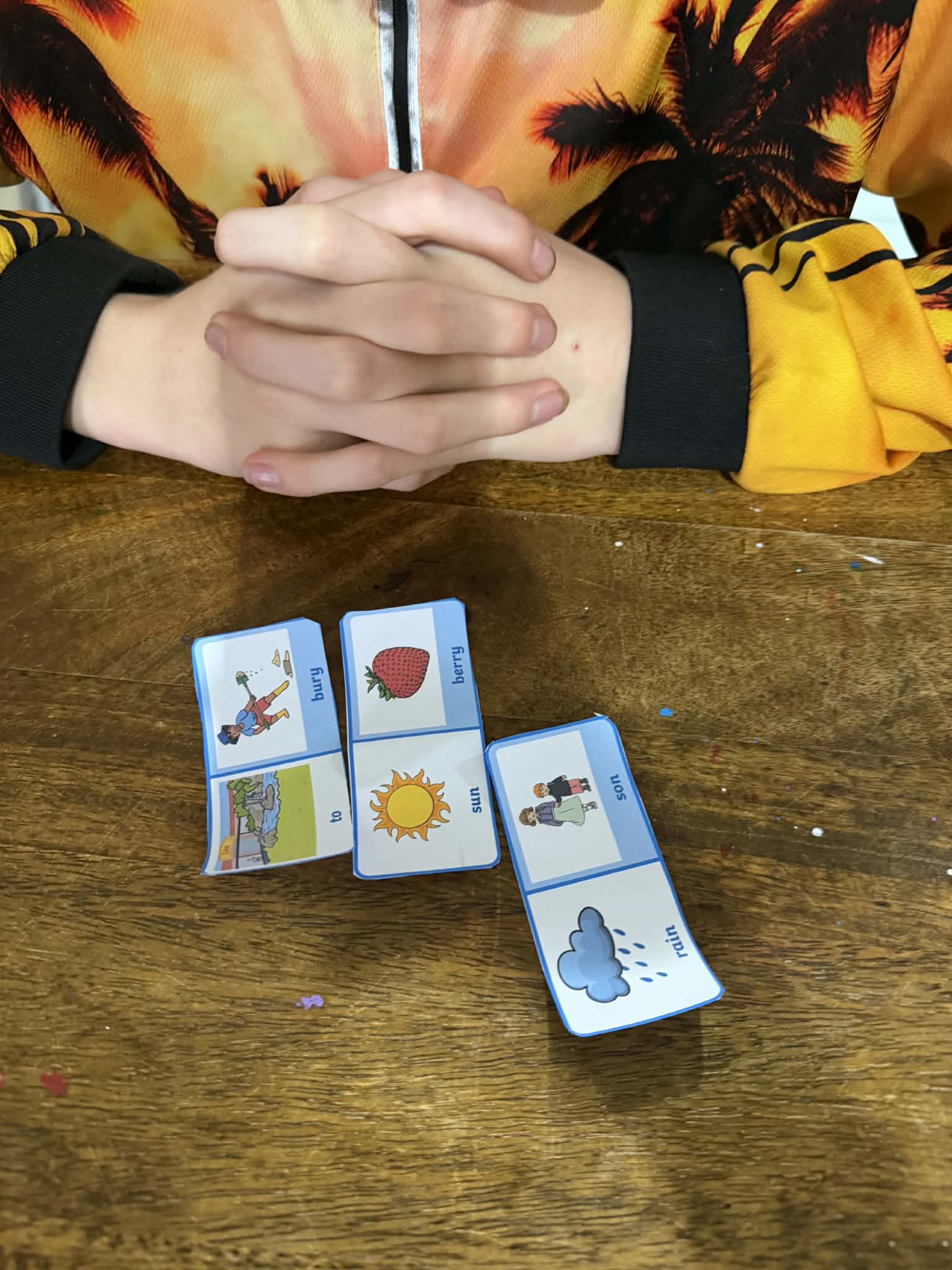
- Rhydan practised identifying homophone pairs: words that sound alike but have different spellings and meanings, such as “sun” and “son” or “rain” and “reign,” as shown on the matching cards.
- Rhydan strengthened spelling awareness by comparing the written forms of words that may sound identical when spoken, noticing that pronunciation alone is not enough to choose the correct spelling.
- Rhydan developed vocabulary and contextual understanding by connecting each word to its picture and meaning, helping distinguish which homophone belongs in a particular sentence or situation.
- Taking turns matching cards supported oral-language skills, careful listening, attention to word meaning, and respectful participation in a shared language activity.
Tips
Tips: Turn the matched pairs into a short sentence-building lesson: ask Rhydan to write one sentence for each word in a homophone pair and underline the context clue that shows its meaning. Next, create a small illustrated homophone dictionary with the spelling, definition, and a drawing for each word. For an experiential extension, go on a “homophone hunt” through books, signs, or household labels and record any examples found. Finish with a playful proofreading challenge in which a few sentences contain incorrect homophones and Rhydan explains how to correct them.
Book Recommendations
- The Word Collector by Peter H. Reynolds: A visually engaging story about collecting and appreciating words, providing a natural bridge to vocabulary exploration and word meanings.
- The Phantom Tollbooth by Norton Juster: A classic fantasy novel filled with wordplay, puns, and imaginative uses of language that can prompt discussion about how words create meaning.
- Frindle by Andrew Clements: A humorous school story about how words are created and adopted, encouraging reflection on vocabulary, language choices, and communication.
Learning Standards
- AC9E7LA01: Connects with understanding how language features, including word choices and vocabulary, shape meaning; Rhydan distinguishes meanings attached to words with the same pronunciation.
- AC9E7LA02: Supports understanding how cohesion and meaning are developed through vocabulary and context; matching a homophone to its picture or situation requires attention to meaning across language and visual cues.
- AC9E7LY06: Relates to creating and editing texts for purpose and audience; the suggested sentence-writing and proofreading extensions apply accurate spelling and word selection in context.
- AC9E7LY07: Connects with using interaction skills in collaborative activities; taking turns, listening carefully, and responding during the matching game support respectful spoken interaction.
Try This Next
- Homophone sentence worksheet: write one meaningful sentence for each word in a pair, such as “sun/son” and “rain/reign.”
- Create illustrated homophone cards with the word, definition, picture, and an original example sentence.
- Homophone detective quiz: choose the correct word to complete short sentences and explain the context clue.
- Make a short comic in which two homophones appear correctly in different speech bubbles.