Core Skills Analysis
English
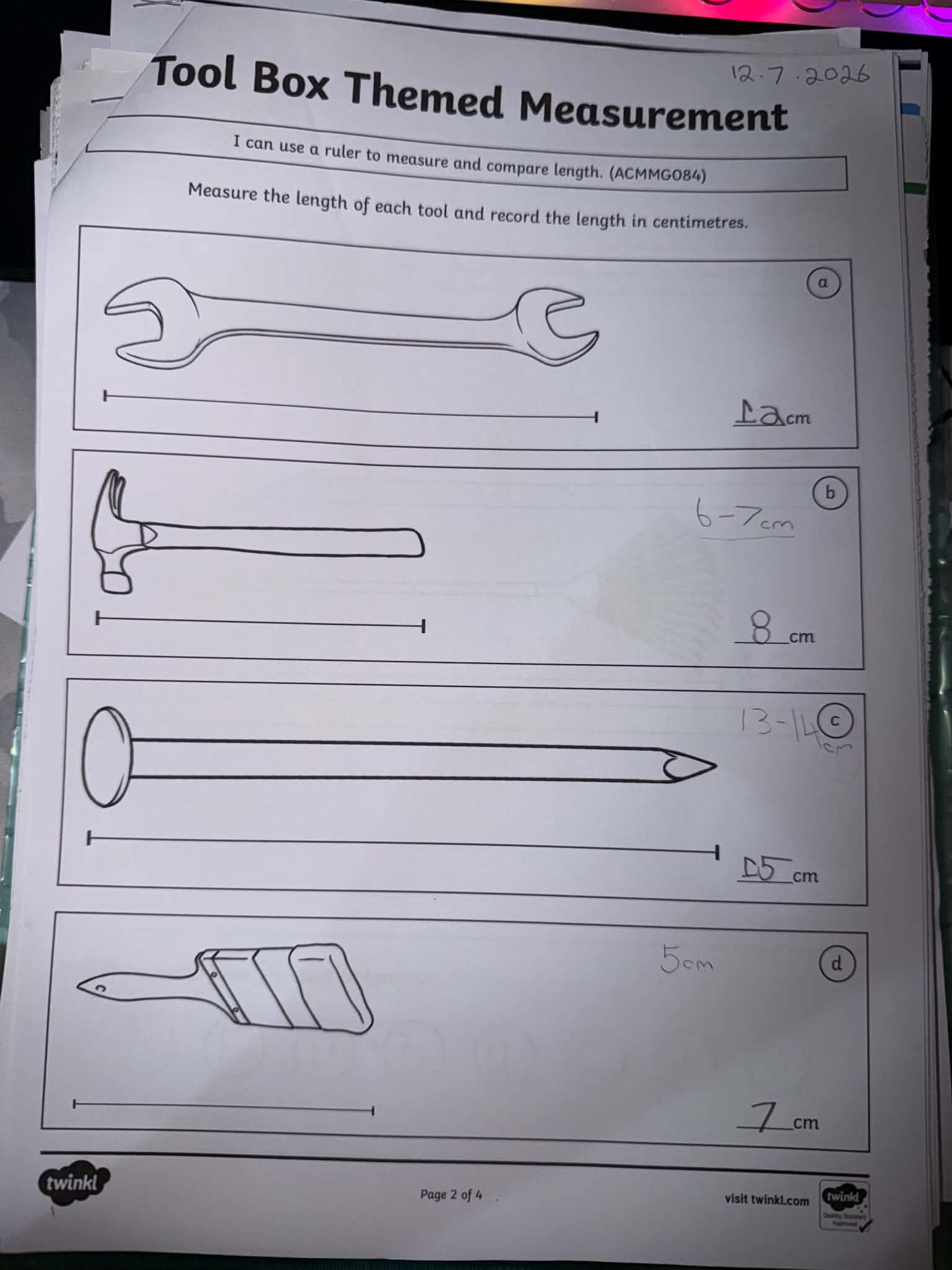
- Rhydan practised using precise measurement vocabulary, including words such as "guess," "measure," "compare," "length," and "centimetres," while discussing the tool-box worksheet.
- By first predicting each tool's length and then checking it with a ruler, Rhydan used spoken language to explain ideas, respond to questions, and communicate whether the measured result matched his estimate.
- Rhydan interpreted visual information from labelled worksheet sections, including the wrench, hammer, pencil, and tape measure, and connected each illustration with a written numerical answer.
- Recording answers such as 8 cm, 15 cm, and 7 cm gave Rhydan practice presenting information clearly using numerals, the abbreviation "cm," and concise written responses.
Tips
Tips: Turn the activity into a short measurement investigation by asking Rhydan to keep a prediction-and-result journal for several household objects. Encourage him to write complete comparison sentences, such as "The pencil was longer than I guessed" or "The hammer was shorter than the wrench." Invite him to sort the tools from shortest to longest and explain his reasoning aloud using comparative vocabulary. For a creative extension, Rhydan could design his own tool-themed worksheet, draw four objects, write measurement clues, and challenge someone else to predict and measure them.
Book Recommendations
- Measuring Penny by Loreen Leedy: A lively picture book in which a child measures a dog in different ways, supporting discussion of measurement language, comparison, recording, and explanation.
- How Big Is a Foot? by Rolf Myller: A humorous story about measuring length and the importance of using consistent units, providing useful vocabulary for prediction and comparison.
- Actual Size by Steve Jenkins: A visual nonfiction book that invites readers to compare real-life sizes and discuss descriptive language, scale, and evidence.
Learning Standards
- Australian Curriculum v9 English – AC9E7LA01: Rhydan used language suited to the activity's purpose, including measurement vocabulary and comparison terms when discussing predictions and results. This match is most appropriate if Rhydan is working at Year 7 level.
- Australian Curriculum v9 English – AC9E7LY02: The discussion required Rhydan to listen to instructions and questions, interpret the task, and communicate responses about the objects and their measured lengths.
- Australian Curriculum v9 English – AC9E7LY06: Rhydan recorded information from a visual worksheet using concise written answers, numerals, and the conventional abbreviation "cm." This connection is strongest when the written recording is treated as an informative text.
- Australian Curriculum v9 Mathematics – AC9M4M01: Although the requested subject focus is English, the activity directly aligns with measuring and comparing length using centimetres and a ruler. The worksheet itself identifies the related code as ACMMG084, an earlier Australian Curriculum code.
Try This Next
- Create a prediction-versus-result table with columns for object, estimated length, measured length, and a sentence explaining the difference.
- Write five comparison sentences using the measured tools, including "longer than," "shorter than," "about the same length as," and "I estimated..."
- Design a new tool-themed worksheet with four drawings, centimetre answer lines, and a short instruction paragraph.
- Make a vocabulary quiz matching measurement words such as estimate, ruler, length, compare, centimetre, shortest, and longest to their meanings.