Core Skills Analysis
Language Arts
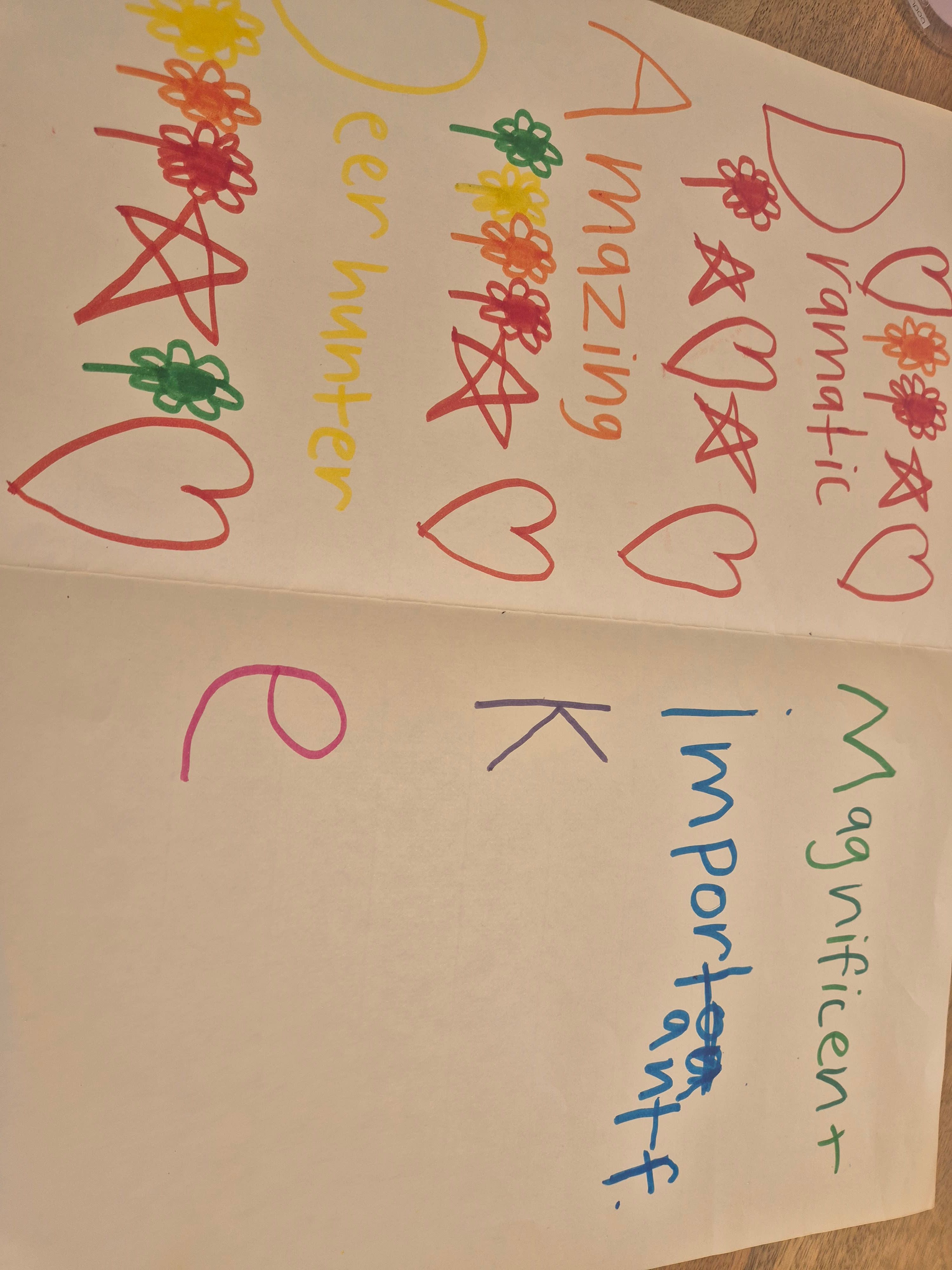
- Georgia practiced composing an acrostic poem, using the letters of a word or phrase to organize ideas in a structured format.
- The activity supported purposeful writing because the poem and cards were created for a real audience: her father.
- The visible marks include repeated letter-like forms and partial written words, showing opportunities to develop handwriting, letter formation, and communicating meaning through print.
- Creating cards encouraged Georgia to connect pictures, symbols, and written messages to express a personal idea.
Visual Arts
- Georgia explored line, shape, and color through flowers, stars, large curved forms, and other colorful drawings.
- The repeated flower designs show experimentation with pattern and variation while using different marker colors.
- The drawings combine recognizable forms with imaginative marks, allowing Georgia to communicate visually without needing every image to be realistic.
- Making several different presents—drawings and cards—gave her practice choosing how to represent an idea for a particular person.
Mathematics
- The flower drawings provide an informal opportunity to notice and count repeated parts, such as petals or interior shapes.
- Georgia explored geometric ideas by drawing stars, triangles, circles, curved lines, and enclosed shapes.
- The repeated motifs can support early pattern recognition, including comparing which designs have more petals, lines, or repeated elements.
- The page layout invites discussion of position and spatial language, such as above, below, beside, inside, and around.
Social-Emotional Learning
- Preparing Father's Day presents shows intentional effort directed toward celebrating and appreciating a family member.
- Making multiple kinds of gifts—an acrostic poem, drawings, and cards—gave Georgia several ways to communicate care and personal meaning.
- The activity likely supported ownership and pride because Georgia created original work rather than completing a single prescribed product.
- Choosing colors, shapes, and messages encouraged personal expression within a warm, relationship-centered project.
Fine-Motor and Early Design Skills
- Using markers to create repeated petals, straight lines, curves, and enclosed shapes supported hand control and coordination.
- Filling in flower centers and coloring larger areas gave practice with pressure, direction, and sustained tool use.
- Arranging drawings and writing across the paper involved early planning of space and visual balance.
- Switching among writing, drawing, and card-making tasks encouraged flexibility and coordination between visual attention and hand movement.
Tips
Tips: Turn the project into a short keepsake lesson by inviting Georgia to read or dictate the acrostic poem aloud and explain how each line connects to her father. Together, count the petals on several flowers, sort the drawings by color or shape, and create a simple picture graph of the results. Ask her to choose one drawing and add a beginning, middle, and ending to make a tiny story about the picture. Finally, let her design one finished card with a front illustration, an inside message, and her name, emphasizing that thoughtful communication matters more than perfect spelling or drawing.
Book Recommendations
- Just Me and My Dad by Mercer Mayer: A gentle picture book about a young child and father sharing an outdoor adventure, making it a natural connection to celebrating a dad.
- My Dad by Anthony Browne: A playful picture book in which a child describes the many wonderful qualities of a father, inspiring conversation and personalized messages.
- A Perfect Father's Day by Eve Bunting: A warm Father's Day story that can prompt discussion about gifts, family traditions, and meaningful ways to show appreciation.
Try This Next
- Acrostic worksheet: Write FATHER or DAD vertically and add one describing word or phrase for each letter.
- Petal-counting challenge: Choose three flower drawings, count their petals, and record the totals in a simple table.
- Card-design task: Divide a page into front and inside sections; add an illustration to the front and a two-sentence message inside.
- Picture-story prompt: Choose one drawing and write or dictate what happens before, during, and after the scene.