Core Skills Analysis
Visual Arts
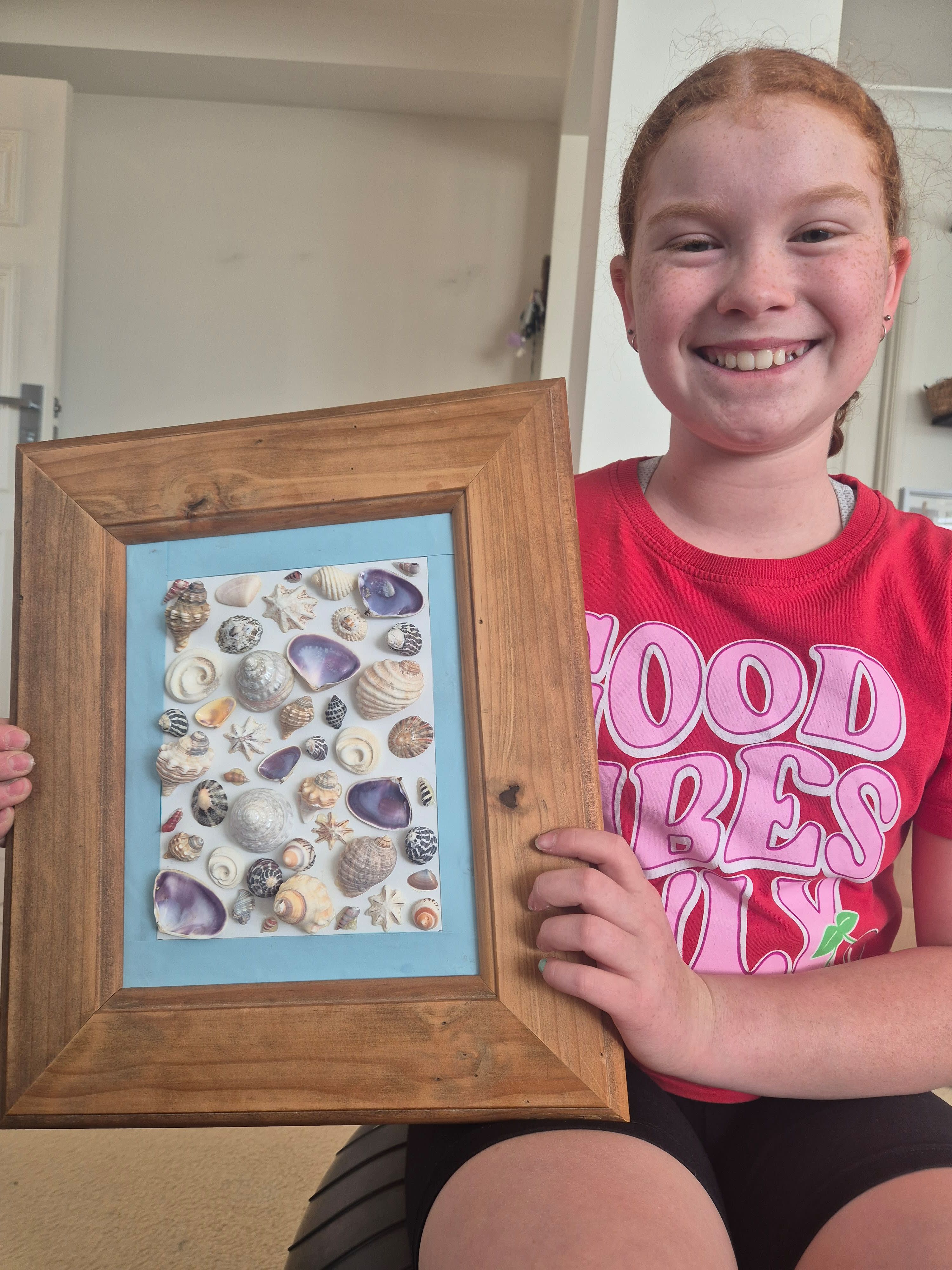
- The activity demonstrates creative composition through the arrangement of many shells within a framed artwork.
- The student explored natural textures, spiral patterns, varied shapes, and contrasting colors such as cream, gray, brown, purple, and orange.
- The finished piece shows attention to presentation by placing the shell collection against a blue background and surrounding it with a wooden frame.
- The student appears to take pride in displaying the completed artwork, supporting confidence and ownership of the creative process.
Science
- The shell collage provides an opportunity to observe differences among shells, including size, shape, ridges, openings, thickness, and surface patterns.
- The student can begin distinguishing shells from different kinds of marine animals, such as snails, clams, and other mollusks, while recognizing that shells are natural structures.
- The visible spiral forms support early discussions about growth patterns and how some shells become larger as the animal grows.
- The variety of shells encourages careful observation, classification, and questions about where shells are found and how they are formed.
Mathematics
- The artwork offers practice with sorting objects by observable attributes, including color, size, shape, texture, and pattern.
- The student can compare shells using mathematical language such as larger, smaller, wider, narrower, smoother, rougher, and more heavily ridged.
- Counting the shells or grouping them into categories can build one-to-one correspondence, addition, and data-organization skills.
- The rectangular frame and repeated shell arrangements create opportunities to discuss position, rows, symmetry, spacing, and two-dimensional shapes.
Language Arts
- Presenting the artwork creates an opportunity for the student to describe the materials, colors, patterns, and choices made during the project.
- The student can practice sequencing language by explaining how the shells were selected, arranged, and displayed.
- Naming shell features and describing similarities and differences develops precise vocabulary and oral communication.
- The completed piece can serve as a prompt for a short narrative, such as imagining a journey taken by one shell from the ocean to the artwork.
Social-Emotional Learning
- The student's broad smile while displaying the framed artwork suggests enjoyment, pride, and engagement with the finished creation.
- Completing and presenting a personal art project can strengthen persistence, self-expression, and confidence.
- Choosing how to arrange natural objects supports decision-making and a sense of creative independence.
- Sharing the artwork with another person encourages positive communication, celebration of effort, and appreciation of personal accomplishments.
Tips
Tips: Turn the artwork into a mini shell investigation by inviting the student to choose three shells, sketch them, measure or compare them, and record their similarities and differences. Create a simple sorting chart using categories such as color, spiral shape, or texture, then count each group and make a picture graph. Read a nonfiction book about shells or ocean animals and encourage the student to label a drawing with newly learned vocabulary. Finally, ask the student to give a short “gallery talk” explaining the title of the artwork, the arrangement choices, and one thing they are especially proud of; keep the emphasis on curiosity, observation, and personal creativity.
Book Recommendations
- A House for Hermit Crab by Eric Carle: A colorful story about a hermit crab that decorates and changes its shell, connecting naturally with shell observation, animal homes, and creative design.
- Seashells by the Seashore by Marianne Berkes: An engaging counting and nature book that introduces children to different seashells while reinforcing observation and early mathematical thinking.
- Hello Ocean by Pam Muñoz Ryan: A lyrical exploration of the ocean through the senses, offering a strong connection to the colors, textures, and natural setting represented in the artwork.
Try This Next
- Shell sorting worksheet: classify pictured shells by size, color, texture, and spiral pattern, then count each category.
- Observation journal: draw one shell and label its shape, ridges, opening, color, and texture.
- Gallery-talk prompt: “My artwork is called ____. I arranged the shells this way because ____.”
- Design challenge: create a paper shell collage using repeating patterns and at least three different textures.