Core Skills Analysis
Mathematics
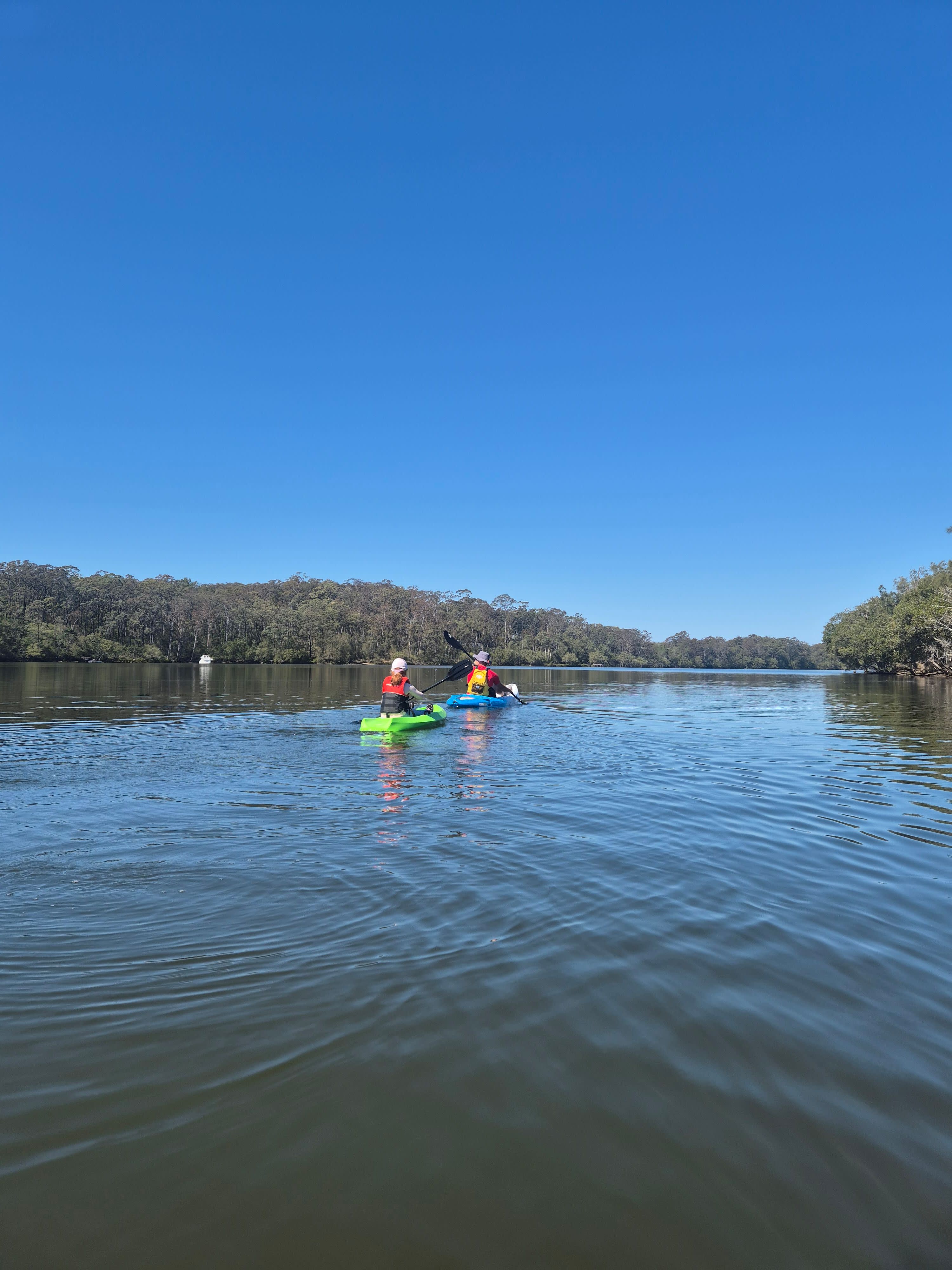
- The learner practiced thinking about distance by discussing how far the kayaks travelled along the Karuah River.
- The activity connected direction words—such as forward, backward, left, and right—to real movement on the water.
- Paddling provided an opportunity to compare travel distances and consider how the route taken affected the journey.
- The learner encountered practical measurement concepts in an authentic outdoor setting rather than only through written exercises.
Science
- The learner explored how river currents can influence the movement of a kayak and affect the effort needed to travel.
- The discussion introduced distinctions among rivers, lakes, and ocean inlets as different types of water environments.
- Observing the water, shoreline, and surrounding forest supported firsthand attention to features of a natural ecosystem.
- The activity encouraged cause-and-effect thinking about how moving water and paddling interact.
Geography
- The learner used a real landscape to understand how waterways form routes through the environment.
- The Karuah River provided a concrete context for discussing spatial relationships, including direction, distance, and position.
- Comparing rivers, lakes, and ocean inlets helped develop an early understanding of different geographic water features.
- The kayak journey connected map-related ideas to physical experience by making movement through a waterway observable.
Physical Education
- Kayaking involved repeated upper-body movements, coordination, and controlled use of a paddle.
- The learner practiced sustaining physical effort while travelling across the river.
- Steering and moving a kayak required attention to body position, paddle direction, and the changing movement of the water.
- Participating alongside another kayaker offered a visible experience of shared outdoor recreation.
Language Arts
- The learner developed topic-specific vocabulary connected with waterways, including river, lake, ocean inlet, current, direction, and distance.
- Talking about the journey supported oral language through describing where the kayaks went and how they moved.
- The experience provided material for sequencing events from the start of the outing to the end.
- Discussing observations from the river encouraged the learner to communicate real-world details and explanations.
Tips
Tips: Turn the outing into a short field-study lesson by having the learner draw the route taken and label the starting point, direction, approximate distance, and any noticeable changes in the current. Compare a river, lake, and ocean inlet using a simple three-column chart, recording how water movement and surrounding features may differ based only on observations and research. For a creative extension, make a paper or foil kayak and test how its shape, weight, and paddle design affect movement in a tub or shallow container of water. Finish with a brief journal entry or spoken retelling that uses the new waterway vocabulary and explains one way the current influenced the journey.
Book Recommendations
- Paddle-to-the-Sea by Holling C. Holling: A beautifully illustrated journey following a carved figure as it travels through waterways toward the ocean, making it a strong connection to rivers, currents, distance, and direction.
- A River by Marc Martin: A visually rich picture book that follows a river through changing landscapes and invites discussion about waterways, geography, and observation.
- The Raft by Jim LaMarche: A story about a child spending time on a river and noticing the natural world, offering connections to outdoor exploration and river habitats.
Try This Next
- Create a route-mapping worksheet with boxes for starting point, direction travelled, estimated distance, current observations, and ending point.
- Make a three-way waterway sorting chart: river, lake, or ocean inlet; add a drawing and two facts for each.
- Write three quiz questions using the words current, distance, direction, and inlet.
- Design and test two small paper boats, then record which design travels farther or stays straighter in moving water.