Core Skills Analysis
Mathematics
- The learner applied spatial reasoning by discussing the direction of travel on the Karuah River.
- The activity connected movement with distance, creating an authentic context for estimating, comparing, or recording how far the kayaks travelled.
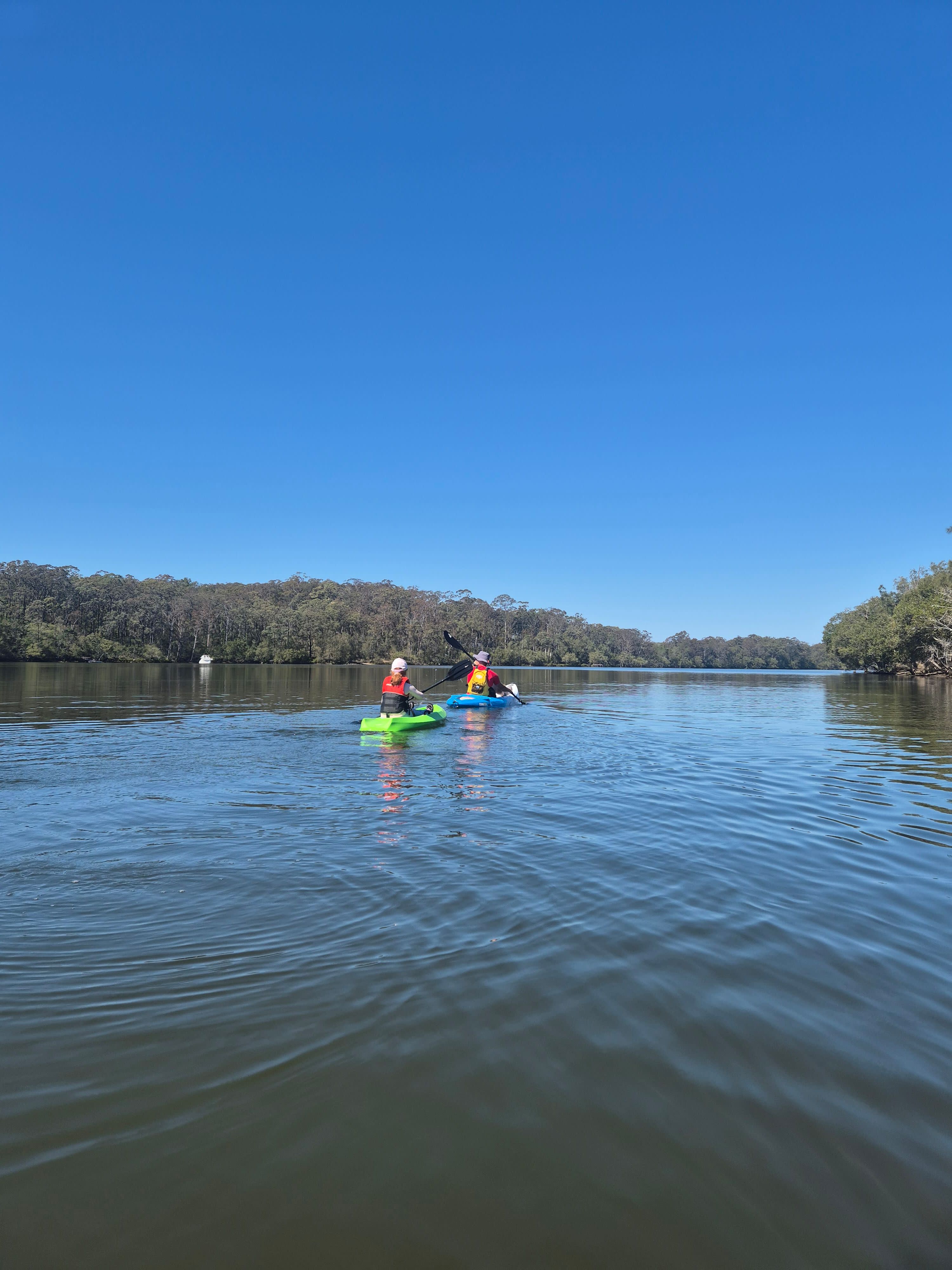
- Observing the kayaks’ changing position on the river supported early ideas about routes, landmarks, and measuring travel.
- The learner encountered practical problem-solving: considering how the river’s movement might affect the planned direction and distance.
Science
- The learner explored how currents can influence the movement of a kayak through water.
- The river setting provided a direct example of a flowing freshwater system and encouraged observation of moving and still water.
- The discussion of rivers, lakes, and ocean inlets introduced comparisons between different types of waterways.
- The visible ripples and wake behind the kayaks offered an opportunity to notice how objects and paddles disturb the water’s surface.
Geography
- The learner studied the Karuah River as a real local landscape rather than only encountering rivers through books or maps.
- Talking about direction and distance supported basic map-reading and geographic-navigation concepts.
- The activity introduced the idea that rivers connect with other bodies of water, including lakes and ocean inlets.
- The surrounding forest and shoreline helped the learner observe how waterways exist within and shape a larger natural environment.
Physical Education
- Kayaking provided practical experience with coordinated upper-body movement, paddling, balance, and control.
- The learner practiced adjusting movement in response to the direction of the kayak and the river’s current.
- Travelling alongside another kayak created a natural setting for pacing, cooperation, and shared outdoor participation.
- The activity encouraged sustained physical engagement in an outdoor environment.
Language Arts
- The learner used or encountered subject-specific vocabulary such as direction, distance, currents, rivers, lakes, and ocean inlets.
- Discussing the journey creates a meaningful basis for sequencing events from departure to travel and return.
- The experience can support descriptive language about the water’s movement, the forested shoreline, and the appearance of the kayaks.
- Explaining how the current affected travel would develop cause-and-effect speaking and writing.
Tips
Tips: Turn the outing into a short field-study lesson by drawing the route travelled and adding arrows to show direction, current, and any stops. Invite the learner to estimate the distance first, then compare the estimate with a map, GPS reading, or marked route if one is available. Create a simple comparison chart for a river, lake, and ocean inlet, recording how each looks, moves, and connects to other waterways. Finish with a reflective journal entry beginning, “The current affected our journey because…” Encourage the learner to include observations rather than guesses, helping build careful scientific thinking while preserving the enjoyment of the outdoor experience.
Book Recommendations
- A River by Marc Martin: A richly illustrated journey that follows a river through changing landscapes and encourages close observation of waterways and their surroundings.
- We Are Water Protectors by Carole Lindstrom: A lyrical picture book that encourages appreciation, respect, and care for water and the natural environments connected to it.
- National Geographic Kids: Rivers by Kathleen Weidner Zoehfeld: An accessible nonfiction introduction to rivers, including how they move, where they flow, and why they matter.
Try This Next
- Route-mapping worksheet: draw the journey, label direction arrows, and mark estimated distances.
- Waterway comparison chart: compare a river, lake, and ocean inlet by movement, shape, and connections.
- Current investigation: float a leaf or small stick in a safe, supervised water setting and record its direction and travel time.
- Writing prompt: “Our kayak journey changed when we noticed the current…”