Core Skills Analysis
English Language Arts
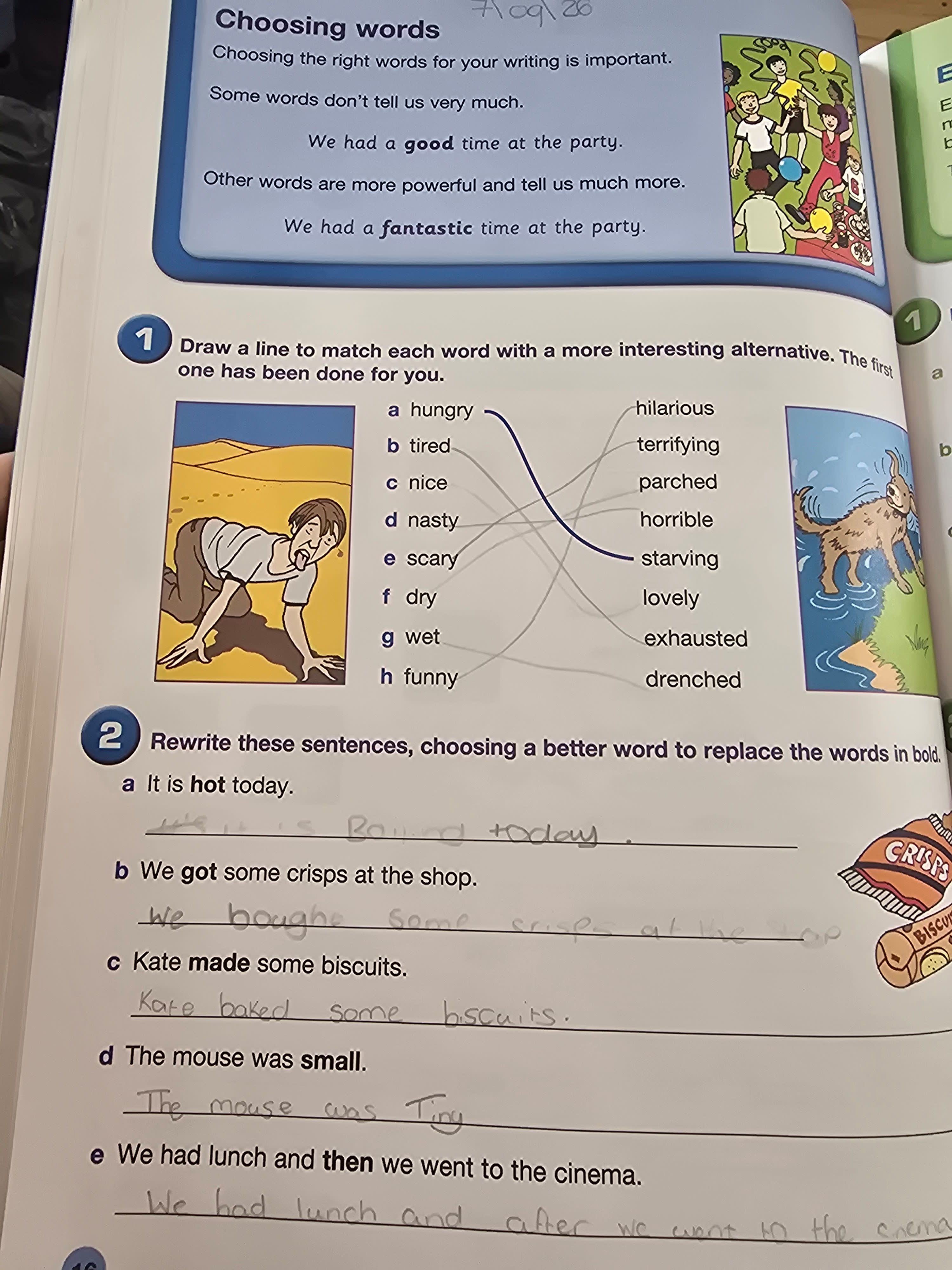
The student learned that choosing precise and interesting words can make writing more vivid and informative. She matched ordinary words such as "hungry," "tired," "nice," "nasty," "scary," "dry," "wet," and "funny" with stronger alternatives, including "starving," "exhausted," "lovely," "horrible," "terrifying," "parched," "drenched," and "hilarious." She also rewrote sentences by replacing simpler words with more specific vocabulary, such as changing "hot" to a stronger description and describing the mouse as "tiny." Through sentences about crisps, biscuits, lunch, and going to the cinema, she practiced applying new vocabulary in context while developing sentence-writing and handwriting skills.
Tips
Tips: Continue the lesson by creating a personal word ladder in which the student arranges words from mild to powerful, such as warm, hot, boiling, and scorching. Invite her to describe a familiar object, meal, or outing twice—first with simple words and then with more precise vocabulary—and discuss which version creates a clearer picture. During shared reading, pause to collect interesting adjectives and verbs, then use a thesaurus or child-friendly dictionary to find alternatives and check that each word fits the sentence. Finish with a short vocabulary game in which one person acts out a word such as exhausted or hilarious while the other guesses it and uses it in a sentence.
Book Recommendations
- The Word Collector by Peter H. Reynolds: A warmly illustrated story about a child who collects words and discovers how powerful and meaningful language can be.
- The Boy Who Loved Words by Roni Schotter: A story about a boy who enjoys collecting words and learns how vocabulary can help him connect with others.
- The Right Word: Roget and His Thesaurus by Jennifer Fisher Bryant: A picture-book biography explaining how Peter Mark Roget organized words and created the thesaurus.
Try This Next
- Create a word-strength worksheet with columns for ordinary, stronger, and strongest words; include examples such as tired, exhausted, and completely worn out.
- Write five simple sentences about a party, meal, or day out, then revise each sentence by replacing one ordinary word with a more precise alternative.
- Make synonym cards for words such as hungry, wet, funny, and scary; have the student match each card to its stronger alternative and use the pair in a sentence.
- Draw a picture of a tiny mouse, a drenched person, or a hilarious scene and label the drawing with at least five vivid describing words.