Core Skills Analysis
English Language Arts
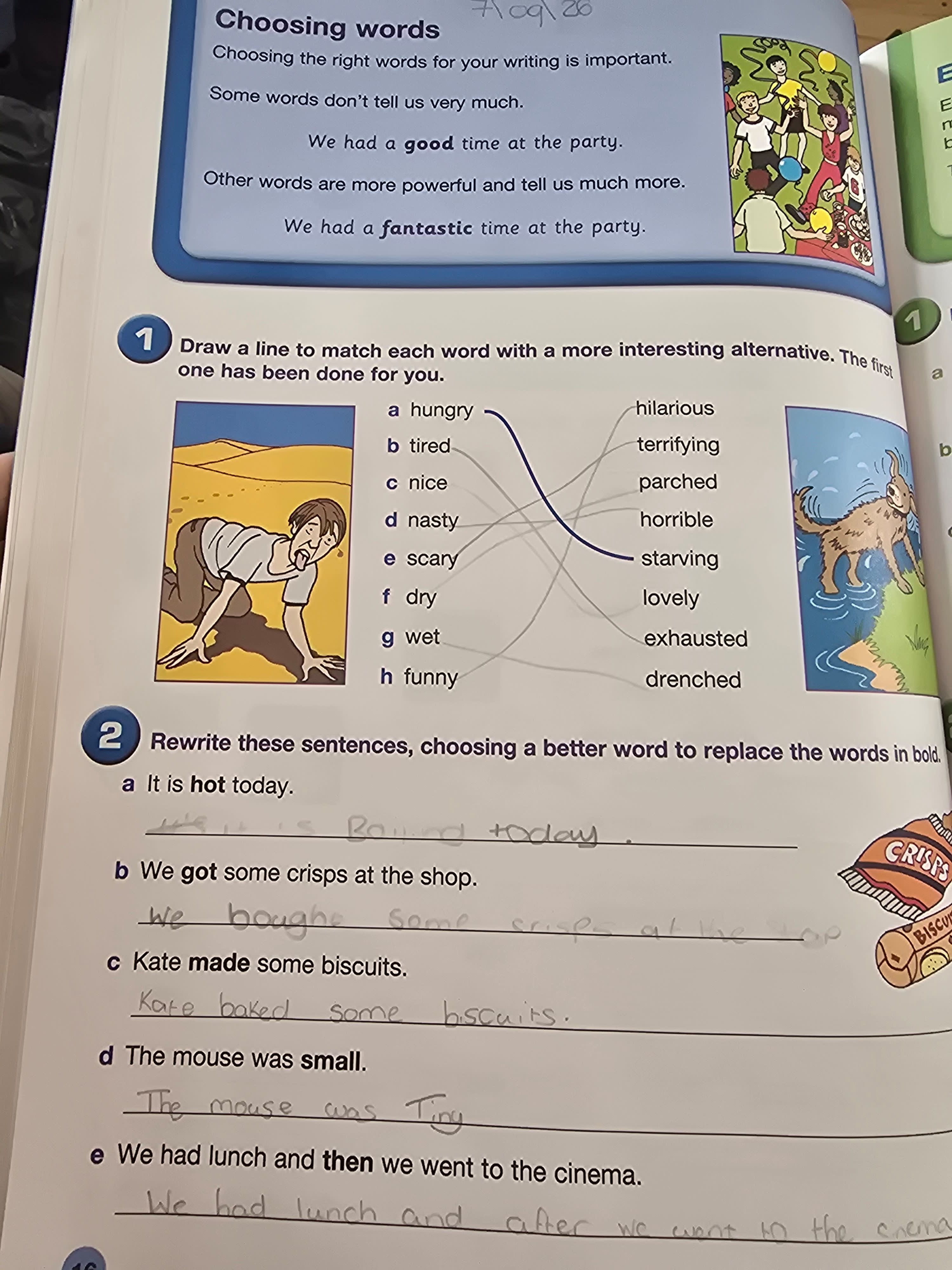
The learner studied how choosing more precise and powerful words could make writing more interesting. She matched ordinary words such as "hungry," "tired," "nice," "scary," and "funny" with stronger alternatives including "starving," "exhausted," "lovely," "terrifying," and "hilarious." She then rewrote sentences by replacing general words with more specific vocabulary, including changing "hot" to "boiling" and describing the mouse as "tiny." This activity helped her understand that carefully selected adjectives and descriptive words could communicate clearer images and stronger feelings.
Vocabulary and Word Choice
The learner explored shades of meaning by comparing everyday words with more vivid alternatives. She encountered vocabulary such as "parched," "drenched," "horrible," and "fantastic," and connected these words to familiar ideas about being dry, wet, unpleasant, or enjoyable. By considering which replacement best fit each sentence, she practiced using context to determine meaning rather than treating words as isolated spellings. She also began building a richer vocabulary that could make future stories and descriptions more expressive.
Writing and Handwriting
The learner applied her vocabulary choices in complete rewritten sentences rather than only copying individual words. Her written responses showed practice with sentence structure, spacing, capital letters, and end punctuation while she recorded ideas such as a boiling day, bought crisps, baked biscuits, a tiny mouse, and a cinema visit. She extended some of the original sentences with additional details, which supported clearer communication. The activity gave her practice transferring a language rule from the example section into her own written work.
Tips
Tips: Turn this lesson into a "word upgrade" mini-workshop by choosing ordinary words from a familiar story, conversation, or daily journal and brainstorming three increasingly vivid alternatives for each one. Invite the learner to act out pairs such as "tired" and "exhausted" or draw scenes for "wet" and "drenched" so she can notice differences in intensity and meaning. Next, create a five-sentence sensory description of a snack, a rainy day, or a trip to the cinema, requiring one precise adjective in every sentence. Finally, read the description aloud together and discuss whether each word gives the reader a clear picture, celebrating effective choices and revising any word that feels too vague or too strong.
Book Recommendations
- The Word Collector by Peter H. Reynolds: A warm picture book about a child who collects interesting words and discovers how powerful language can be.
- Frindle by Andrew Clements: A humorous chapter book showing how words are created, shared, and given meaning.
- The Boy Who Loved Words by Roni Schotter: A story about a child who loves collecting words and learns how language can connect people.
Try This Next
- Create a word-upgrade worksheet with columns for a basic word, a stronger alternative, a definition, and a sentence using the new word.
- Make adjective intensity cards—for example, warm, hot, boiling—and arrange each set from least strong to most strong.
- Write a five-sentence picture description using at least one vivid adjective and one precise verb in every sentence.
- Complete a vocabulary quiz by matching words such as parched, drenched, exhausted, and hilarious to their meanings.