Core Skills Analysis
Physical Education
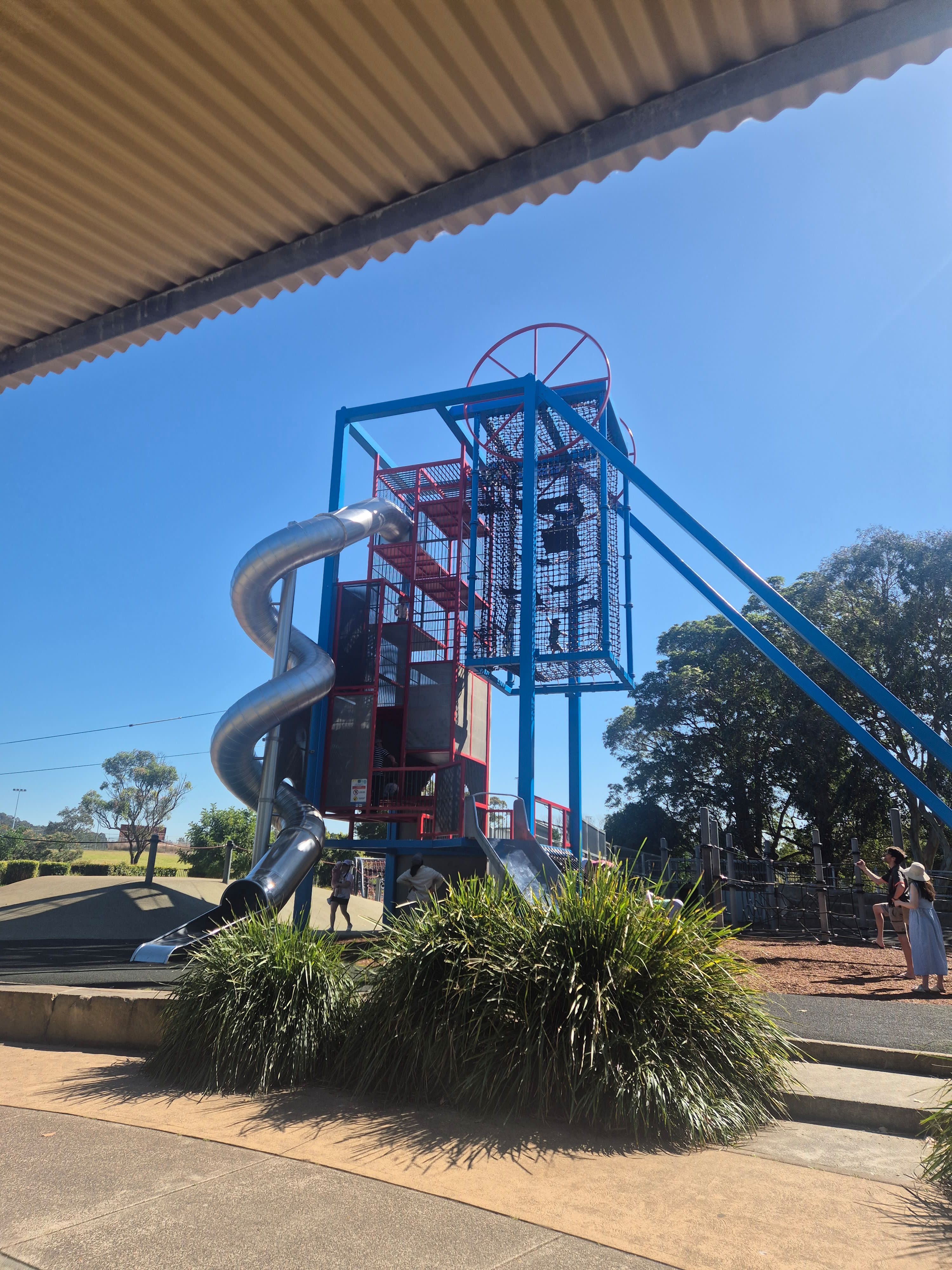
- The large playground structure offers opportunities to develop gross-motor skills through climbing, sliding, walking, balancing, and navigating different levels.
- Climbing nets, platforms, ladders, and slides can challenge body coordination, core strength, agility, and spatial awareness.
- Using playground equipment encourages children to notice their own physical limits and practice safe movement around structures and other visitors.
- The visit supports active outdoor play, which can build endurance and confidence through movement.
Science
- The slides provide a natural way to observe gravity, as a person moves from a higher platform toward the ground.
- Children can investigate how surface materials affect movement by comparing the smooth metal slide with textured climbing nets and solid platforms.
- The image shows strong sunlight, shadows, trees, and planted grasses, creating opportunities to observe how light interacts with outdoor objects.
- The equipment demonstrates how different materials—metal, rope, mesh, and painted structural beams—can be combined to create a safe play environment.
Mathematics
- The playground contains recognizable geometric forms, including circular rings, straight beams, rectangles, curves, and repeating grid patterns.
- Children can practice counting by tallying slides, platforms, ladders, poles, rings, or sections of climbing mesh visible in the structure.
- The tall equipment invites comparisons involving height, length, distance, and position, such as higher versus lower platforms or longer versus shorter slides.
- The structure supports spatial-language practice with terms such as above, below, beside, inside, outside, through, around, and under.
Language Arts
- The visit provides concrete vocabulary for describing playground features, including tower, slide, platform, railing, net, tunnel, ring, beam, shade, and garden.
- A child can organize an oral or written recount by describing what was seen first, next, and last during the park visit.
- The unusual height and many connected parts of the equipment encourage detailed observation and descriptive sentences using color, shape, size, texture, and action words.
- A drawing paired with labels or a short caption would connect visual observation with early informational writing.
Social-Emotional Learning
- A busy playground setting offers practice in noticing shared-space expectations, including waiting, moving carefully, and allowing others room to play.
- The variety of equipment can support choice-making as children decide which challenges feel comfortable and which they may want to attempt later.
- Outdoor exploration can encourage curiosity, independence, and persistence when a structure requires more than one attempt to navigate.
- Because the image does not show the child's feelings or specific actions, emotional responses should be discussed through open questions rather than assumed.
Tips
Tips: Turn the park visit into a short investigation by inviting the child to sketch the playground and label its shapes, materials, and parts. Compare the different routes through the structure and discuss which features might make movement easier or harder, using words such as friction, balance, height, and gravity. Afterward, create a simple sequence map showing the visit from arrival to departure, then encourage the child to dictate or write a few descriptive sentences. For a creative extension, design a safer or more exciting playground on paper using at least three shapes, two types of equipment, and one feature for shade or plants.
Book Recommendations
- Maisy Goes to the Playground by Lucy Cousins: A colorful picture book about Maisy's active exploration of playground equipment, making it a natural connection to visiting and describing a park.
- Rosie's Walk by Pat Hutchins: A classic story that encourages children to follow movement, direction, sequence, and positional words while observing an outdoor journey.
- The Playground by James Ransome: A visually rich picture book celebrating the sights, movement, and imaginative possibilities of a playground.
Try This Next
- Playground Shape Hunt worksheet: draw or list circles, rectangles, curves, straight lines, and repeating patterns seen in the equipment.
- Science prompt: “Why do you think a person moves down a slide? What might make one slide feel faster or slower?”
- Design challenge: draw a new playground with two slides, one climbing feature, three geometric shapes, and a shaded rest area.
- Movement-and-map activity: create a simple route using arrows and label locations as above, below, beside, inside, and around.