Core Skills Analysis
Science
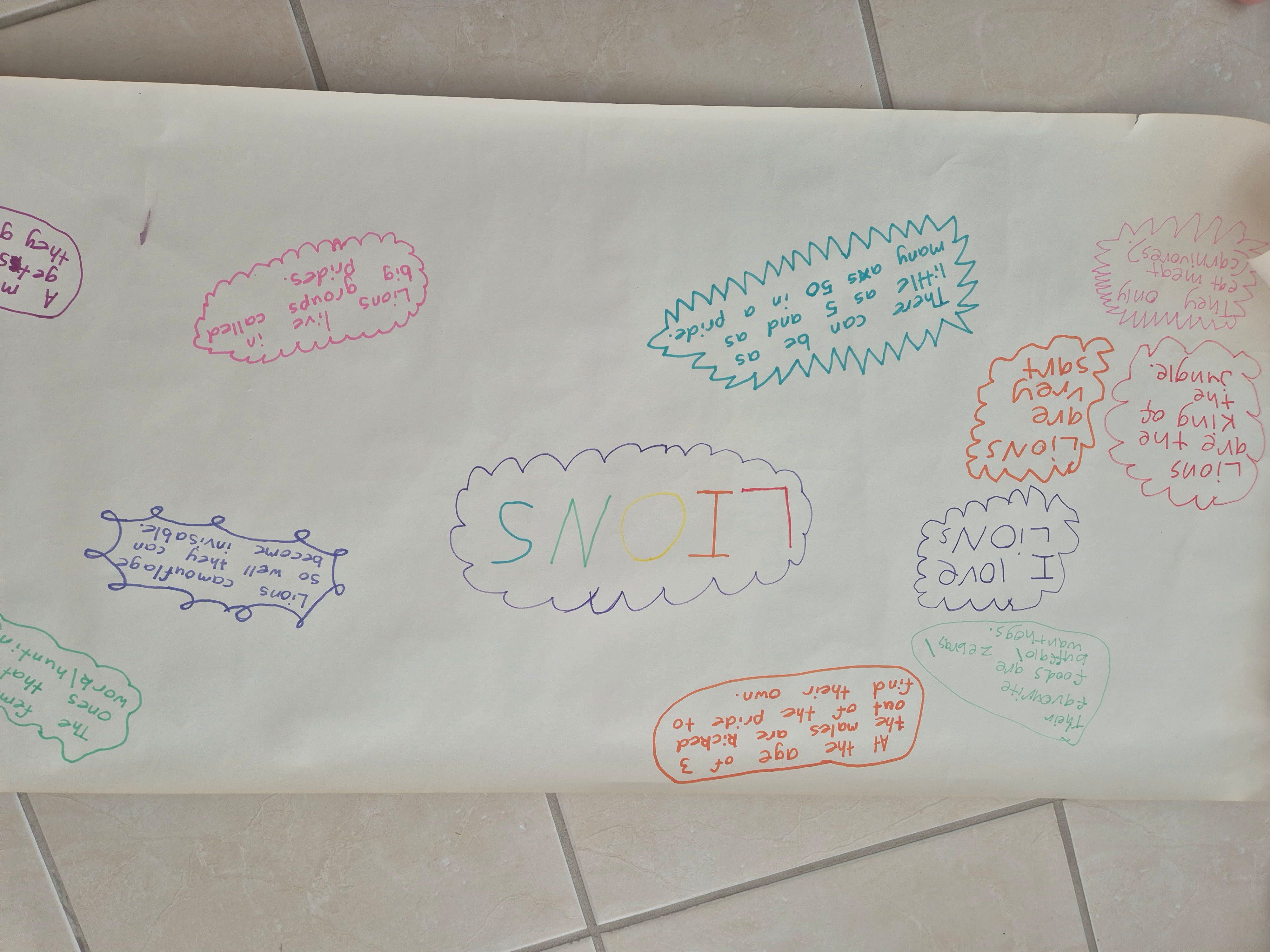
- The girls recalled and recorded facts about lions after watching a documentary, showing that they could retrieve information from a previous learning experience.
- The poster format helped them organize knowledge about a real animal into a visual science resource.
- Writing facts together encouraged them to compare what they remembered and decide which information belonged on the poster.
- The activity practiced communicating animal knowledge clearly for other people to read.
Language Arts
- The girls practiced informational writing by creating factual statements rather than a fictional story.
- They worked on selecting important details and expressing remembered ideas in written form.
- The colorful speech- and cloud-shaped sections provided opportunities to connect short pieces of text with visual headings or categories.
- Collaborative writing supported discussion, vocabulary development, spelling practice, and revision as the girls built the poster together.
Visual Arts and Communication
- The poster uses multiple colors, outlined shapes, and large lettering to make information visually engaging.
- The girls practiced arranging text and illustrations so that facts could be shared in a display format.
- Decorative borders and varied lettering show attention to presentation, design, and audience.
- Creating a shared poster allowed them to combine individual ideas into one coordinated project.
Social-Emotional Learning
- Working on one poster together required turn-taking, listening, and making space for each girl's ideas.
- The project encouraged cooperation while the girls recalled information from the same documentary.
- Sharing responsibility for the finished product supported ownership, confidence, and pride in learning.
- The activity offered a positive way to practice group decision-making, such as choosing what facts and designs to include.
Tips
Tips: Continue the learning by having the girls sort their lion facts into categories such as appearance, habitat, food, family life, and behavior, using only information they can verify from the documentary or a library book. Invite each girl to choose one fact to explain orally and then write a caption or question about it. As an experiential extension, compare a lion with another big cat by creating a simple Venn diagram, or use toy animals and a map to discuss where different animals live. Finish with a small “lion museum” display in which the girls present the poster and answer questions from family members.
Book Recommendations
- National Geographic Readers: Lions by Laura Marsh: A nonfiction reader with accessible facts and photographs about lions, making it a strong follow-up to the documentary and fact poster.
- The Lion Inside by Rachel Bright: A playful picture book about a mouse who discovers inner courage, offering a fictional connection to the lion theme and a chance to discuss character traits.
- The Lion and the Mouse by Jerry Pinkney: A wordless retelling of Aesop’s fable that encourages children to study illustrations, sequence events, and discuss kindness and cooperation.
Try This Next
- Create a lion-fact sorting worksheet with headings such as habitat, diet, appearance, family, and behavior.
- Write three quiz questions from the poster and provide an answer key using only the girls’ recorded facts.
- Draw and label a lion, adding only features or facts confirmed by the documentary.
- Make a lion-versus-another-animal Venn diagram using information from a nonfiction book.