Core Skills Analysis
Visual Arts
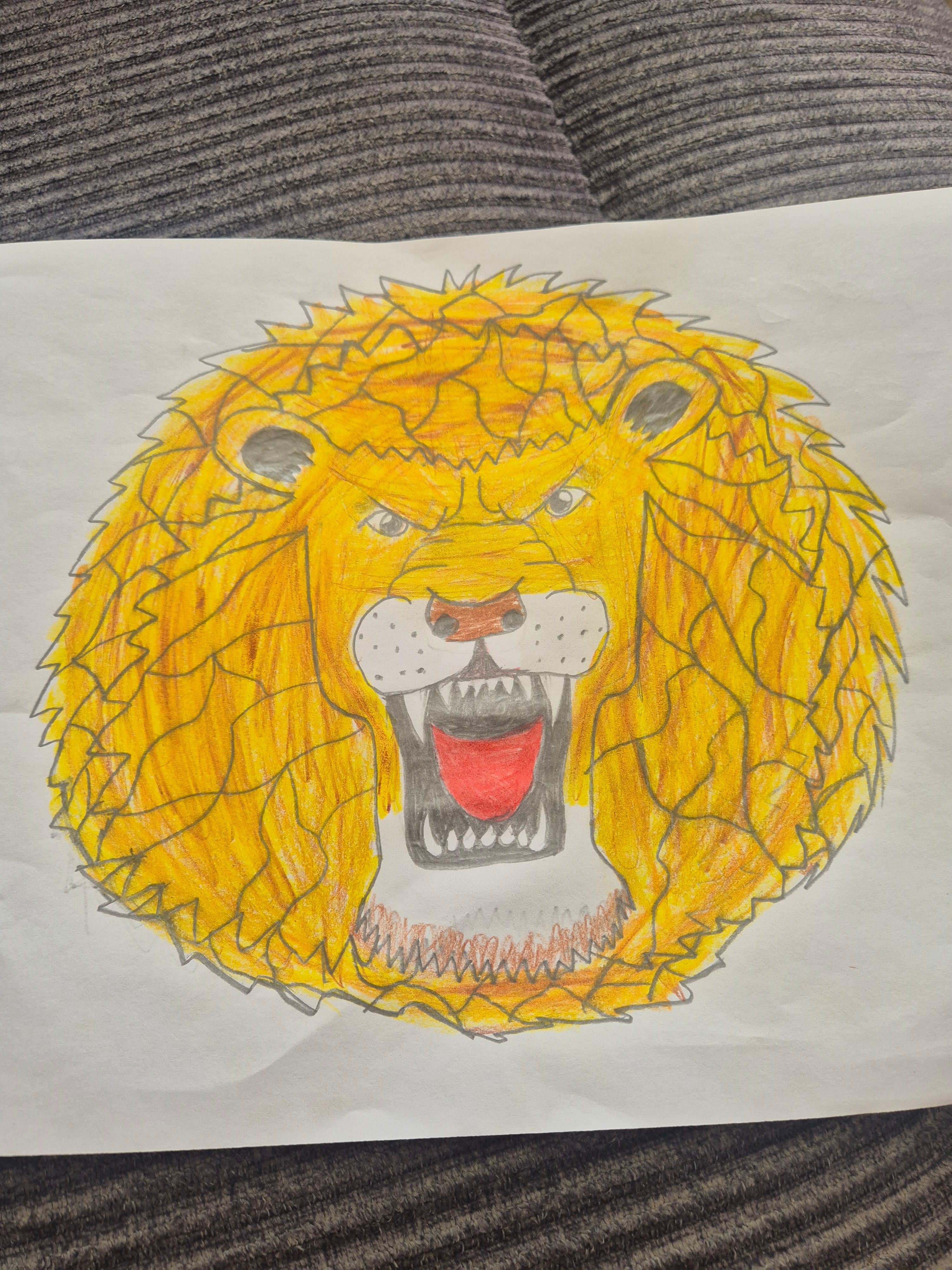
- The student practiced directed drawing by translating a lion reference or set of instructions into a complete original picture.
- The drawing demonstrates use of contour lines, overlapping shapes, and repeated jagged forms to create the lion’s mane.
- Color choices—especially yellow, orange, gray, red, and brown—create contrast between the mane, face, nose, mouth, and teeth.
- The expressive eyes, open mouth, tongue, and visible teeth show attention to character, facial expression, and visual storytelling.
Geometry and Spatial Reasoning
- The student organized the lion around a central vertical axis, placing the eyes, nose, mouth, and mane in relation to one another.
- The repeated pointed shapes around the mane provided practice with patterns, angles, and irregular geometric forms.
- The artwork shows awareness of proportion by making the mane substantially larger than the central facial features.
- Layered outlines and overlapping sections suggest practice with spatial relationships, foreground details, and a picture’s overall composition.
Language Arts
- Creating a recognizable lion supports vocabulary development through words such as mane, whiskers, muzzle, nose, teeth, tongue, eyes, and outline.
- The expressive facial features create an opportunity to communicate mood without written words; the lion appears energetic, playful, or fierce.
- A directed drawing sequence encourages listening comprehension, following steps in order, and using descriptive language to explain artistic choices.
- The finished image can serve as a visual prompt for oral storytelling, character development, or a short imaginative narrative.
Science: Observation and Living Things
- The student represented recognizable lion features, including a large mane, whiskers, rounded muzzle, nose, teeth, and tongue.
- Drawing from observation or instruction encourages careful attention to the shape, placement, and relative size of animal body parts.
- The activity provides a natural starting point for distinguishing observed animal features from imaginative artistic details.
- The completed picture can support further learning about lions while keeping the focus grounded in what is visibly represented in the artwork.
Social-Emotional Learning
- The detailed coloring and many repeated mane lines suggest sustained attention and willingness to work through a multi-step creative task.
- The exaggerated expression gives the student a safe way to explore and communicate qualities such as confidence, excitement, fierceness, or humor.
- Completing a recognizable character can build pride, ownership, and confidence in the student’s ability to create from instructions.
- Because the image is highly personal and expressive, inviting the student to describe it can encourage self-expression without requiring a single correct answer.
Tips
Tips: Use the finished lion as the beginning of a short mini-unit: first, invite the student to point to and label the visible features, then compare the drawing with a photograph or nonfiction picture of a lion and discuss which details are realistic and which are imaginative. Next, ask the student to give the lion a name, choose a personality, and dictate or write a three-sentence story about what happens before or after the picture. For a hands-on art extension, repeat the directed drawing using only lines, then create a second version with warm and cool colors and compare the mood of each. End with a gentle reflection such as, “Which step was easiest, which was challenging, and what would you change next time?”
Book Recommendations
- The Lion and the Mouse by Jerry Pinkney: A richly illustrated wordless retelling of Aesop’s fable that encourages visual storytelling, observation, and discussion of kindness and courage.
- The Lion Inside by Rachel Bright: A rhyming picture book about a small mouse who discovers that bravery and confidence can come in unexpected forms.
- How to Hide a Lion by Helen Stephens: A humorous story about a girl and a gentle lion that invites children to explore character expression, friendship, and imaginative situations.
Try This Next
- Create a lion-feature labeling worksheet with blanks for mane, eyes, nose, muzzle, whiskers, teeth, and tongue.
- Write a six-sentence story answering: Who is the lion, where is it, what is it feeling, and what happens next?
- Draw the same lion using only three colors, then describe how the color choices change its mood.
- Compare the drawing with a lion photograph and make a two-column chart labeled “Observed Detail” and “Imagined Detail.”