Core Skills Analysis
Visual Arts
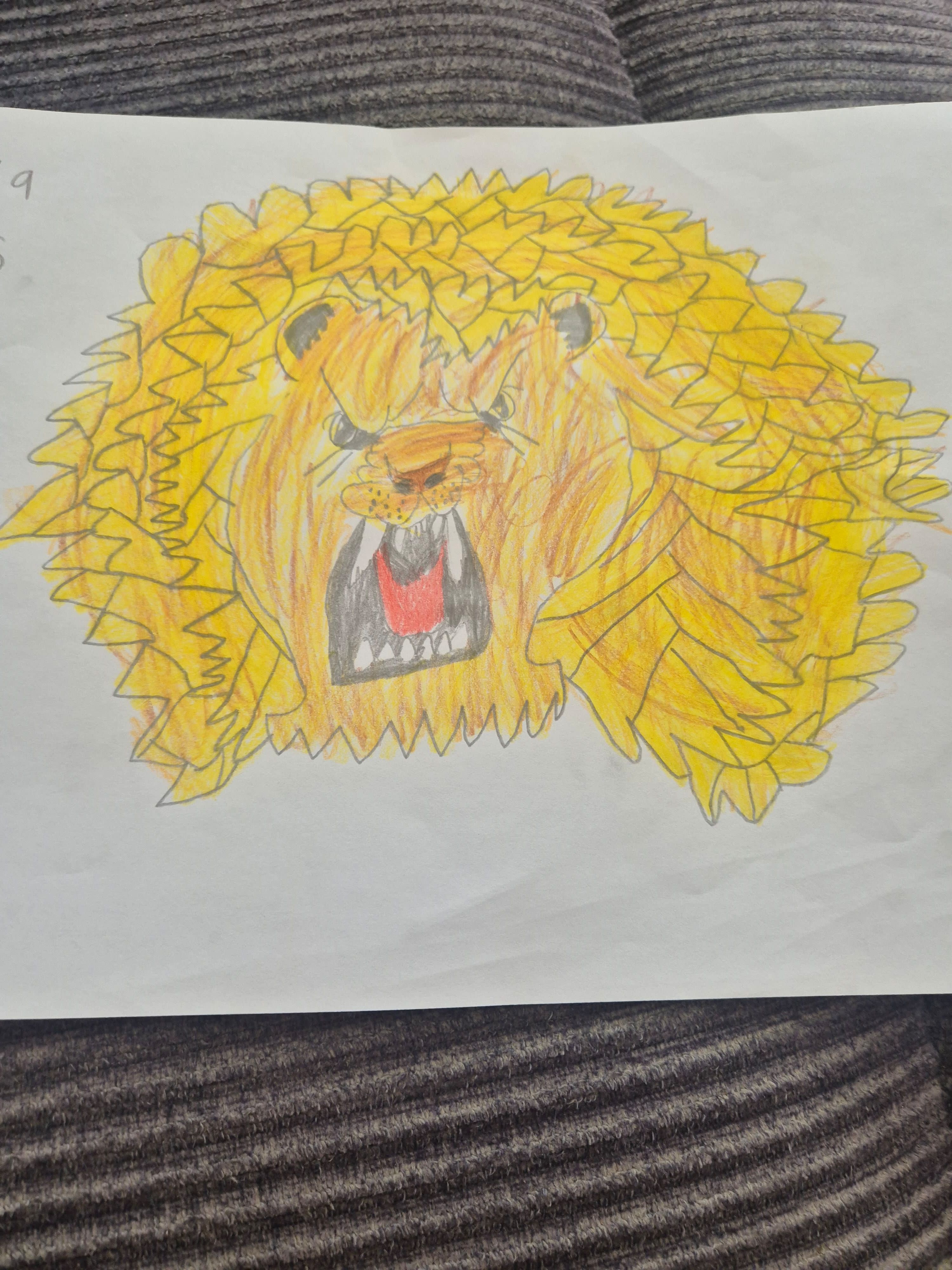
- The student followed a directed-drawing process to create a recognizable lion with a face, mane, mouth, eyes, and body.
- The drawing shows use of warm colors, especially yellow, orange, and brown, to communicate the lion’s appearance and create visual emphasis.
- The student practiced line work by outlining many mane strands and facial features with darker strokes.
- The large, detailed mane suggests sustained attention, creative effort, and willingness to add personal details beyond a simple outline.
Science
- The activity provided practice observing and representing key external features of a lion, including its mane, eyes, nose, teeth, and fur.
- The student connected color and shape to an animal’s appearance by using yellows, oranges, browns, and darker tones for the face and mane.
- The drawing can support early classification vocabulary, such as mammal, predator, wild animal, mane, whiskers, claws, and habitat.
- The artwork shows how an illustration can communicate information about an animal even when it is not a realistic scientific diagram.
Language Arts
- The completed picture can serve as a visual prompt for describing the lion using sensory and precise adjectives such as golden, shaggy, fierce, enormous, or powerful.
- The student can practice oral storytelling by explaining what the lion might be doing, where it lives, and how it feels.
- The drawing supports sequencing language because the student can describe the directed-drawing steps in order, from outlining the head to adding the mane and coloring.
- The recognizable character offers an opportunity to develop a short narrative with a beginning, middle, and end.
Mathematics and Spatial Reasoning
- The student practiced noticing and creating shapes, including curved forms for the head and mane and angular points for individual tufts of fur.
- The drawing involves spatial relationships, such as placing the eyes above the nose, the mouth below the nose, and the mane around the face.
- Repeated mane shapes provide an informal introduction to pattern, repetition, and visual symmetry.
- The student made scale and proportion choices by drawing a large mane around a smaller central face.
Tips
Tips: Turn the artwork into a mini lion study by inviting the student to label the mane, eyes, nose, teeth, and ears, then compare the drawing with a photograph or nonfiction book. Next, practice descriptive language by creating a five-word word bank and using it to write three sentences about the lion. For an experiential extension, visit a zoo, wildlife center, or virtual animal camera and record two similarities and two differences between the illustrated lion and a real lion. Finally, encourage artistic reflection by asking which directed-drawing step was easiest, which was most challenging, and what detail the student would add in a second version.
Book Recommendations
- The Lion and the Mouse by Jerry Pinkney: A richly illustrated wordless retelling of Aesop’s fable that encourages storytelling, observation, and discussion of kindness and cooperation.
- The Lion Inside by Rachel Bright: A rhyming picture book about confidence and finding courage, offering a strong connection to the expressive lion character in the drawing.
- Lions by Gail Gibbons: An accessible nonfiction introduction to lion bodies, behavior, families, and habitats that can help the student compare factual information with the artwork.
Try This Next
- Create a lion-labeling worksheet with arrows pointing to the mane, eyes, nose, mouth, ears, and whiskers.
- Write a short story titled "The Lion with the Golden Mane" using a beginning, middle, and end.
- Make a mane-pattern challenge: draw three different repeating patterns using triangles, curves, or zigzags.
- Compare the drawing with a lion photograph and list two similarities and two differences.