Core Skills Analysis
Mathematics and Spatial Reasoning
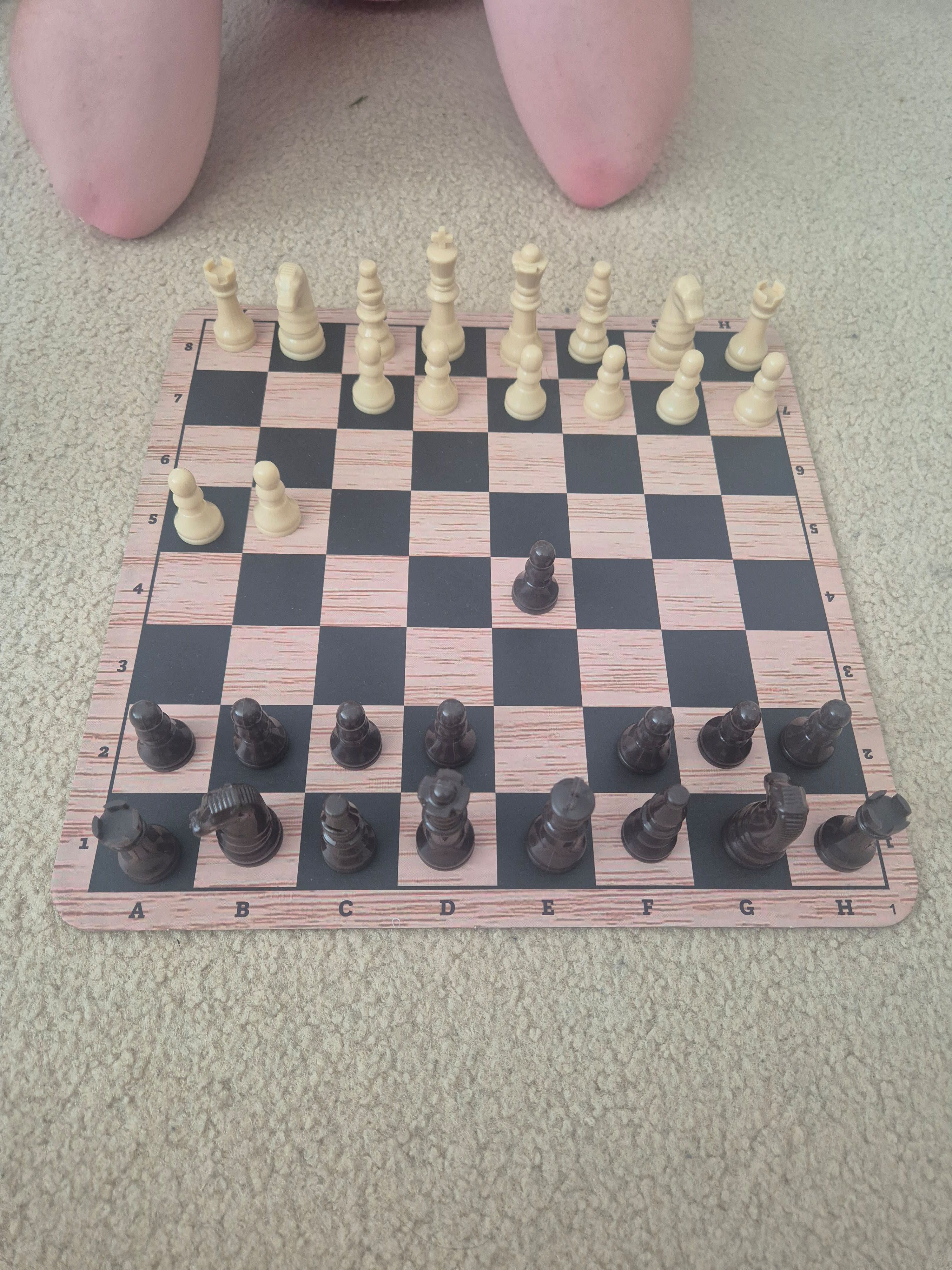
- Georgia was introduced to the chessboard as an organized grid made of eight files labeled A–H and eight ranks numbered 1–8.
- The activity supports coordinate skills as Georgia learns to identify locations such as a square’s letter-and-number name.
- Moving chess pieces encourages visualizing direction, distance, patterns, and the relationship between diagonal, horizontal, and vertical paths.
- Counting squares can strengthen one-to-one correspondence, sequencing, and basic distance comparisons.
Language Arts
- Teaching chess gives Georgia opportunities to learn and use precise vocabulary, including king, queen, rook, bishop, knight, pawn, move, capture, check, and checkmate.
- Explaining how pieces move develops clear oral communication and the ability to organize instructions in a logical sequence.
- Georgia can practice listening comprehension by following a rule, repeating it, and demonstrating it on the board.
- Chess notation provides an authentic reason to connect spoken directions with symbols, letters, and numbers.
History and Cultural Studies
- The activity introduces Georgia to chess as a traditional strategy game with a long history and international appeal.
- The contrasting white and black armies provide a concrete starting point for discussing how games can represent opposing sides without requiring a real-world conflict.
- Learning the names and roles of the pieces can lead to exploration of historical terms such as king, queen, knight, and castle-like rook.
- Playing a structured game helps Georgia experience how rules and traditions can be shared across cultures and generations.
Logic, Planning, and Executive Function
- Georgia was encouraged to think ahead by considering what a piece can do now and what might happen after a move.
- Chess practice develops attention to rules, turn-taking, and the ability to pause before acting.
- The board setup offers practice with categorizing pieces by type, color, and movement pattern.
- A teaching session can build persistence as Georgia gradually connects individual piece movements to larger strategies.
Social-Emotional Learning
- A shared chess activity creates a cooperative learning setting in which Georgia can ask questions, try moves, and receive guidance.
- Taking turns supports patience, fairness, and respect for another player’s thinking time.
- Chess provides a safe context for practicing how to respond to mistakes, revise a plan, and continue after an unsuccessful move.
- The image does not provide enough evidence to determine Georgia’s emotional state, but the one-to-one teaching format may support confidence through hands-on participation.
Tips
Tips: Turn the board into a short, playful lesson by first inviting Georgia to identify the colors, files, ranks, and each piece. Next, choose one piece at a time and have Georgia demonstrate its movement while explaining the rule aloud; use small challenges such as finding all legal moves from a selected square or spotting which pieces move diagonally. Create a simple coordinate treasure hunt by calling out squares for Georgia to locate, then introduce a miniature game with only kings and pawns before adding more pieces. End with a reflection in which Georgia draws a favorite piece, labels its movement, and describes one strategy or question for the next chess session.
Book Recommendations
- Chess for Kids by Michael Basman: A child-friendly introduction to the chessboard, pieces, rules, and basic strategies that can reinforce the hands-on lesson.
- The Berenstain Bears and the Chess Game by Stan and Jan Berenstain: A familiar picture-book story that presents chess through family play, making the game approachable for younger learners.
- Bobby Fischer Teaches Chess by Bobby Fischer, Stuart Margulies, and Donn Mosenfelder: An interactive beginner resource that introduces chess concepts through puzzles and guided problems.
Try This Next
- Create a chess-piece movement worksheet: draw arrows showing how the king, queen, rook, bishop, knight, and pawn move.
- Play a coordinate hunt by calling out squares such as A1, D4, or H8 and asking Georgia to place a selected piece there.
- Make a “Which Move Is Legal?” quiz with three illustrated move choices for each chess piece.
- Invite Georgia to draw a chessboard scene and write three sentences explaining what one piece can do.