Core Skills Analysis
Language Arts: Phonics and Decoding
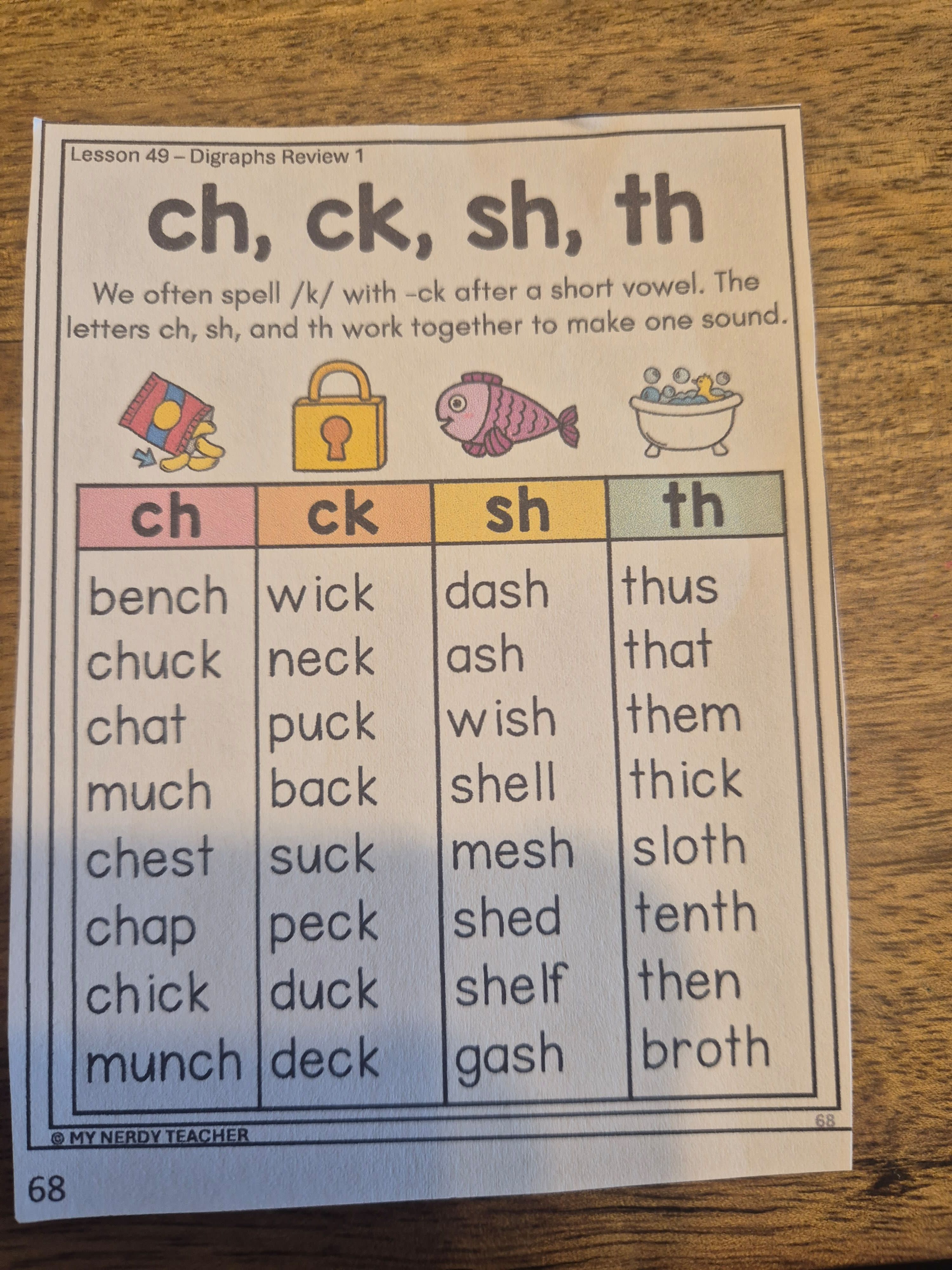
- • The child reviewed the digraphs ch, ck, sh, and th, noticing that two letters can work together to represent one sound.
- • The child practiced distinguishing the digraphs by reading words in separate columns, including ch words such as “bench” and “chick,” sh words such as “dash” and “shell,” and th words such as “that” and “thick.”
- • The worksheet highlights the spelling pattern that ck often follows a short vowel, with examples such as “neck,” “puck,” and “duck.”
- • Reading examples such as “munch,” “shelf,” “tenth,” and “broth” gives the child practice noticing digraphs in different parts of words and blending the sounds to decode them.
Tips
Tips: Make a small set of word cards using examples from the worksheet, then invite the child to sort them by digraph and say each sound aloud. Go on a digraph hunt together in a favorite book or around the home, recording words under ch, ck, sh, and th headings. To explore the ck pattern, build short-vowel words with letter tiles and change the first or final consonant to make new words. Finish by having the child create a silly sentence or illustrated mini-story that includes at least one word from each group.
Book Recommendations
- Hop on Pop by Dr. Seuss: A lively, rhyming early reader that offers an inviting way to practice sounding out short, familiar words.
- Fox in Socks by Dr. Seuss: Playful rhymes and tongue-twisting word patterns encourage careful listening to speech sounds.
- Chicka Chicka Boom Boom by Bill Martin Jr. and John Archambault: A rhythmic alphabet story that builds familiarity with letters and makes sound-focused reading fun.
Try This Next
- Make a four-column word-sorting sheet for ch, ck, sh, and th; add five new words to each column.
- Draw a picture for one word in each group, then label each picture and circle its digraph.
- Ask: Which spelling appears after the short vowel in “duck”—ck or sh?
- Build “neck,” “duck,” and “back” with letter tiles, changing one letter at a time to make new words.